Update on Artemis III

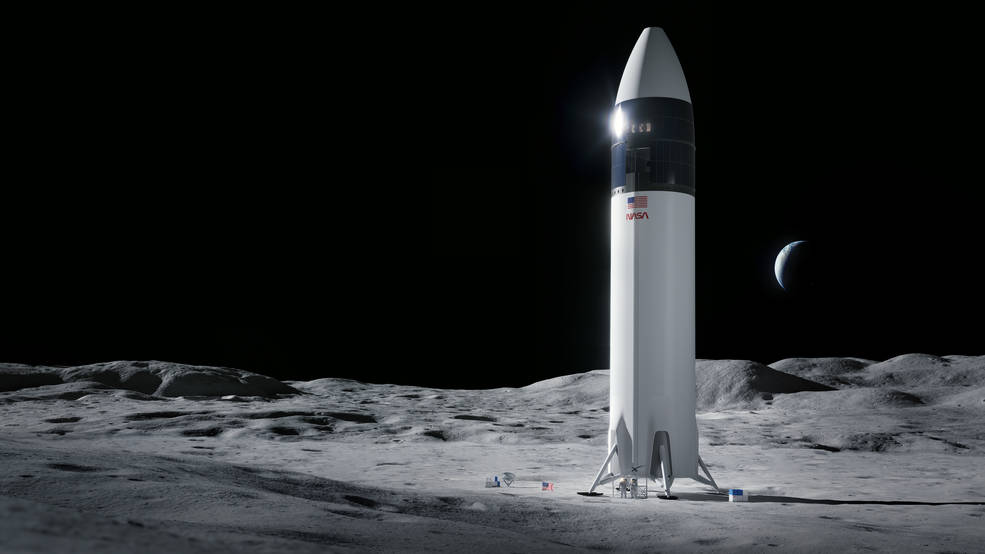
Image (Credit): Arstist’s rendering of SpaceX Starship human landing system design. (SpaceX)

The other week, NASA revealed an update on the Artemis III mission to the Moon in 2025. Now that Artemis I was a success and Artemis II is being readied, Artemis III is becoming much clearer on the horizon. The plan focuses on the first crew to land on the surface, noting that future missions will be involved in building the Gateway lunar space station.

While the Space Launch System (SLS) will get the crew into orbit on Orion, SpaceX has been chosen to bring this first crew to the moon. However, SpaceX will first need to test this human landing system on the Moon without a crew.

The landing site is likely to be on the Moon’s South Pole involving two astronauts who will take the SpaceX human landing system to the surface. They will conduct their research work in Axiom space suits.

It all may have become routine back in the 1970s, but NASA is demoing everything all over again to ensure new systems and new parties are up to par for this return to the Moon. The world is watching again, particularly China. We need to be perfect in this overdue first step back into human space travel.

You can view all of the parts of the mission in the graphic below.

Image (Credit): Artemis III mission map. (NASA)

Space Stories: The End of Geotail, a Galactic Map, and Sweden Gets a Spaceport

Image (Credit): An artist’s rendering of the Geotail spacecraft. (NASA)

Here are some recent stories of interest.

NASA: “NASA’s Geotail Mission Operations Come to an End After 30 Years

After 30 years in orbit, mission operations for the joint NASA-JAXA Geotail spacecraft have ended, after the failure of the spacecraft’s remaining data recorder. Since its launch on July 24, 1992, Geotail orbited Earth, gathering an immense dataset on the structure and dynamics of the magnetosphere, Earth’s protective magnetic bubble. Geotail was originally slated for a four-year run, but the mission was extended several times due to its high-quality data return, which contributed to over a thousand scientific publications. While one of Geotail’s two data recorders failed in 2012, the second continued to work until experiencing an anomaly on June 28, 2022. After attempts to remotely repair the recorder failed, the mission operations were ended on November 28, 2022.

Phys.org: “Billions of Celestial Objects Revealed in Gargantuan Survey of the Milky Way

Astronomers have released a gargantuan survey of the galactic plane of the Milky Way. The new dataset contains a staggering 3.32 billion celestial objects—arguably the largest such catalog so far. The data for this unprecedented survey were taken with the Dark Energy Camera, built by the US Department of Energy, at the NSF’s Cerro Tololo Inter-American Observatory in Chile, a Program of NOIRLab.

Advanced Television: “Sweden Inaugurates Rocket Launch Site

While much of the world’s press recently focused on Virgin Orbit’s failed ‘horizontal’ aircraft launch of a batch of 9 small satellites from Spaceport Cornwall, other rivals are gearing up to tap into the growing demand for satellite launches. Sweden has claimed the crown as “mainland Europe’s first orbital launch site”. Ursula von der Leyen, President of the European Commission, helped cut the ribbon at Kiruna, Sweden, saying: “This spaceport offers an independent European gateway to space. It is exactly the infrastructure we need, not only to continue to innovate but also to further explore the final frontier.”

Another Rocket Setback, This Time in Alaska

Credit: ABL Space Systems

Virgin orbit is not the only rocket company having a bad week. CNN reports that on Tuesday U.S. rocket company ABL Space Systems ran problems off the Alaska coast when its RS1 rocket shut down prematurely during its maiden launch. The rocket and the two satellites it was carrying were lost.

It was a bad week, but the space industry is growing and persistence will pay off. It is also important to have deep pockets to cover early failures. SpaceX and Blue Origin benefited from billionaire backers, and ABL is lucky to have Lockheed Martin in its corner. With an initial order of 58 rocket launches, Lockheed Martin has every reason to encourage continued progress.

Update: As of earlier today, ABL Space Systems has not issued a press release on the Alaska incident, but in a Tweet the company stated:

As expected in this scenario, there is damage to the launch facility. All personnel are safe, and fires have subsided. We’ll plan our return to flight after investigations are complete. Thanks to our stakeholders and the space community for the expressions of support.

The Pacific Spaceport Complex – Alaska, earlier called the Kodiak Launch Complex, is a dual-use (commercial/government) facility owned and operated by the Alaska Aerospace Corporation, which is a public corporation of the State of Alaska. Opened in 1998, the spaceport complex is located on Kodiak Island in Alaska.

Virgin Orbit Experiences a Setback

Image (Credit): Virgin Orbit 747 carrying a LauncherOne rocket. (Virgin Orbit)

It was supposed to be the beginning of rocket launches from the England, but we will have to wait a little longer. While Virgin Orbit’s Cosmic Girl, the 747 carrying the LauncherOne rocket, successfully left Spaceport Cornwall, the launch itself from the belly of the plane did not go as planned. Both the rocket and payload were lost.

Virgin Orbit’s CEO, Dan Hart, made this statement:

While we are very proud of the many things that we successfully achieved as part of this mission, we are mindful that we failed to provide our customers with the launch service they deserve. The first-time nature of this mission added layers of complexity that our team professionally managed through; however, in the end a technical failure appears to have prevented us from delivering the final orbit. We will work tirelessly to understand the nature of the failure, make corrective actions, and return to orbit as soon as we have completed a full investigation and mission assurance process.

Here is the list of items lost in yesterday’s “Start Me Up” mission:

  • IOD-3 AMBER (aka IOD-3) – Developed by Satellite Applications Catapult (“SA Catapult”) and Horizon Technologies and built by AAC Clyde Space, all based in the U.K. IOD-3 Amber is expected to be the first of more than 20 Amber satellites to provide space-based Maritime Domain Awareness (MDA) data to users. 
  • Prometheus-2 – Two cubesats owned by the U.K. Ministry of Defense’s (MOD) Defense Science & Technology Laboratory Dstl. These satellites, co-funded with Airbus Defence and Space who are designing them jointly with In-Space Missions, will support MOD science and technology (S&T) activities both in orbit and on the ground through the development of ground systems focused at Dstl’s site near Portsmouth. 
  • CIRCE (Coordinated Ionospheric Reconstruction CubeSat Experiment) – CIRCE is part of a joint mission between the U.K.’s Defense Science and Technology Laboratory and the U.S. Naval Research Laboratory (NRL).   
  • DOVER – Developed by RHEA Group in the UK, it is the company’s first satellite in its 30-year history. The satellite is being co-funded through the European Space Agency’s (ESA) Navigation Program (NAVISP) and built by Open Cosmos of the United Kingdom. DOVER is a SmallSat that was created as a pathfinder for resilient global navigation satellite systems.   
  • ForgeStar-0 – Developed by Space Forge of Wales, the satellite is a fully returnable and reusable platform to enable in-space manufacturing. This launch will be the first for the company’s ForgeStar platform and will test future returns from space technology.     
  • AMAN – Oman’s first orbital mission, it is a single earth observation satellite meant to demonstrate the future feasibility of a larger constellation and was developed after a memorandum of understanding among the Sultanate of Oman, Polish Small Satellite manufacturer and operator SatRev, Poland-originated AI data analytics specialists TUATARA, and Omani-based merging technology innovator ETCO. The agreement includes additional planned small satellites, including this, the first in Oman’s history.
  • STORK-6  Stork-6 is the next installment of Polish Small Satellite manufacturer and operator SatRev’s STORK constellation. Virgin Orbit previously launched two spacecraft in this constellation on a previous launch and looks forward to continuing to launch SatRev’s STORK spacecraft in the future.

Virgin Orbit had four consecutive launch successes until this latest mishap. An investigation will be necessary to review what happened.

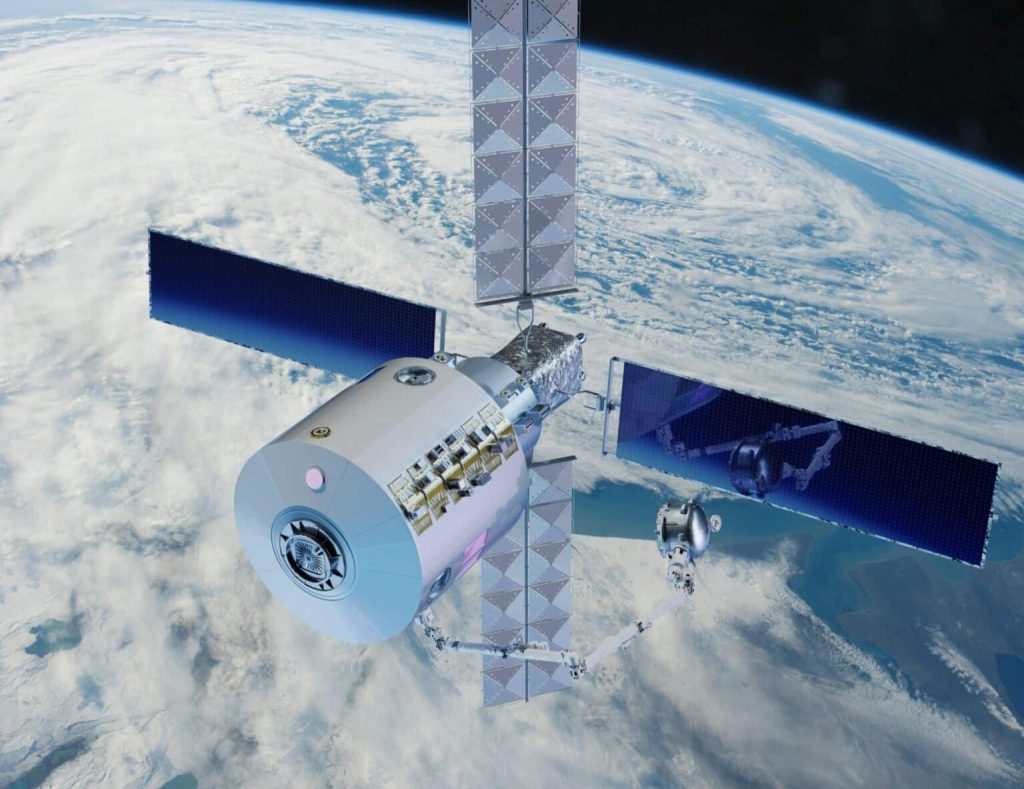
Space Quote: Starlab to Replace the ISS

Image (Credit): Image of Starlab from the Voyager Space website. (Voyager Space)

“This partnership with Voyager Space is the first step toward fielding the next generation of space stations to serve international astronauts. We are excited to support a project aimed at changing history…This collaboration is an important step in making Starlab a reality, providing a foundation for long-lasting European and American leadership in space. Our team is looking forward to diving in on the technology and putting our best engineers to work.”

-Statement by Jean-Marc Nasr, Executive Vice President of Space Systems at Airbus Defence and Space, in a press release regarding Voyager Space and Airbus Defence and Space partnering to develop and operate Starlab in 2028. The Low-Earth Orbit space station will serve NASA, ESA, and others in the scientific community following the retirement of the International Space Station. NASA has already awarded $160 million to Voyager and Nanoracks, its operating company, to create the new space station.