Russian Rockets No Longer an Option

Image (Credit): Antares rocket on the launch pad. (Northrop Grumman)

Northrop Grumman is switching from Russian-made rocket engines to U.S.-made rocket engines for its Antares rocket ships that bring supplies to the U.S. International Space Station (ISS). Russia has not shipped any engines since March following its invasion of Ukraine, so Northrop Grumman needs an alternative. It can fly two more missions with the Russian-made rockets in its inventory.

Firefly Aerospace in Texas will be able to meet these needs. In a press release, Northrop Grumman stated:

Firefly’s propulsion technology utilizes the same propellants as the current Antares rocket, which minimizes launch site upgrades. The Antares 330 will utilize seven of Firefly’s Miranda engines and leverage its composites technology for the first stage structures and tanks, while Northrop Grumman provides its proven avionics and software, upper-stage structures and Castor 30XL motor, as well as proven vehicle integration and launch pad operations. This new stage will also significantly increase Antares mass to orbit capability.

Fortunately, we have some redundancy in ISS cargo missions, with SpaceX able to pick up slack as necessary. In fact, Northrop Grumman will be contracting with SpaceX to handle three of its missions as it prepares for the new Antares system for mid-to-late 2024.

China Needs Reusable Rockets

Image (Credit): The July 24th launch of a Long March 5B rocket transporting China’s second module for its Tiangong space station. (CNS/AFP/Getty Images)

A few days ago debris from China’s Long March 5B rocket landed in the waters off the Philippine island of Palawan. The 1.8 million pounds of rocket brought a module to the Chinese space station. Such problems with Chinese rocket debris is a clear example that China needs to follow both SpaceX and Blue Origin and start using resusable rockets in the future.

NASA’s Administrator was not happy, tweeting:

The People’s Republic of China did not share specific trajectory information as their Long March 5B rocket fell back to Earth.

All spacefaring nations should follow established best practices, and do their part to share this type of information in advance to allow reliable predictions of potential debris impact risk, especially for heavy-lift vehicles, like the Long March 5B, which carry a significant risk of loss of life and property.

Doing so is critical to the responsible use of space and to ensure the safety of people here on Earth.

China has plans to develop reusable rockets for future heavy-lift missions to its space station and the Moon. This would certainly reduce the risk to parties below and hopefully add some efficiencies to the launch process.

Of course, China is not alone when it comes to falling space debris. SpaceX appears to be responsible for debris that landed in Australia last month (see below). While confirmation is still needed, the material appears to be from a SpaceX Dragon capsule.

Image (Credit): One of the panels of the debris found in Australia. (The Guardian/Brad Tucker)

SpaceX and Russia: Shuttle Swaps

Image (Credit): Artist’s image of the Boeing Starliner space capsule. (Boeing)

It wasn’t that long ago U.S. astronauts were completely dependent on Russian rockets to get to the International Space Station (ISS). NASA was paying about $60 million per seat on the Soyuz spacecraft. Well, times have certainly changed with SpaceX now ferrying astronauts, Boeing working on its own crewed Starliner capsule, and Northrop Grumman already helping with cargo.

Now NASA is mixing it up. NASA and Russia’s Roscosmos agreed this weak to place astronauts on the Soyuz again and cosmonauts on the SpaceX Dragon spacecraft. Bloomberg reports NASA stated that such mixed crews “ensures there are appropriately trained crew members on board the station for essential maintenance and spacewalks.” In other words, with two launches to the ISS planned in September, a mixing of the crews will ensure some stability in space if only one makes it to the station. Not a bad idea.

Even with all the rhetoric and stunts taking place, it’s nice to see a little bit of common sense prevailing.

SpaceX Starship: Booster Issues

Image (Credit): Test run of the Starship Booster on May 5, 2022. (SpaceX)

Earlier this week, SpaceX conducted another test of its Starship. However, the booster was damaged by an explosion during a pre-launch test and will now need to be inspected to determine whether it can be used in the inaugural launch of the Starship later this summer.

For more on the Starship, check out the Cool Worlds video titled “Why Starship Could Transform Astronomy.” It argues that reduced launch costs, reduced complexity, and heavier payloads would allow NASA to launch a fleet of telescopes within current budgets. For instance, the larger Starship payload would have allowed NASA to avoid all of the contortions necessary to fold the James Webb Space Telescope into a smaller rocket. The video also argues that SpaceX’s willingness to take risks is something NASA may want to emulate.

These are interesting times with NASA and SpaceX testing new rockets to place astronauts on distant objects. Even if Russia wants to sit this one out, we have a full blown space race underway domestically.

One of the Artemis Rocket Launches

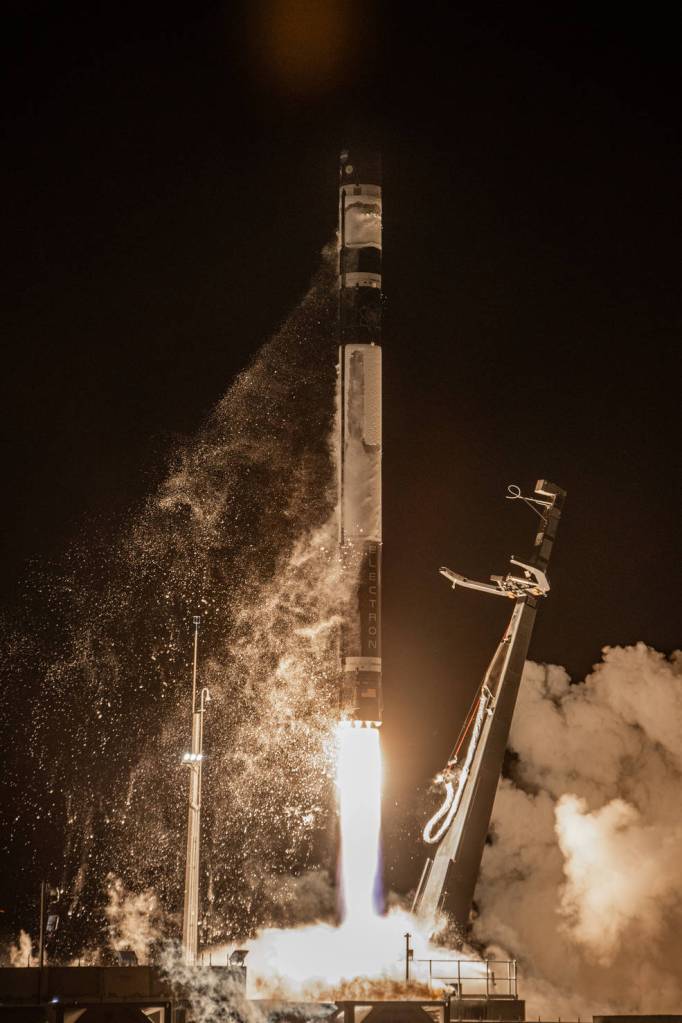
Image (Credit): June 28th launch of CAPSTONE aboard Rocket Lab’s Electron rocket from the Rocket Lab Launch Complex 1 on the Mahia Peninsula of New Zealand. (Rocket Lab)

While we are awaiting the launch of the uncrewed Artemis phase-one rocket later this summer to test the waters for a crewed mission, other related missions are ongoing. NASA’s Cislunar Autonomous Positioning System Technology Operations and Navigation Experiment (CAPSTONE) was launched earlier in the week from New Zealand and will take about four months before it orbits the Moon for another six months. The miniaturized satellite, or CubeSat, is designed to test the future lunar orbit of Gateway, a lunar space station being planned by NASA and its commercial and international partners to support NASA’s Artemis program, including astronaut missions.

Here are CAPSTONE’s mission objectives:

  • Verify the characteristics of a cis-lunar near rectilinear halo orbit for future spacecraft;
  • Demonstrate entering and maintaining this unique orbit that provides a highly-efficient path to the Moon’s surface and back;
  • Demonstrate spacecraft-to-spacecraft navigation services that allow future spacecraft to determine their location relative to the Moon without relying exclusively on tracking from Earth;
  • Lay a foundation for commercial support of future lunar operations; and
  • Gain experience with small dedicated launches of CubeSats beyond low-Earth orbit, to the Moon, and beyond.

In a press release, Elwood Agasid, project manager for CAPSTONE at NASA’s Ames Research Center in California’s Silicon Valley, stated:

CAPSTONE is a pathfinder in many ways, and it will demonstrate several technology capabilities during its mission timeframe while navigating a never-before-flown orbit around the Moon…CAPSTONE is laying a foundation for Artemis, Gateway, and commercial support for future lunar operations.

We forget about all of the smaller missions (literally, in this case) that make the full mission possible. CAPSTONE is a key mission to test some ideas and reduce risk for future astronauts.

Image (Credit): Artist’s impression of CAPSTONE in orbit near the Moon. (Illustration by NASA/Daniel Rutter)