ESA’s Euclid Space Telescope Safely Launched

Credit: ESA

Earier today, the European Space Agency’s (ESA) Euclid Space Telescope was safely launched from Cape Canaveral on a Space X Falcon 9 rocket (though the original plan was to use a Russian Soyuz rocket until the invasion nixed that idea). The space telescope is destined for the Sun-Earth Lagrange point 2 (L2), which is an average distance of 1 million miles beyond Earth’s orbit. It will join the James Webb Space Telescope.

In addition to the 1.2 meter diameter telescope, the mission includes two scientific instruments: a visible-wavelength camera (the VISible instrument, VIS) and a near-infrared camera/spectrometer (the Near-Infrared Spectrometer and Photometer, NISP). 

The focus of the new space telescope will be to create a 3D map of the universe to better understand dark matter and dark energy. As noted on the ESA’s website, Euclid hopes to answer these questions:

  • What is the structure and history of the cosmic web?
  • What is the nature of dark matter?
  • How has the expansion of the Universe changed over time?
  • What is the nature of dark energy?
  • Is our understanding of gravity complete?

It is a tall order for this new telescope. Astronomer Isobel Hook from the UK’s Lancaster University put it this way to BBC News:

It will be like setting off on a ship before people knew where land was in different directions. We’ll be mapping out the Universe to try to understand where we fit into it and how we’ve got here – how the whole Universe got from the point of the Big Bang to the beautiful galaxies we see around us, the Solar System and to life.

Space Stories: Launch of the Euclid Space Telescope, Mercury Flyby, and a Super Hot Brown Dwarf

Image (Credit): Artist’s rendering of the ESA’s Euclid Space Telescope. (ESA, CC BY-SA 3.0 IGO)

Here are some recent stories of interest.

NASA/JPL: “NASA to Provide Coverage for Launch of ESA ‘Dark Universe’ Mission

The ESA (European Space Agency) and SpaceX are targeting no earlier than 11:11 a.m. EDT (8:11 a.m. PDT) Saturday, July 1, to launch the Euclid spacecraft. Euclid is an ESA mission with contributions from NASA that will shed light on the nature of dark matter and dark energy, two of the biggest modern mysteries about the universe.

Sky&Telescope: “BepiColombo Mission Makes Third Mercury Flyby

An intrepid space mission had another brief glimpse of its final destination this week, as the European Space Agency’s BepiColombo flew past Mercury for a third time. The team confirms that the spacecraft is in good health post flyby, and that all instruments performed as planned. “Everything went very smoothly with the flyby and the images from the monitoring cameras taken during the close-approach phase of the flyby have been transmitted to the ground,” said Ignacio Clerigo (ESA) in a recent press release. “While the next Mercury flyby isn’t until September 2024, there are still challenges to tackle in the intervening time.”

Phys.org: “Discovery of a Brown Dwarf Hotter than the Sun

An international team of astronomers has discovered a planet-like object that is hotter than the sun. Their report has been accepted for publication in the journal Nature Astronomy and is currently available on the arXiv pre-print server. Brown dwarfs are sometimes called failed stars and do not qualify for the category of either a planet or a star. In this new effort, the researchers have identified one that orbits a star so closely that its temperature is hotter than our sun.

Space Stories: Eruptions on Mars, World’s Largest Radio-Astronomy Observatory, and Saudi Space Hotels

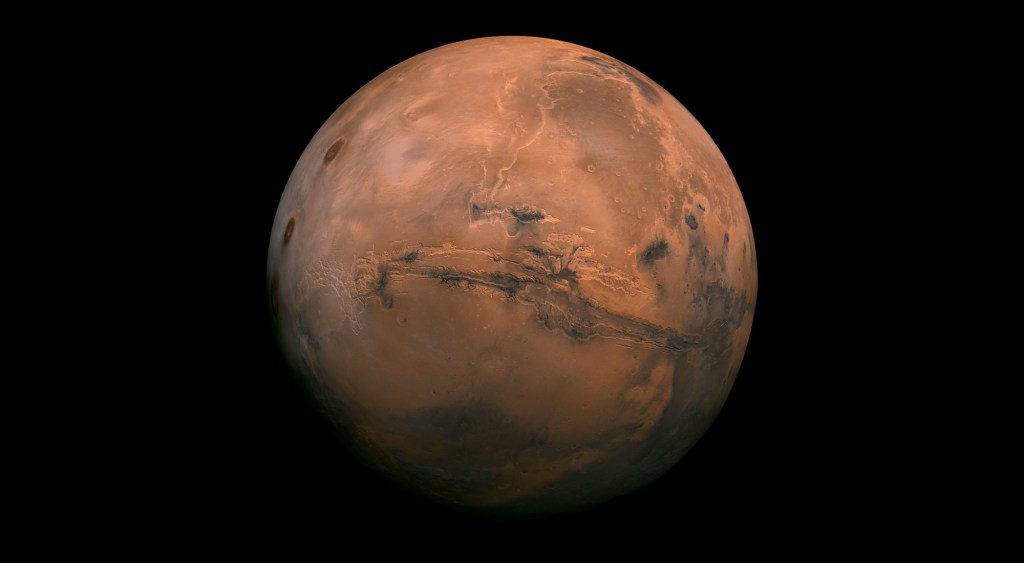
Image (Credit): Image of the planet Mars. (NASA)

Here are some recent stories of interest.

University of Arizona: “Giant Mantle Plume Reveals Mars is More Active Than Previously Thought

In a study published in Nature Astronomy, scientists from the University of Arizona challenge current views of Martian geodynamic evolution with a report on the discovery of an active mantle plume pushing the surface upward and causing earthquakes and volcanic eruptions. The finding suggests that the planet’s deceptively quiet surface may hide a more tumultuous interior than previously thought…Mantle plumes are large blobs of warm and buoyant rock that rise from deep inside a planet and push through its intermediate layer – the mantle – to reach the base of its crust, causing earthquakes, faulting and volcanic eruptions. The island chain of Hawaii, for example, formed as the Pacific plate slowly drifted over a mantle plume.

Nature.com: “‘Great Scientific Step Forward’: Construction of World’s Largest Radio Observatory is Finally Under Way

After 30 years of planning and negotiations, construction begins this week on the Square Kilometre Array (SKA), the world’s largest radio-astronomy observatory. The giant instrument — to be built across sprawling sites in Australia and Africa — will collect the radio signals emitted by celestial objects and will hopefully shed light on some of the most enigmatic problems in astronomy, such as the nature of dark matter and how galaxies form.

UAE in Space: “Saudi Arabia in Talks over Plans for Next-Generation Space Stations

Saudi Arabia is in talks with other nations over plans for the next generation of space stations, which could one day serve as floating hotels among the stars. Mohammed bin Saud Al Tamimi, governor of the Communications, Space and Technology Commission, said he sees space commodities as a “huge opportunity”. He was speaking remotely on the first day of the Abu Dhabi Space Debate, a major conference that addressed the new geopolitics of space and emerging trends. Mr Al Tamimi said that the Kingdom would be announcing its national space strategy early next year.

Pic of the Week: Hickson Compact Group 40

Image (Credit): The NASA/ESA Hubble Space Telescope view of five galaxies, called the Hickson Compact Group 40. (NASA/ESA Hubble)

This week’s image is from the NASA/ESA Hubble Space Telescope. It shows an amazing collection of five galaxies in close proximity to one another in what is known as the Hickson Compact Group 40. In about one billion years they are expected to coalesce into one large galaxy.

Here is the summary from the Hubble site:

This menagerie includes three spiral-shaped galaxies, an elliptical galaxy and a lenticular (lens-like) galaxy. Somehow, these different galaxies have crossed paths to create an exceptionally crowded and eclectic galaxy sampler.

Caught in a leisurely gravitational dance, the whole group is so crowded that it could fit within a region of space that is less than twice the diameter of our Milky Way’s stellar disc.

Though such galaxy groupings can be found in the heart of huge galaxy clusters, these galaxies are notably isolated in their own small patch of the Universe, in the direction of the constellation Hydra.

One possibility is that there’s a lot of dark matter (a poorly understood and invisible form of matter) associated with these galaxies. If they come close together the dark matter can form a big cloud within which the galaxies orbit. As the galaxies plough through the dark matter they feel a frictional force that results from its gravitational effects. This slows their motion and makes the galaxies lose energy, so they fall together. Therefore, this snapshot catches the galaxies at a very special moment in their lifetimes. In about 1 billion years they will eventually collide and merge to form a single giant elliptical galaxy.

Astronomers have studied this compact galaxy group not only in visible light, but in radio, infrared, and at X-ray wavelengths. Almost every one of the galaxies has a compact radio source at its core, which could be evidence for the presence of a supermassive black hole. X-ray observations show that the galaxies have been gravitationally interacting as witnessed by the presence of a lot of hot gas amongst them. Infrared observations reveal clues to the rate of formation of new stars.

Though over 100 such compact galaxy groups have been catalogued in sky surveys going back several decades, Hickson Compact Group 40 is one of the most densely packed. Observations suggest that such tight groups may have been more abundant in the early Universe and provided fuel for powering black holes, known as quasars, whose light from superheated inflating material blazed across space. Studying the details of galaxies in nearby groups like this helps astronomers sort out when and where galaxies assembled themselves, and what they are assembled from.

Space Mission: ESA’s Euclid Telescope

To follow up on the previous post, Russia also lost out on launching the European Space Agency’s (ESA) Euclid spacecraft. Russia was supposed to launch it on a Soyuz-ST/Fregat rocket this December, but the country’s invasion of Ukraine led to a change in plans. SpaceX will now be launching the spacecraft next year.

Euclid was designed to study dark energy and dark matter, and make a 3D-map of the Universe. The project includes scientists from 14 countries: Austria, Denmark, France, Finland, Germany, Italy, Netherlands, Norway, Spain, Switzerland, Portugal, Romania, the UK, and the US.

Euclid hopes to answer the following questions:

  • How did the Universe originate? What were the conditions just after the Big Bang, and how did these give rise to the large-scale structures we see today?
  • Why is the Universe expanding at an accelerating rate today?
  • Is dark energy – a term often used to signify the mysterious force behind this cosmic acceleration – real? If so, is it a constant energy density intrinsic to and spread throughout space, or a new force of nature that slowly evolves as the Universe expands?
  • What is the nature of dark matter, and how do neutrinos possibly contribute? Are there other as-yet-undetected massive particles in the Universe?

Once launched, Euclid will operate in the Sun-Earth Lagrange point 2 (L2), which is where the James Webb Space Telescope is located as well as ESA’s Gaia spacecraft. Gaia, launched in December 2013, is currently mapping the stars in the Milky Way galaxy. It seems L2 is the place to be.

NASA is contributing infrared flight detectors for one of Euclid’s two science instruments. You can read more about the NASA contribution here.