Pic of the Week: Hickson Compact Group 40

Image (Credit): The NASA/ESA Hubble Space Telescope view of five galaxies, called the Hickson Compact Group 40. (NASA/ESA Hubble)

This week’s image is from the NASA/ESA Hubble Space Telescope. It shows an amazing collection of five galaxies in close proximity to one another in what is known as the Hickson Compact Group 40. In about one billion years they are expected to coalesce into one large galaxy.

Here is the summary from the Hubble site:

This menagerie includes three spiral-shaped galaxies, an elliptical galaxy and a lenticular (lens-like) galaxy. Somehow, these different galaxies have crossed paths to create an exceptionally crowded and eclectic galaxy sampler.

Caught in a leisurely gravitational dance, the whole group is so crowded that it could fit within a region of space that is less than twice the diameter of our Milky Way’s stellar disc.

Though such galaxy groupings can be found in the heart of huge galaxy clusters, these galaxies are notably isolated in their own small patch of the Universe, in the direction of the constellation Hydra.

One possibility is that there’s a lot of dark matter (a poorly understood and invisible form of matter) associated with these galaxies. If they come close together the dark matter can form a big cloud within which the galaxies orbit. As the galaxies plough through the dark matter they feel a frictional force that results from its gravitational effects. This slows their motion and makes the galaxies lose energy, so they fall together. Therefore, this snapshot catches the galaxies at a very special moment in their lifetimes. In about 1 billion years they will eventually collide and merge to form a single giant elliptical galaxy.

Astronomers have studied this compact galaxy group not only in visible light, but in radio, infrared, and at X-ray wavelengths. Almost every one of the galaxies has a compact radio source at its core, which could be evidence for the presence of a supermassive black hole. X-ray observations show that the galaxies have been gravitationally interacting as witnessed by the presence of a lot of hot gas amongst them. Infrared observations reveal clues to the rate of formation of new stars.

Though over 100 such compact galaxy groups have been catalogued in sky surveys going back several decades, Hickson Compact Group 40 is one of the most densely packed. Observations suggest that such tight groups may have been more abundant in the early Universe and provided fuel for powering black holes, known as quasars, whose light from superheated inflating material blazed across space. Studying the details of galaxies in nearby groups like this helps astronomers sort out when and where galaxies assembled themselves, and what they are assembled from.

Space Mission: ESA’s Euclid Telescope

To follow up on the previous post, Russia also lost out on launching the European Space Agency’s (ESA) Euclid spacecraft. Russia was supposed to launch it on a Soyuz-ST/Fregat rocket this December, but the country’s invasion of Ukraine led to a change in plans. SpaceX will now be launching the spacecraft next year.

Euclid was designed to study dark energy and dark matter, and make a 3D-map of the Universe. The project includes scientists from 14 countries: Austria, Denmark, France, Finland, Germany, Italy, Netherlands, Norway, Spain, Switzerland, Portugal, Romania, the UK, and the US.

Euclid hopes to answer the following questions:

  • How did the Universe originate? What were the conditions just after the Big Bang, and how did these give rise to the large-scale structures we see today?
  • Why is the Universe expanding at an accelerating rate today?
  • Is dark energy – a term often used to signify the mysterious force behind this cosmic acceleration – real? If so, is it a constant energy density intrinsic to and spread throughout space, or a new force of nature that slowly evolves as the Universe expands?
  • What is the nature of dark matter, and how do neutrinos possibly contribute? Are there other as-yet-undetected massive particles in the Universe?

Once launched, Euclid will operate in the Sun-Earth Lagrange point 2 (L2), which is where the James Webb Space Telescope is located as well as ESA’s Gaia spacecraft. Gaia, launched in December 2013, is currently mapping the stars in the Milky Way galaxy. It seems L2 is the place to be.

NASA is contributing infrared flight detectors for one of Euclid’s two science instruments. You can read more about the NASA contribution here.

Space Stories: Approaching Lucy, Chinese Space Ambitions, and Conan the Bacterium

Image (Credit): Image from NASA’s Lucy spacecraft showing the Earth and Moon from 890,000 miles away (look closely – the moon on the left is a very pale dot). (NASA/Goddard/SwRI)

Here are some recent stories of interest.

NASA.gov: “NASA’s Lucy Spacecraft Captures Images of Earth, Moon Ahead of Gravity Assist

On October 13, 2022, NASA’s Lucy spacecraft captured [the above] image of the Earth and the Moon from a distance of 890,000 miles (1.4 million km). The image was taken as part of an instrument calibration sequence as the spacecraft approached Earth for its first of three Earth gravity assists. These Earth flybys provide Lucy with the speed required to reach the Trojan asteroids — small bodies that orbit the Sun at the same distance as Jupiter. On its 12 year journey, Lucy will fly by a record breaking number of asteroids and survey their diversity, looking for clues to better understand the formation of the solar system.

SpaceNews.com: “China Considering Mission to Ceres and Large Dark Matter Space Telescope

The Chinese Academy of Sciences is considering potential missions including a Ceres orbiter and a huge telescope to hunt for clues about the nature of dark matter. More than 20 candidates are vying for funding for further study under the Chinese Academy of Sciences Strategic Priority Program on Space Science, also known as the New Horizon Program, and are currently undergoing evaluation.

Space.com: “Extremophiles on Mars Could Survive for Hundreds of Millions of Years

One of Earth’s toughest microbes could survive on Mars, lying dormant beneath the surface, for 280 million years, new research has shown. The findings increase the probability that microbial life could still exist on the Red Planet. Deinococcus radiodurans, nicknamed “Conan the Bacterium,” is one of the world’s toughest microbes, capable of surviving in radiation strong enough to kill any other known life-form. Experiments have now shown that if Conan the Bacterium or a similar microbe existed on Mars, it could survive 33 feet (10 meters) beneath the surface, frozen and dried out, for 280 million years.

You Stole My Dark Matter!

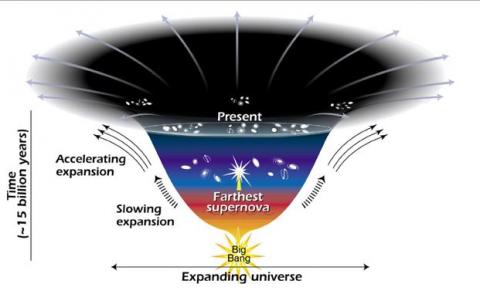
Image (Credit): This NASA diagram reveals changes in the rate of expansion since the universe’s birth 15 billion years ago. The more shallow the curve, the faster the rate of expansion. The curve changes noticeably about 7.5 billion years ago, when objects in the universe began flying apart as a faster rate. Astronomers theorize that the faster expansion rate is due to a mysterious, dark force that is pulling galaxies apart. (NASA)

ScienceDaily reports that astrophysicists found some small galaxies lack Dark Matter after encounters with larger galaxies. In the article, “How Galaxies Can Exist Without Dark Matter,” we learn that the astrophysicists found seven galaxies stripped of dark matter after collisions with galaxies about 1,000 times more massive.

Astrophysicist James Bullock from the University of California, Irvine and Pomona College, who was part of the team that made the discovery, stated:

The observation that there are dark matter-free galaxies has been a little bit worrying to me…We have a successful model, developed over decades of hard work, where most of the matter in the cosmos is dark. There is always the possibility that nature has been fooling us.

Just when we think we have figured things out, a wrench is thrown into the works. It does keep things interesting.