Profile: COSMIC

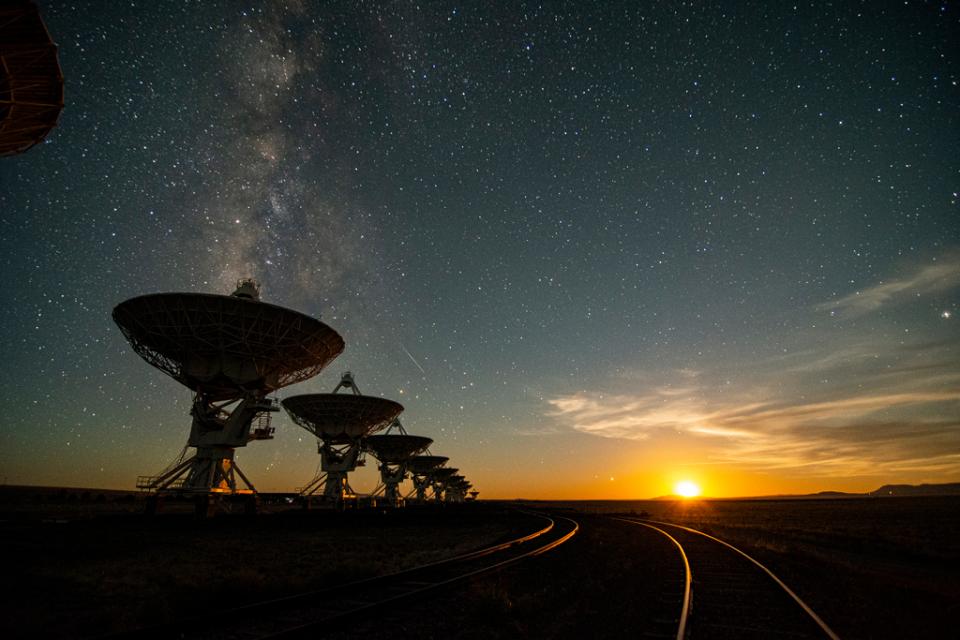
Image (Credit): Karl G. Jansky Very Large Array (VLA) in New Mexico. (Jeff Hellermann, NRAO/AUI/NSF)

COSMIC, also known as the Commensal Open-Source Multimode Interferometer Cluster, is part of the search for extraterrestrial intelligence (SETI) by attempting to find technosignatures using the National Science Foundation’s Karl G. Jansky Very Large Array (VLA) in New Mexico. This new project is a joint venture between the SETI Institute and the National Radio Astronomy Observatory (NRAO). The initial plan is to search for these technosignatures among about 40 million star systems.

Technosignature are basically indicators of technology not caused by natural phenomena. Examples include radio signals, pollutants, nighttime lighting, megastructures, or even the fallout from a nuclear war (not very optimistic, I know). This is different than the biosignatures that other astronomers are looking for among exoplanets by studying the composition of an exoplanet’s atmosphere.  

The NRAO has created a page on the COSMIC project that provides plenty of details.

It is good to see federal funding going into the SETI program again after Congress walked away from the program in 1993. With all the new evidence coming to us regarding the multitude of exoplanets, it only makes sense to have a multi-pronged approach to find alien life, particularly intelligent life.

Let’s hope COSMIC is the start of a new and stronger SETI partnership.

Evening Skies: First Satellites, and Now Wind Turbines

Credit: Grist.org

Earth-bound astronomers have another force to contend with these days – wind turbines. Yes, the efforts to reduce carbon emissions is increase light emissions around the globe. Why can’t anything be easy?

The Wall Street Journal recently noted that the lights added to wind turbines to make them visible to airplanes is causing light pollution for local residents and astronomers alike. In the article, “Lawmakers Crack Down on Wind-Turbine Lights That Flash All Night,” we learn that a simple fix may save the night sky. Lawmakers in some states are requiring that the warning lights remain off until an aircraft approaches.

Of course, this is a costly solution to the wind turbine operators or they would have done it already. The article states:

Aircraft-detection technology approved by the Federal Aviation Administration has been on the market for a half-dozen years. The systems are estimated to cost $1 million to $2 million to install with additional operating expenses each year. 

That said, it seems to be a fair compromise to allow local citizens to enjoy their evenings. I am not sure if anyone is planning to require the same from cell towers and other commercial structures, but it’s a start.

Happy Astronomy Day!

Image (Credit): Adler Planetarium in Chicago, Illinois. (Adler Planetarium)

Today is National Astronomy Day (also called International Astronomy Day). You still have time to look to the heavens if you have yet to do so.

The Farmer’s Almanac has this to say about the day:

This “holiday” was created in 1973 by California astronomer Doug Berger. During the first observance, Berger set up telescopes in busy urban locations, such as street corners, parks, and malls, as a way to bring astronomy “to the people.” Since then, the event has grown to international proportions, with amateur astronomy clubs, planetariums, observatories, and other science organizations throughout the world hosting special events twice each year in honor of Astronomy Day.

Yes, the day is almost over, but how about turning the weekend in to an astronomy weekend? Visit a local planetarium. a local telescope, or a space museum to celebrate. Or, even better, make astronomy a more frequent activity in your life by tapping into a local astronomy club or attending astronomy lectures.

Maybe you can even host your own event for the autumn Astronomy Day currently scheduled for September 23rd. That’s right, as noted above, there are two Astronomy Days per year. How many special days give you a second chance like this?

Good Article: Telescope Mishaps on Earth and in the Heavens

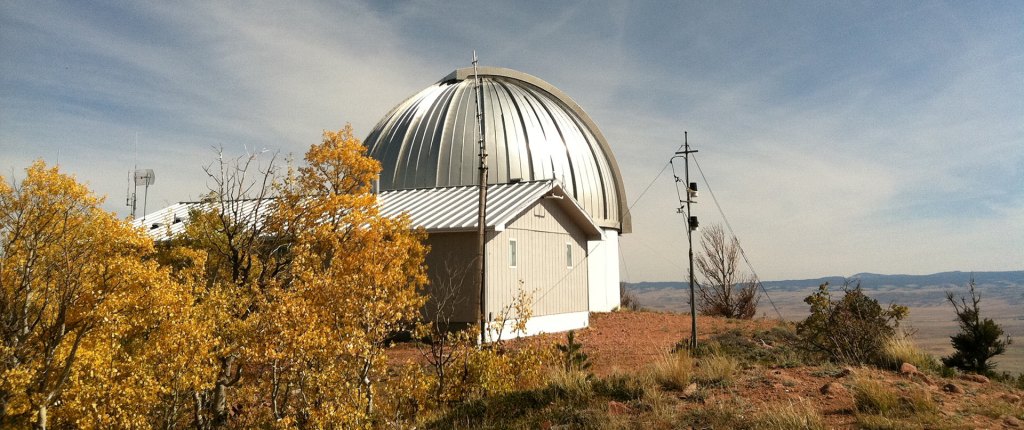
Image (Copy): The Wyoming Infrared Observatory (WIRO). (WIRO)

The New York Times had a good article on various mishaps related to telescopes here on Earth (such as WIRO above) as well as those now floating in space. The story, “From Bullets to ‘Bird Residue,’ the Many Trials of Telescopes,” shares stories about various natural (bird poop) and man-made (dropped tool) events that have left their marks on astronomy.

We have all heard about the misshaped mirror on the Hubble Space Telescope as well as micrometeors hitting the James Webb Space Telescope, but have you heard about the employee who shot and hammered the primary mirror at the McDonald Observatory in West Texas?

Take a look at the article. You will find plenty of stories to amuse you as well as give you pause.

Space Stories: Ancient Water, Nearby Black Hole, and a Lunar Time Zone

Image (Credit): Illustration showing gaseous water in the planet-forming disc around the star V883 Orionis. (European Southern Observatory)

Here are some recent stories of interest.

European Southern Observatory: “Astronomers Find Missing Link for Water in the Solar System

Using the Atacama Large Millimeter/submillimeter Array (ALMA), astronomers have detected gaseous water in the planet-forming disc around the star V883 Orionis. This water carries a chemical signature that explains the journey of water from star-forming gas clouds to planets, and supports the idea that water on Earth is even older than our Sun.

“We can now trace the origins of water in our Solar System to before the formation of the Sun,” says John J. Tobin, an astronomer at the National Radio Astronomy Observatory, USA and lead author of the study published today in Nature. 

SciTech Daily: “Astronomers Uncover Black Hole Closer to Earth Than Ever Before

Astronomers have discovered the closest black hole to Earth, the first unambiguous detection of a dormant stellar-mass black hole in the Milky Way. Its close proximity to Earth, a mere 1,600 light-years away, offers an intriguing target of study to advance understanding of the evolution of binary systems.

New York Times: “The Moon May Get Its Own Time Zone

What time is it on the moon? Since the dawn of the space age, the answer has been: It depends. For decades, lunar missions have operated on the time of the country that launched them. But with several lunar explorations heading for the launchpad, the European Space Agency has deemed the current system unsustainable. The solution, the agency said last week, is a lunar time zone.