Space Stories: Astronomical Damage in Ukraine, An Awakened Black Hole, and Understanding Jupiter’s Giant Red Spot

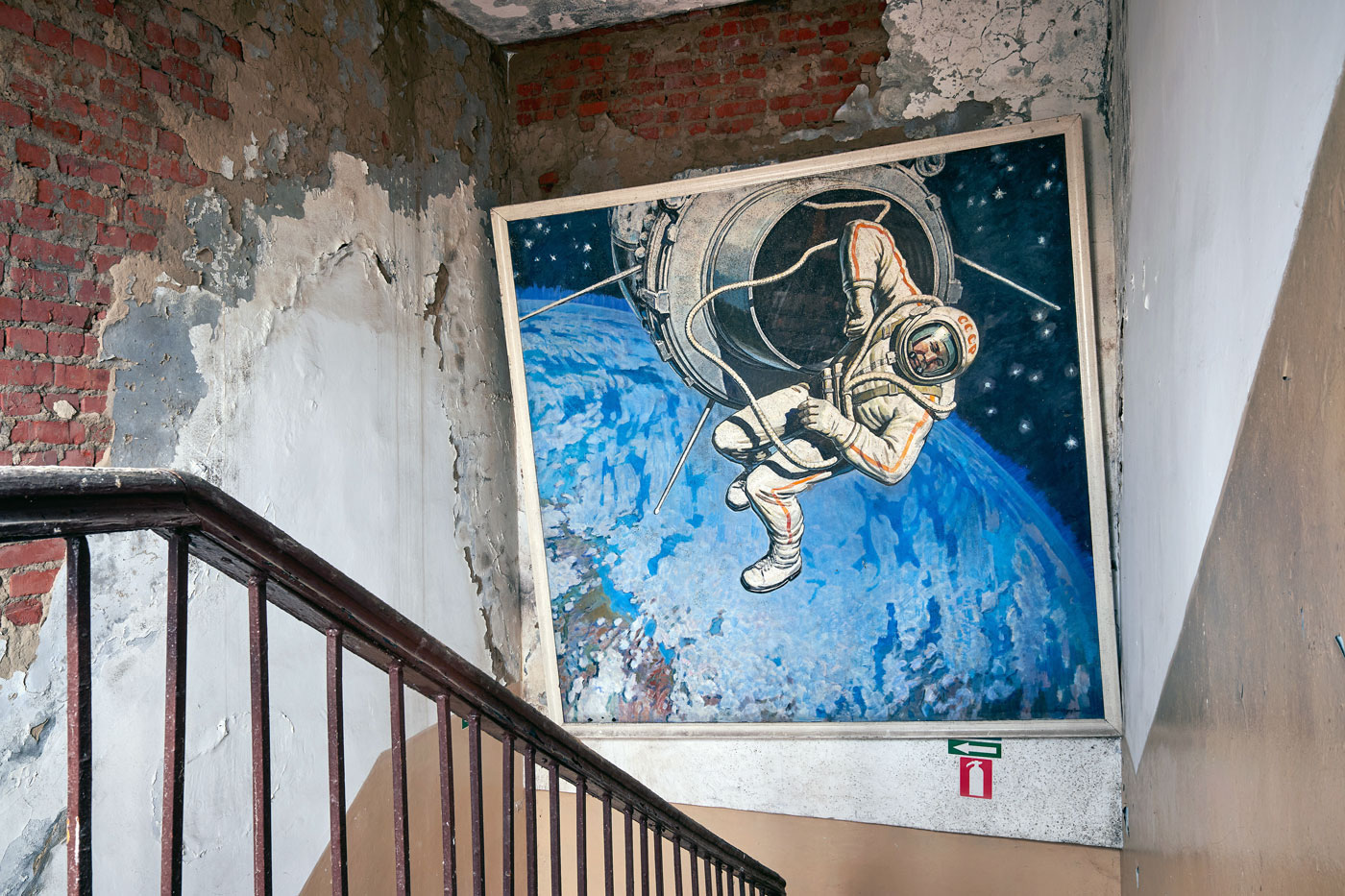
Image (Credit): Stairwell of the Braude observatory’s main building with a painting of Alexei Leonov, the Soviet cosmonaut who performed the first spacewalk in 1965. (Science.org/Eric Lusito)

Here are some recent stories of interest.

—Science.org: “A Shattered Window to the Radio Sky“

In November 2023, photographer Eric Lusito made a rare visit to the Braude Radio Astronomy Observatory near Kharkiv, Ukraine, once one of the nation’s flagship scientific facilities. Since his visit, the Kharkiv region, which was partly occupied by Russian forces in 2022 but liberated later that year, has again faced a renewed Russian assault. As of this writing, military specialists say that effort has stalled. Here is Lusito’s account of his visit.

—The Guardian: “Astronomers Detect Sudden Awakening of Black Hole 1m Times Mass of Sun“

The mysterious brightening of a galaxy far, far away has been traced to the heart of the star system and the sudden awakening of a giant black hole 1m times more massive than the sun. Decades of observations found nothing remarkable about the distant galaxy in the constellation of Virgo, but that changed at the end of 2019 when astronomers noticed a dramatic surge in its luminosity that persists to this day. Researchers now believe they are witnessing changes that have never been seen before, with the black hole at the galaxy’s core putting on an extreme cosmic light show as vast amounts of material fall into it.

—University of the Basque Country: “Establishing Age and Origin of Jupiter’s Great Red Spot“

As a popular icon among objects in the Solar System, Jupiter’s Great Red Spot (GRS) is probably the best-known atmospheric structure. Its large size (right now its diameter is that of the Earth) and the contrast of its reddish colour against the planet’s pale clouds make it an object that can be easily seen even with small telescopes…Speculation about the origin of the GRS dates back to the first telescopic observations made by the astronomer Giovanni Domenico Cassini, who in 1665 discovered a dark oval at the same latitude as the GRS and named it the ‘Permanent Spot’ (PS), since it was observed by him and other astronomers until 1713. Track of it was subsequently lost for 118 years and it was not until 1831 and later years that S. Schwabe again observed a clear structure, roughly oval in shape and at the same latitude as the GRS; that can be regarded as the first observation of the current GRS, perhaps of a nascent GRS.
Space Stories: Spaceplane Planned for ISS, AI Assists Astronomy, and Water Older Than the Sun

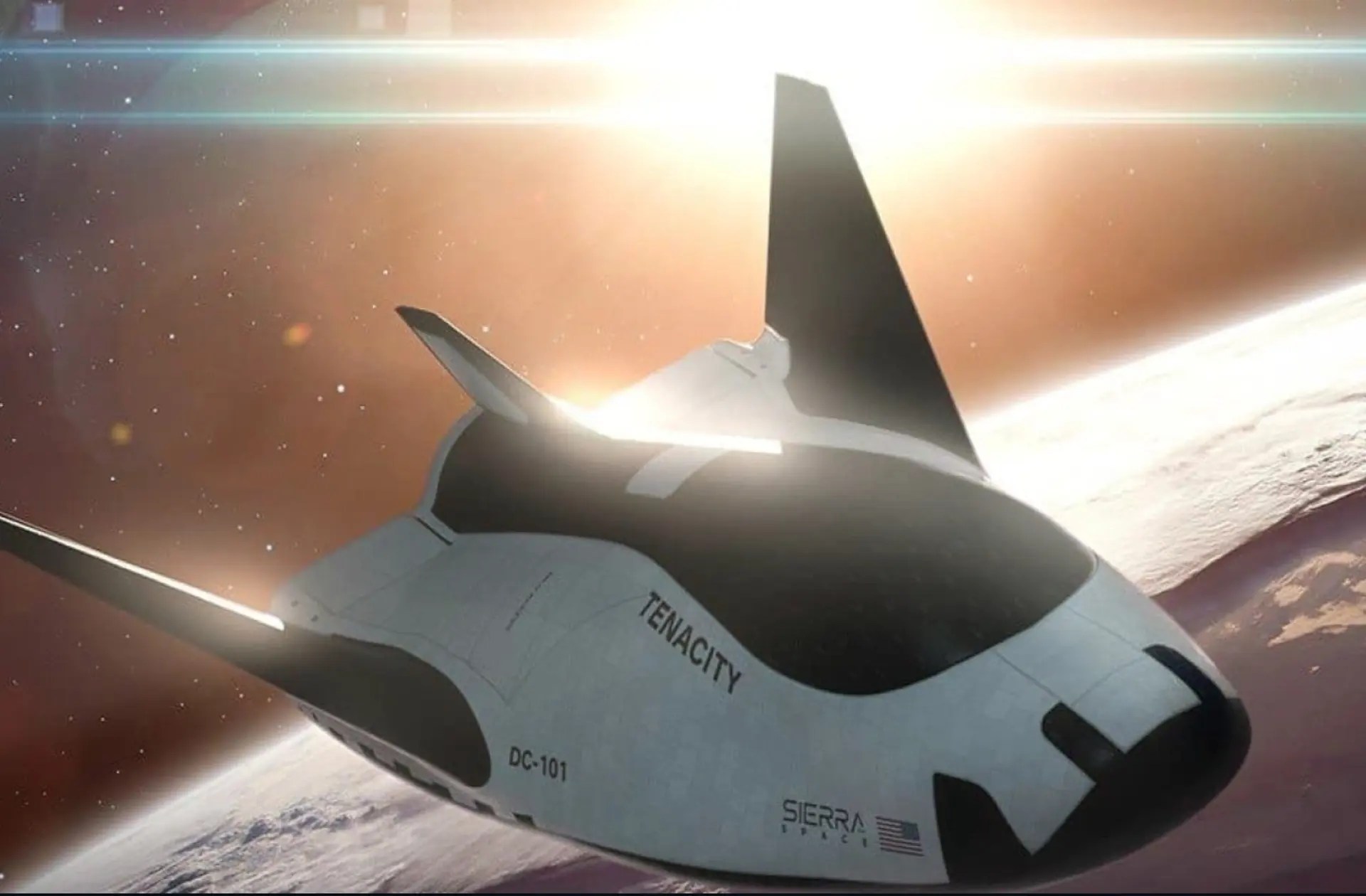
Image (Credit): Artist’s rendering of the Dream Chaser DC-100 spaceplane. (Sierra Space)

Here are some recent stories of interest.

—New Atlas: “World’s First Commercial Spaceplane in Final Stages Before Debut ISS Flight“

The world’s first winged commercial spaceplane has arrived at NASA’s Kennedy Space Center in Florida, its final destination before its first mission to the International Space Station (ISS) later this year. Following rigorous testing at Ohio’s Neil Armstrong Test Facility, the Dream Chaser DC-100 spaceplane named Tenacity got the green light to commence final pre-launch preparations, such as finishing its thermal protection system and payload integration, before it hitches a ride on a United Launch Alliance (ULA) Vulcan rocket to deliver 7,800 pounds (3,540 kg) of food, water and science experiments to the ISS.

—MIT Technology Review: “Astronomers are Enlisting AI to Prepare for a Data Downpour“

In deserts across Australia and South Africa, astronomers are planting forests of metallic detectors that will together scour the cosmos for radio signals. When it boots up in five years or so, the Square Kilometer Array Observatory will look for new information about the universe’s first stars and the different stages of galactic evolution.  But after syncing hundreds of thousands of dishes and antennas, astronomers will quickly face a new challenge: combing through some 300 petabytes of cosmological data a year—enough to fill a million laptops…In preparation for the information deluge, astronomers are turning to AI for assistance, optimizing algorithms to pick out patterns in large and notoriously finicky data sets. Some are now working to establish institutes dedicated to marrying the fields of computer science and astronomy—and grappling with the terms of the new partnership.

—BBC Sky at Night: “Earth’s Water is Even Older Than the Sun, Having Formed Billions of Years Ago, Say Astronomers“

How old is Earth’s water? Could it be older even than the planet itself? A team of astronomers say they’ve found the “missing link” that shows how water is delivered from gaseous star-forming regions in space to planets like Earth. The research suggests that Earth’s water is even older than the Sun. The news comes as a result of studies of a dusty planet-forming disc surrounding a star 1,300 lightyears from Earth

Space Stories: New Observatory in Chile, Why Exoplanets Spiral Towards their Sun, and Citizens Help Find an Exoplanet

Image (Credit): University of Tokyo Atacama Observatory, built on the summit of a desert mountain in northern Chile. (The University of Tokyo Atacama Observatory Project)

Here are some recent stories of interest.

—University of Tokyo: “New Observatory in Chile—the Highest in the World—Aims to Reveal Origins of Planets, Galaxies and More“

At an altitude of 5,640 meters, the University of Tokyo Atacama Observatory (TAO), built on the summit of a desert mountain in northern Chile, is the highest astronomical observatory in the world, which should give it unrivaled capabilities, but presents some novel challenges…”Construction on the summit of Cerro Chajnantor was an incredible challenge, not just technically, but politically too. I have liaised with Indigenous peoples to ensure their rights and views are considered, the Chilean government to secure permission, local universities for technical collaboration, and even the Chilean Health Ministry to make sure people can work at that altitude in a safe manner. Thanks to all involved, research I’ve only ever dreamed about can soon become a reality, and I couldn’t be happier.”

—Durham University: “Scientists Explain Why Some Exoplanets are Spiraling Towards their Stars“

According to existing theories, the closeness of hot Jupiters should create powerful gravitational ‘tidal waves’ between the planet and star. Over billions of years, these tides transfer energy, causing the planets to spiral inwards until they are eventually consumed by their stars. However, some hot Jupiters like WASP-12b seem to be spiralling in way too quickly for the theories to explain. Scientists were missing a key part of the mystery. Our scientists say they have found the missing piece – magnets!

—Simons Foundation: “Citizen Scientists Help Discover Record-Breaking Exoplanet in Binary Star System“

With an orbit longer than those of most of its brethren, the new planet spotted by volunteer planet hunters and confirmed by Flatiron Institute scientists and their colleagues could offer insights into how exoplanets form and remain stable in multi-star systems…The newfound planet — formally called TOI 4633 c, but nicknamed Percival (after a character from the “Harry Potter” book series) by the scientists — was first identified by citizen scientists sifting through data collected by NASA’s Transiting Exoplanet Survey Satellite (TESS). 

Space Stories: Voyager 1 Gibberish, Lunar Rovers Underway, and the Largest Digital Camera

Image (Credit): Artist’s rendering of the Voyager 1 spacecraft. (NASA)

Here are some recent stories of interest.

—ScienceAlert: “NASA Has Finally Identified The Reason Behind Voyager 1’s Gibberish“

For months now, the most distant spacecraft to Earth – Voyager 1 – has been talking gibberish on the interplanetary ‘radio’. The repetitive jumble of 1s and 0s it’s sending back to our planet, 24 billion kilometers (15 billion miles) away, has made no sense to scientists until now. Turns out, officials at NASA just needed to give the oh-so-distant craft a bit of a ‘poke’ to ask it how it was feeling. The system returned a software readout to Earth that scientists have now used to confirm about 3 percent of its memory is corrupted. Which is why turning the FDS on and off didn’t resolve the issue back in November of 2023.

—CBS News: “3 Companies Win NASA Contracts to Develop New Artemis Moon Rover Designs“

Along with funding the commercial development of new rockets, Artemis moon landers and new spacesuits, NASA is pressing ahead with plans to buy an unpressurized moon rover that can carry astronauts, science payloads — or both — across the rugged terrain of the lunar south pole, officials said Wednesday. The agency announced contract awards to three companies to develop competing designs for a Lunar Terrain Vehicle, or LTV, similar in concept to the rovers that carried the last three Apollo crews across the moon’s surface more than 50 years ago.

—NOIRLab: “Construction of Largest Digital Camera Ever Built for Astronomy Completed“

After two decades of work, scientists and engineers at the Department of Energy’s SLAC National Accelerator Laboratory and their collaborators are celebrating the completion of the LSST Camera. Once mounted on Vera C. Observatory’s Simonyi Survey Telescope, the 3200-megapixel camera will help researchers observe our Universe in unprecedented detail. During its ten-year Legacy Survey of Space and Time, the LSST Camera will generate an enormous trove of data on the southern night sky that researchers will mine for new insights into dark energy, dark matter, the changing night sky, the Milky Way and our Solar System.

Space Quote: The 8 Billion-Year-Old Signal

Image (Credit): The Australian Square Kilometre Array Pathfinder (ASKAP) radio telescope in Western Australia, which detected the 8 billion-year-old signal. (https://www.icrar.org/)

“We were lucky to be looking at that little spot in the sky for that one millisecond after the eight billion years the pulse had travelled to catch it.”

-Statement by Ryan Shannon, an astrophysicist at Australia’s Swinburne University and co-author of a study describing the signal that was received June 10th last year, as quoted by CBS News. The same article noted that “The pulse was so powerful that — in under a millisecond — it released as much energy as the sun emits over 30 years.”