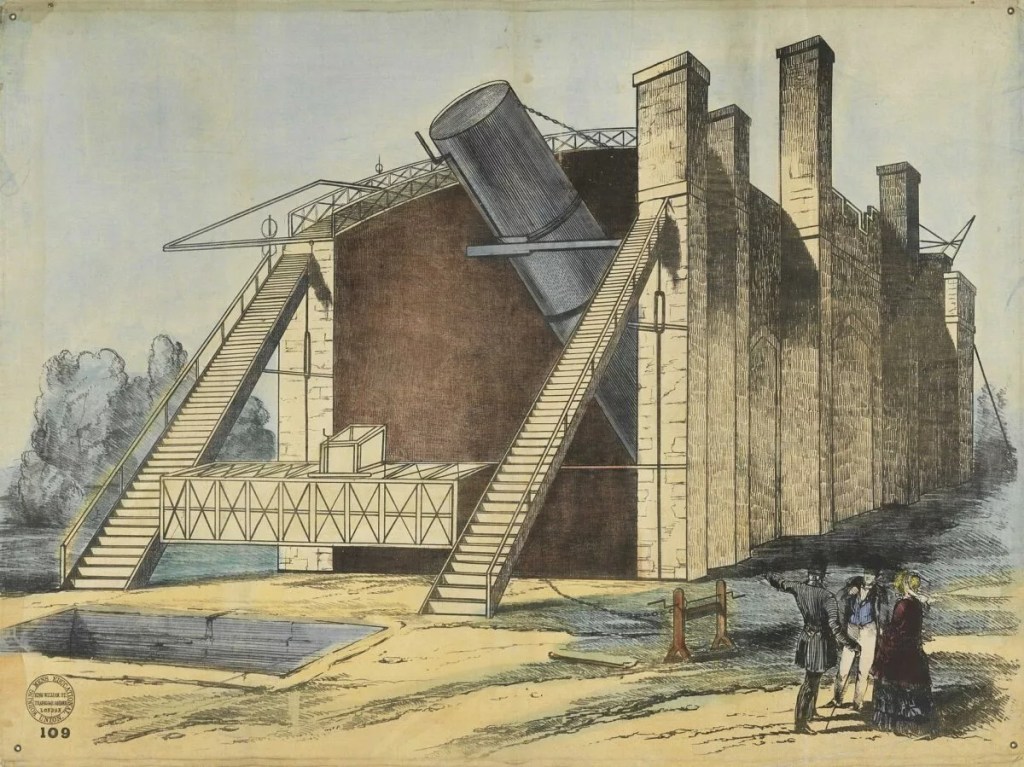
Image (Credit): The Leviathan of Parsonstown, or Rosse six-foot telescope. (Planetary Society)
On this day in 1845, a 72-inch reflecting telescope built by William Parsons, the 3rd Earl of Rosse, came into use on his estate in Ireland. The telescope remained the largest in the world until 1917, when it was eclipsed by the Hooker reflecting telescope in California.
Known as both the Leviathan of Parsonstown and Rosse six-foot telescope, it was used William Parson to observe star clusters and nebulae. For example, it was used to view a spiral nebula that we know today as the spiral galaxy Messier 51, or The Whirlpool Galaxy, which is about 31 million light years from Earth (see below). You can see The Whirlpool Galaxy today with a pair of binoculars.
Go here for more information on the Earl and his telescope.
Image (Credit): Spiral galaxy Messier 51, also called The Whirlpool Galaxy. (NASA, ESA, S. Beckwith (STScI) and the Hubble Heritage Team (STScI/AURA))
After 30 years in orbit, mission operations for the joint NASA-JAXA Geotail spacecraft have ended, after the failure of the spacecraft’s remaining data recorder. Since its launch on July 24, 1992, Geotail orbited Earth, gathering an immense dataset on the structure and dynamics of the magnetosphere, Earth’s protective magnetic bubble. Geotail was originally slated for a four-year run, but the mission was extended several times due to its high-quality data return, which contributed to over a thousand scientific publications. While one of Geotail’s two data recorders failed in 2012, the second continued to work until experiencing an anomaly on June 28, 2022. After attempts to remotely repair the recorder failed, the mission operations were ended on November 28, 2022.
Astronomers have released a gargantuan survey of the galactic plane of the Milky Way. The new dataset contains a staggering 3.32 billion celestial objects—arguably the largest such catalog so far. The data for this unprecedented survey were taken with the Dark Energy Camera, built by the US Department of Energy, at the NSF’s Cerro Tololo Inter-American Observatory in Chile, a Program of NOIRLab.
While much of the world’s press recently focused on Virgin Orbit’s failed ‘horizontal’ aircraft launch of a batch of 9 small satellites from Spaceport Cornwall, other rivals are gearing up to tap into the growing demand for satellite launches. Sweden has claimed the crown as “mainland Europe’s first orbital launch site”. Ursula von der Leyen, President of the European Commission, helped cut the ribbon at Kiruna, Sweden, saying: “This spaceport offers an independent European gateway to space. It is exactly the infrastructure we need, not only to continue to innovate but also to further explore the final frontier.”
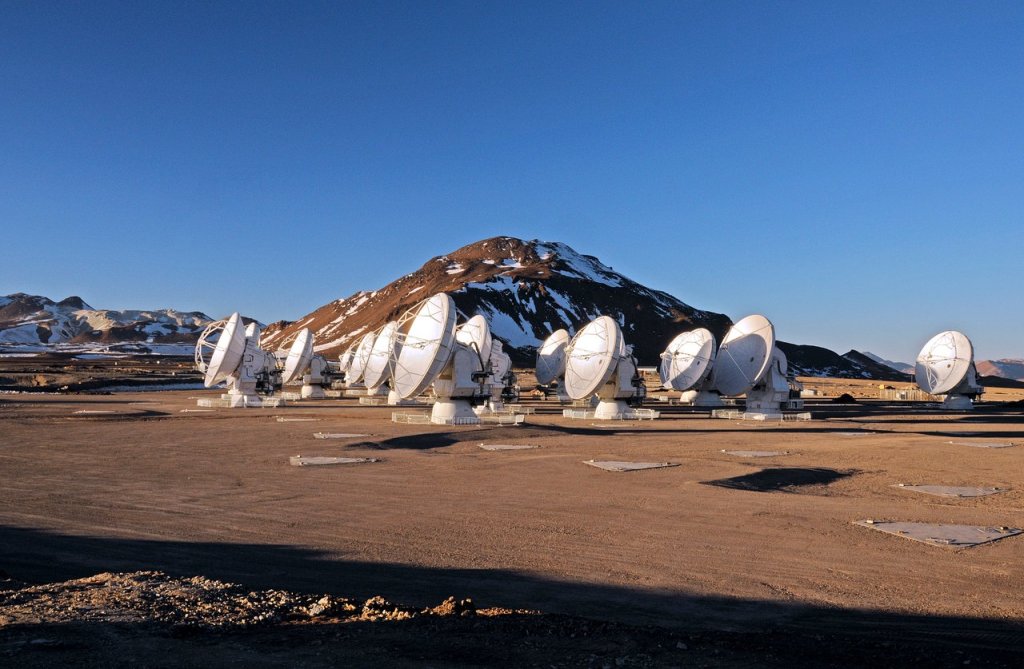
Image (Credit): The ALMA antennas on the Chajnantor Plateau in northern Chile. (ESO)
A recent Phyls.org article, “Chile’s ALMA Observatory Resumes Work After Cyberattack,” discusses a recent hacking incident at the European Southern Observatory’s (ESO) Atacama Large Millimeter/submillimeter Array (ALMA). The telescope was offline for about two months after the attack.
The ALMA telescope in northern Chile is a key asset in the search for early galaxies with its 66 antennas spread over 10 miles. Why would someone want to attack it?
When it comes to a cyber attack in the space industry, this has an added level of danger as future travel missions could be left in danger of being hi-jacked – with hackers having the potential to cause inter-space collisions and destroy communication systems, for example, should they be able to penetrate mission-critical, earth-based systems.
While the articles I read on this attack did not discuss the motive or possible attacker, it’s essential this matter be thoroughly investigated and used as an example to harden other scientific locations. We have made too much progress in astronomy for it to derailed by these outside parties.
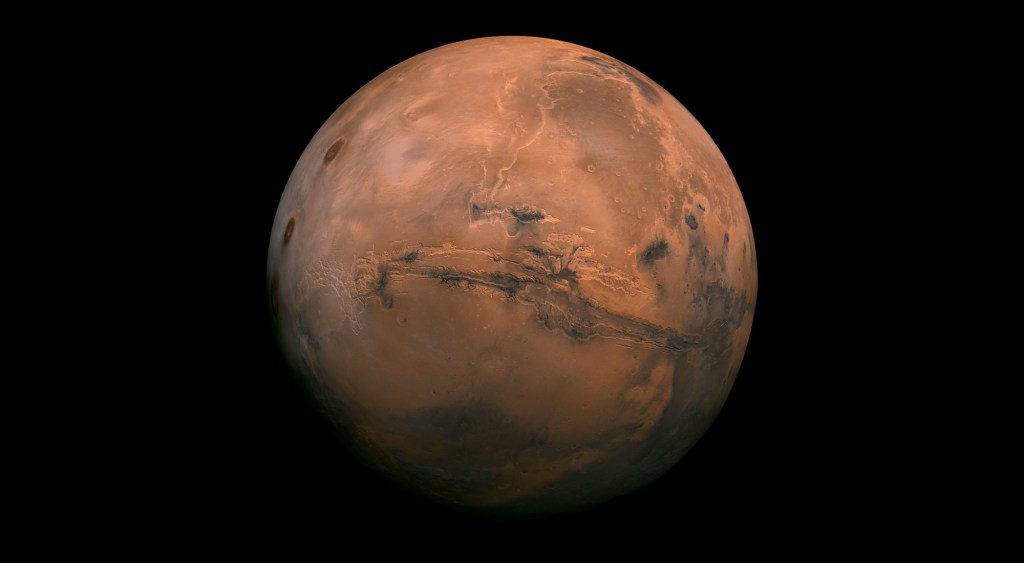
In a study published in Nature Astronomy, scientists from the University of Arizona challenge current views of Martian geodynamic evolution with a report on the discovery of an active mantle plume pushing the surface upward and causing earthquakes and volcanic eruptions. The finding suggests that the planet’s deceptively quiet surface may hide a more tumultuous interior than previously thought…Mantle plumes are large blobs of warm and buoyant rock that rise from deep inside a planet and push through its intermediate layer – the mantle – to reach the base of its crust, causing earthquakes, faulting and volcanic eruptions. The island chain of Hawaii, for example, formed as the Pacific plate slowly drifted over a mantle plume.
After 30 years of planning and negotiations, construction begins this week on the Square Kilometre Array (SKA), the world’s largest radio-astronomy observatory. The giant instrument — to be built across sprawling sites in Australia and Africa — will collect the radio signals emitted by celestial objects and will hopefully shed light on some of the most enigmatic problems in astronomy, such as the nature of dark matter and how galaxies form.
Saudi Arabia is in talks with other nations over plans for the next generation of space stations, which could one day serve as floating hotels among the stars. Mohammed bin Saud Al Tamimi, governor of the Communications, Space and Technology Commission, said he sees space commodities as a “huge opportunity”. He was speaking remotely on the first day of the Abu Dhabi Space Debate, a major conference that addressed the new geopolitics of space and emerging trends. Mr Al Tamimi said that the Kingdom would be announcing its national space strategy early next year.
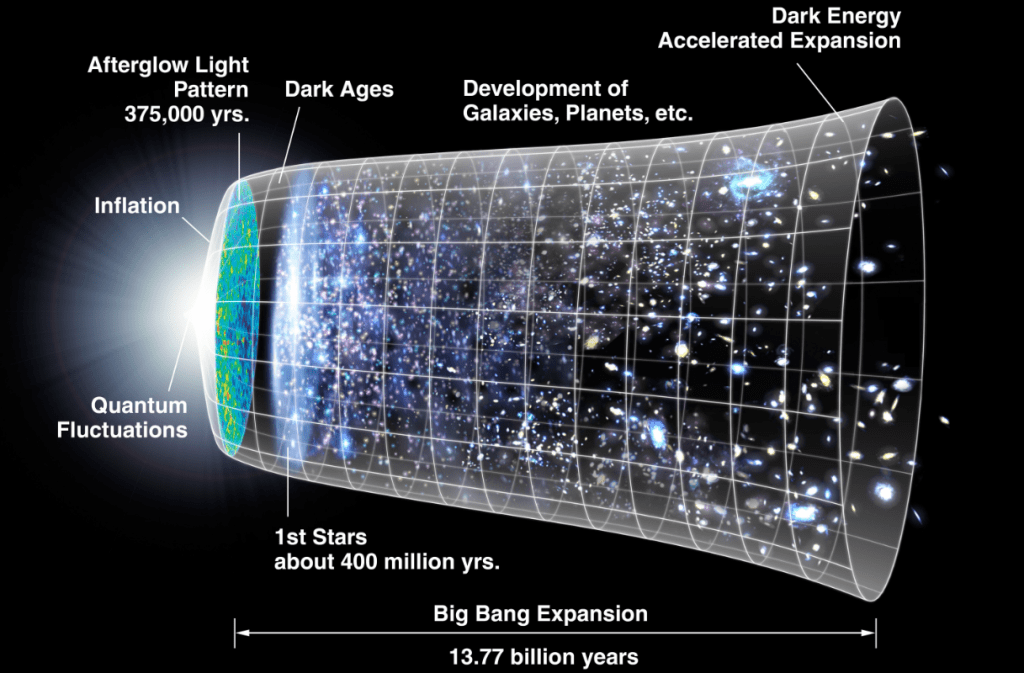
Image (Credit): Big Bang expansion. (NASA/WMAP Science Team]
About 10,000 amateur scientists in 85 countries have already assisted with galaxy-mapping, but more help is needed in locating these distant galaxies billions of light-years away.
It is all part of the Dark Energy Explorers project using data from the Hobby-Eberly Telescope, a 10 meter telescope located at the McDonald Observatory in West Texas. Volunteers will assist with the Hobby-Eberly Dark Energy Experiment (HETDEX), which is designed to:
….find over one million galaxies that are 9 billion to 11 billion light-years away, yielding the largest map of the universe ever produced. The map will allow HETDEX astronomers to measure how fast the universe was expanding at different times in its history. Changes in the expansion rate will reveal the role of dark energy at different epochs. Various explanations for dark energy predict different changes in the expansion rate, so by providing exact measurements of the expansion, the HETDEX map will eliminate some of the competing ideas.
The Explorers website can walk you through all of the necessary details to help identify signals from distant galaxies. Approximately 247,000 galaxies have already been identified, but that is just a fraction of what scientist believe is out there in the patch of sky being observed.
Ultimately, the plan is to build a 3D map of the cosmos concentrated on galaxies in the early universe. This should assist scientists with their understanding of dark energy.
This is your chance to be an astronomer. Time to have fun and pitch in.



 Our Awesome Universe