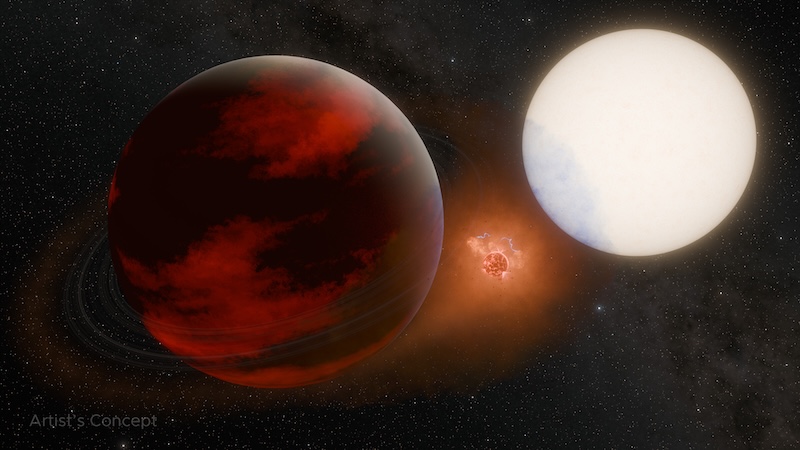
Image (Credit): An artist’s rendering of a volcanic moon orbiting WASP-49 b. (NASA/ JPL-Caltech)
The search for new exoplanets in our galaxy continues, but now it may include the first exomoon. This was something that was expected to occur at some point as the detection methods became better over time.
The exomoon in question is believed to be a volcanic moon orbiting a giant planet about 635 light-years away. Detected using the European Southern Observatory’s Very Large Telescope in Chile, the exomoon is discussed in a paper written by researchers with NASA’s Jet Propulsion Laboratory and Caltech in California. The clue was a cloud of sodium that did not appear to come from the host exoplanet.
The new discovery is being compared to Jupiter’s volcanic moon Io, which is the most volcanically active world in the solar system.
If you want to learn more about exomoons, I recommend a Cool Worlds video narrated by Assistant Professor of Astronomy David Kipping who provides five reasons that the study of exomoons is so important.
NASA has sent a whole host of spacecraft across the Solar System and even beyond. They range from crewed ships to orbit and to the Moon to robotic explorers. Among them are a range of mission classes from Flagships to Discovery Class programs. Now a new category has been announced: Probe Explorers. This new category will fill the gap between Flagship and smaller missions. Among them are two proposed missions; the Advanced X-ray Imaging Satellite and the Probe Far-Infrared Mission for Astrophysics.
It is a major goal of astronomical research to find planets other than Earth that might be suitable for sustaining life. There are a number of factors which many scientists agree are essential to a planet being habitable, but an important one is whether or not a planet has an atmosphere. Scientists have found other rocky, Earth-like exoplanets, but none that we can definitively say have atmospheres. Finding these planets will reveal insights into how such atmospheres are formed and retained, so that we can better predict which planets could be habitable. A study conducted by University of Chicago PhD student Qiao Xue with Prof. Jacob Bean’s group has demonstrated a new way to determine if faraway exoplanets have an atmosphere—and showed that it was simpler and more efficient than previous methods. The new technique, when applied to more planets, has the potential to help us learn more about patterns in atmosphere formation.
A giant wakes as the Sun sets in Western Australia. The workers can finally rest easy after more than a day spent using an enormous crane to lift the colossal 122-tonne, 35-metre diameter reflector dish and crown ESA’s newest deep space communication antenna. With the dish and its quadrupole now installed, ESA is on track to inaugurate its fourth deep-space antenna, and second at the New Norcia site in Australia, by the end of 2025. Referred to as NNO3, the New Norcia 3 antenna will allow spacecraft to send and receive more valuable data collected from onboard scientific instruments and vital flight instructions for mission operations.
The canonical theory for planet formation in circumstellar disks proposes that planets are grown from initially much smaller seeds. The long-considered alternative theory proposes that giant protoplanets can be formed directly from collapsing fragments of vast spiral arms induced by gravitational instability—if the disk is gravitationally unstable. For this to be possible, the disk must be massive compared with the central star: a disk-to-star mass ratio of 1:10 is widely held as the rough threshold for triggering gravitational instability, inciting substantial non-Keplerian dynamics and generating prominent spiral arms. Although estimating disk masses has historically been challenging, the motion of the gas can reveal the presence of gravitational instability through its effect on the disk-velocity structure. Here we present kinematic evidence of gravitational instability in the disk around AB Aurigae, using deep observations of 13CO and C18O line emission with the Atacama Large Millimeter/submillimeter Array (ALMA). The observed kinematic signals strongly resemble predictions from simulations and analytic modelling. From quantitative comparisons, we infer a disk mass of up to a third of the stellar mass enclosed within 1″ to 5″ on the sky.
Citation: Speedie, J., Dong, R., Hall, C. et al. Gravitational instability in a planet-forming disk. Nature 633, 58–62 (2024). https://doi.org/10.1038/s41586-024-07877-0
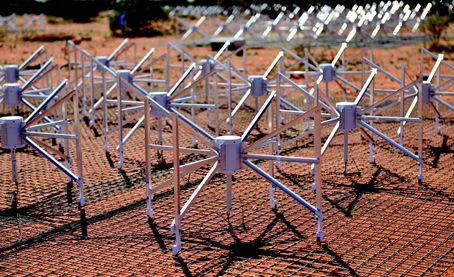
The SETI Institute, the Berkeley SETI Research Center and the International Centre for Radio Astronomy Research announced a groundbreaking study using the Murchison Widefield Array (MWA) in Western Australia. Led by Dr. Chenoa Tremblay of the SETI Institute and Prof. Steven Tingay of Curtin University, this research is the first to search for signs of alien technology in galaxies beyond our own, focusing on low radio frequencies (100 MHz).
This innovative study used the MWA’s large field of view (FOV), allowing the team to cover about 2,800 galaxies in one observation, of which 1300 we know the distance to. Usually, the search for extraterrestrial intelligence (SETI) has focused on signals within our galaxy. This new approach goes further, looking at distant galaxies. This new approach looks at distant galaxies, making it one of the most detailed searches for super civilizations—those more advanced than ours. To send a signal from another galaxy, a civilization would need technology powerful enough to use the energy of their sun or several stars in their galaxy.
NASA needs some help with frozen liquid. As part of the space agency’s planned trip to the moon as part of the Artemis mission, NASA is looking for a way to store “super-chilled” propellants for months on end. They’re asking college students for help. Announced earlier this month, NASA’s 2025 Human Lander Challenge (HuLC) is open for submissions. The competition, now in its second year, is asking for students to develop innovative methods for “in-space cryogenic liquid storage.”
A citizen science project, which invites members of the public to take part in identifying cosmic explosions, has already identified 20 new astronomical discoveries. Over 2,000 volunteers across 105 different countries have worked on 600,000 classifications over a six-month period. The project ‘Kilonova Seekers’ aims to find kilonovae – the cosmic explosions of neutron stars and black holes colliding in distant galaxies. Volunteers are asked to play ‘spot the difference’ using data from the two Gravitational-wave Optical Transient Observer (GOTO) telescopes, which are located on opposite sides of the planet – on La Palma, in Spain’s Canary Islands, and Australia’s Siding Spring Observatory.
Next summer’s program is titled “Exploring the Universe with JWST.” Here is a little more detail on the program:
Since the first release of data from the James Webb Space Telescope (JWST) in July 2022, we have witnessed a transformation in astronomy. VOSS 2025 will present a comprehensive overview of the major JWST results in its first three years (2022-2025), covering the four major scientific themes of JWST: (1) First Light and Reionization, (2) Assembly and Evolution of Galaxies, (3) Birth of Stars and Protoplanetary systems, and (4) Planetary Systems and the Origin of Life. In parallel, we will also provide a series of hands-on tutorials for JWST data processing and analysis. VOSS 2025 will convey the excitement of astronomical research in the era of JWST and the skills to pursue research projects spanning a broad range of themes in astrophysics.
The Catholic Church has come a long way since its treatment of Galileo. This observatory is just one example of the Church’s openness to the world around us.
You can read more about the 2023 summer program from the students themselves in this article.