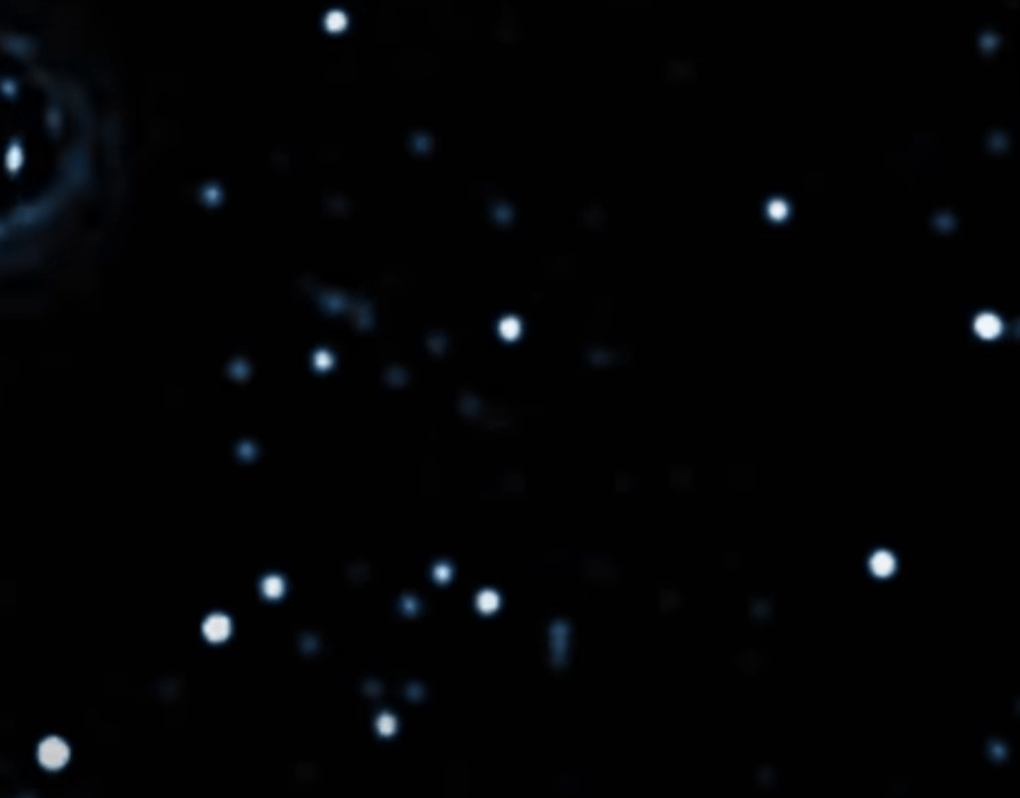
Image (Credit): Image from the Very Large Telescope in Chile showing stars orbiting the supermassive black hole that lies at the heart of the Milky Way. (ESO/MPE)
The earlier article on a black hole binary system was pretty amazing, yet the video accompanying the story was created to demonstrate the phenomena. I found an even more amazing real video of stars orbiting the supermassive black hole at the center or the Milky Way galaxy. You can see the 20-year time-lapse video here from the NaCo instrument on the European Space Telescope’s Very Large Telescope in Chile. This black hole, Sagittarius A*, is about 27 000 light-years away from Earth.
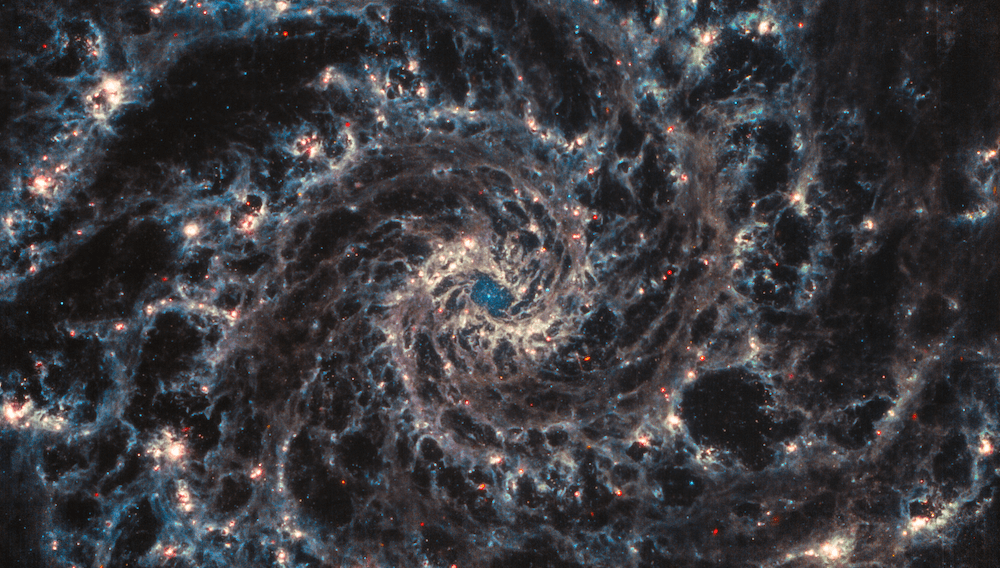
Image (Credit): View from above the spiral galaxy NGC 628. (NASA/ESA/CSA/Judy Schmidt)
Here is another recent images from the James Webb Space Telescope (JWST). This one is a unique close-up view of a spiral galaxy looking from above (or below) rather that from the side. It is NGC 628, which is about 32 million light years away.
You can see more such JWST images by visiting the Physics at High Angular resolution in Nearby GalaxieS (PHANGS) Survey site. The site also includes images from the Hubble Space Telescope, the Spitzer Space Telescope, the Atacama Large Millimeter/submillimeter Array (ALMA), and other sources.
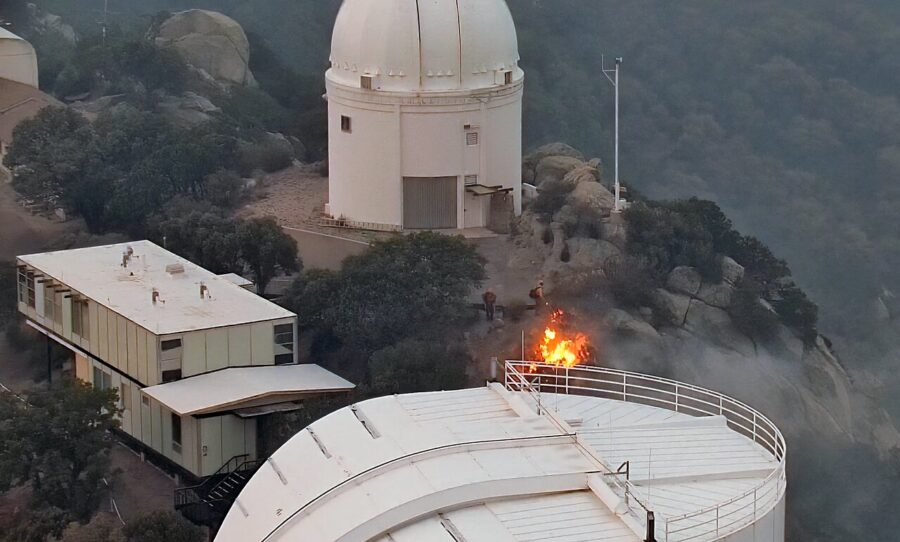
Image (Credit): View from the Nicholas U. Mayall 4-meter Telescope showing the Contreras Fire burning near the summit of Kitt Peak on Thursday 16 June 2022. (KPNO / NOIRLab / NSF / Aura)
Earlier this month, a lightening strike led to a fire in Baboquivari Mountains in southern Arizona, home of the Kitt Peak National Observatory (KPNO). According to news reports, the telescopes themselves are fine, but four “non-scientific” buildings were lost in the fire. Pro-active fire crews were able to prevent greater damage in the area.
This is the latest summary from the blog of the National Science Foundation’s (NSF) NSF’sNational Optical-Infrared Astronomy Research Laboratory (NOIRLab):
Update 21 June pm:
Today the area affected by the Contreras fire increased by 4,401 acres to a total of 24,761 acres. Containment increased to 50% according to the Eastern Area Incident Management Team.
The Team reports that fire around the eastern flank of the summit of Kitt Peak National Observatory is now controlled and they expect to have the northern flank controlled today. The fight is not over for our Tohono O’odham neighbors and we are keeping these communities in our thoughts...
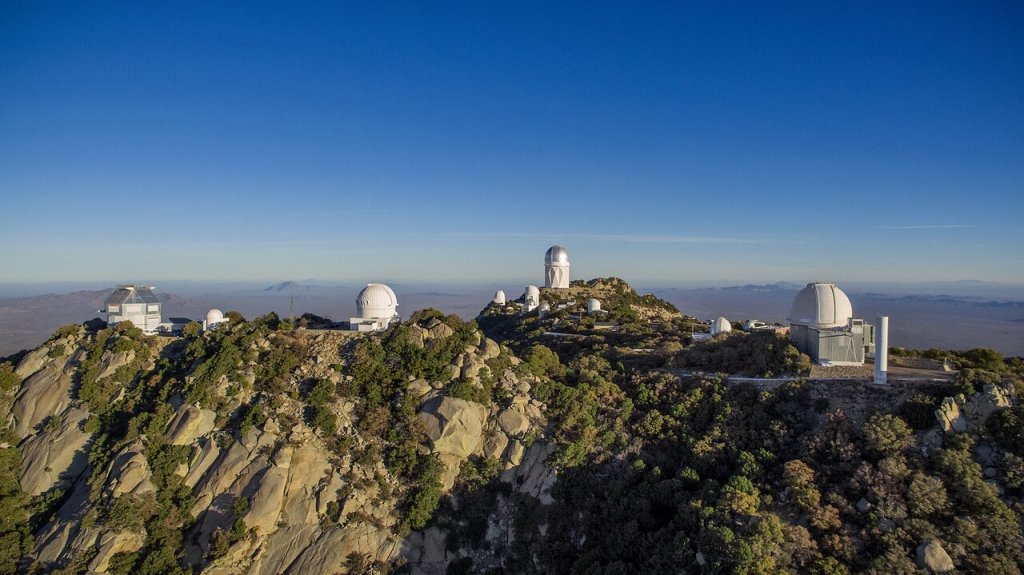
According to the NOIRLab site, the site hosts the Nicholas U. Mayall 4-meter Telescope on behalf of the Dark Energy Spectroscopic Instrument (DESI) survey, the WIYN 3.5-meter Telescope, and the facilities of consortia that operate between them more than a dozen optical telescopes and two radio telescopes. Since the start of COVID, the KPNO has been closed to visitors, so the threat to people in the area reduced.
While the mountains of Arizona offer plenty of benefits for observatories, seasonal fires are also part of the deal. Luckily, the fire crews were there in time to keep Mother Nature in check.
Image (Credit): The Kitt Peak National Observatory in Tucson, AZ, (NSF telescopes from left to right) showing the WIYN 3.5-meter Telescope, the Visitor Center Levine 0.4-meter Telescope, 0.9-meter, Nicholas U. Mayall 4-meter Telescope, and KPNO 2.1-meter Telescope. (NOIRLab)
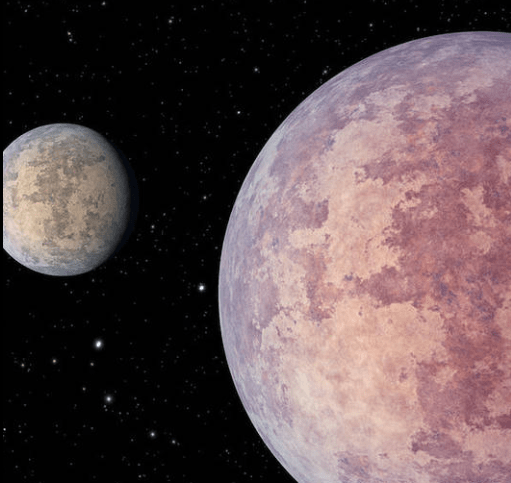
Image (Credit): Artist’s image of two new planets orbiting HD 260655. (NASA)
MIT News reports a star about 33 light years away contains two Earth-like planets, one that is 1.2 times the size of the Earth and the second that is about 1.5 times the size.
The discovery of these exoplanets orbiting the M-dwarf star, named HD 260655, came about when scientists combined data from NASA’s Transiting Exoplanet Survey Satellite (TESS) with data from the High Resolution Echelle Spectrometer (HIRES) in Hawaii and CARMENES at the Calar Alto Observatory in Spain.
While both planets are too close to their sun, and thereby too hot to have liquid water on their surface, they are still objects for further study. The article quotes Michelle Kunimoto, a postdoc in MIT’s Kavli Institute for Astrophysics and Space Research and one of the discovery’s lead scientists:
Both planets in this system are each considered among the best targets for atmospheric study because of the brightness of their star…Is there a volatile-rich atmosphere around these planets? And are there signs of water or carbon-based species? These planets are fantastic test beds for those explorations.
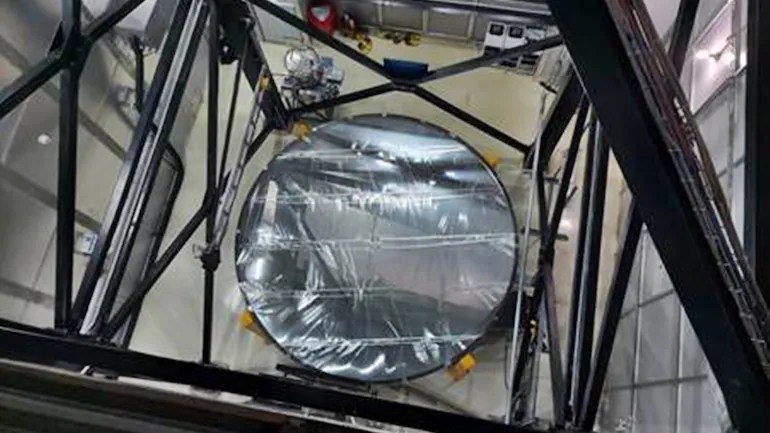
Image (Credit): Top view of the International Liquid Mirror Telescope located at the Devasthal Observatory of the Aryabhatta Research Institute of Observational Sciences showing the liquid mercury mirror covered by a thin mylar film. (India Today)
An earlier post mentioned NASA’s plans for a liquid mirror telescope in space. Well, India now has one here on Earth.
The Indian Expressreports that the liquid mirror telescope was designed and built at the Advanced Mechanical and Optical Systems Corporation and the Centre Spatial de Liege, Belgium. While funded by Canada and Belgium, it will be maintained and operated by India. The article states:
India’s first liquid-mirror telescope, which will observe asteroids, supernovae, space debris and all other celestial objects from an altitude of 2,450 metres in the Himalayas, has seen its first light. It has now entered the commissioning phase and will start scientific observations some time in October this year.
Liquid mirror telescopes have a few advantages, including being inexpensive to build and providing a very efficient way to image a large area of the sky. A disadvantage is that such a telescope must lie flat on Earth and can only observe what passes overhead (unlike space where the lack of gravity may offer other options). Even so, India expects to obtain plenty of information using this new form of telescope.
A new way to view the heavens. This may be the start of something pretty amazing.

 Our Awesome Universe