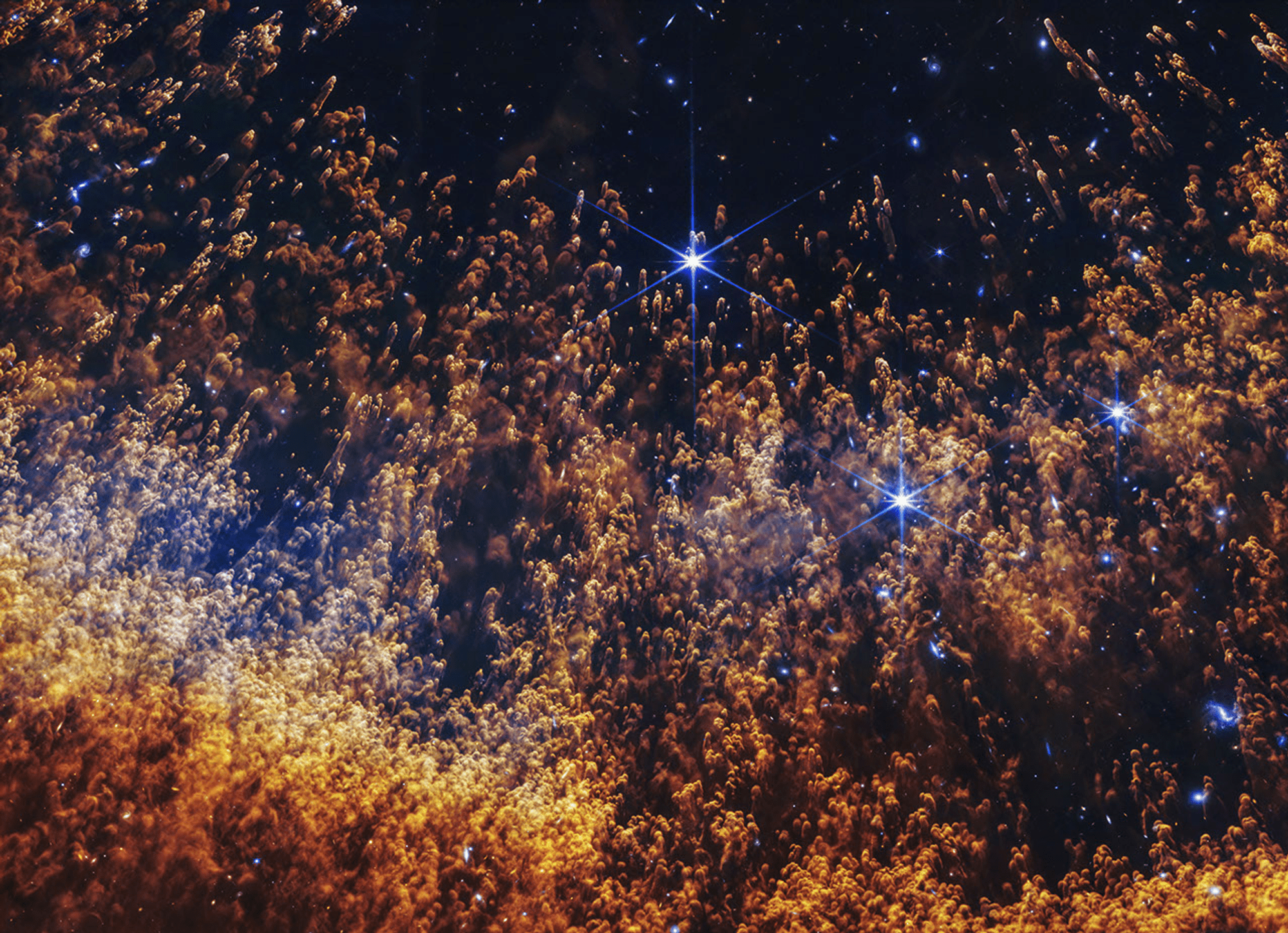
Image (Credit): Part of the Helix Nebula as captured by NASA’s James Webb Space Telescope. (NASA, ESA, CSA, STScI; Image Processing: Alyssa Pagan (STScI))
This week’s image from the James Webb Space Telescope (JWST) shows an up-close view of the Helix Nebula, which is about 650 light years away. Taken by the JWST’s Near-Infrared Camera, we see the colors of the gases moving away from the exploding star.
Here, blistering winds of fast-moving hot gas from the dying star are crashing into slower moving colder shells of dust and gas that were shed earlier in its life, sculpting the nebula’s remarkable structure…A blazing white dwarf, the leftover core of the dying star, lies right at the heart of the nebula…Its intense radiation lights up the surrounding gas, creating a rainbow of features: hot ionized gas closest to the white dwarf, cooler molecular hydrogen farther out, and protective pockets where more complex molecules can begin to form within dust clouds. This interaction is vital, as it’s the raw material from which new planets may one day form in other star systems.
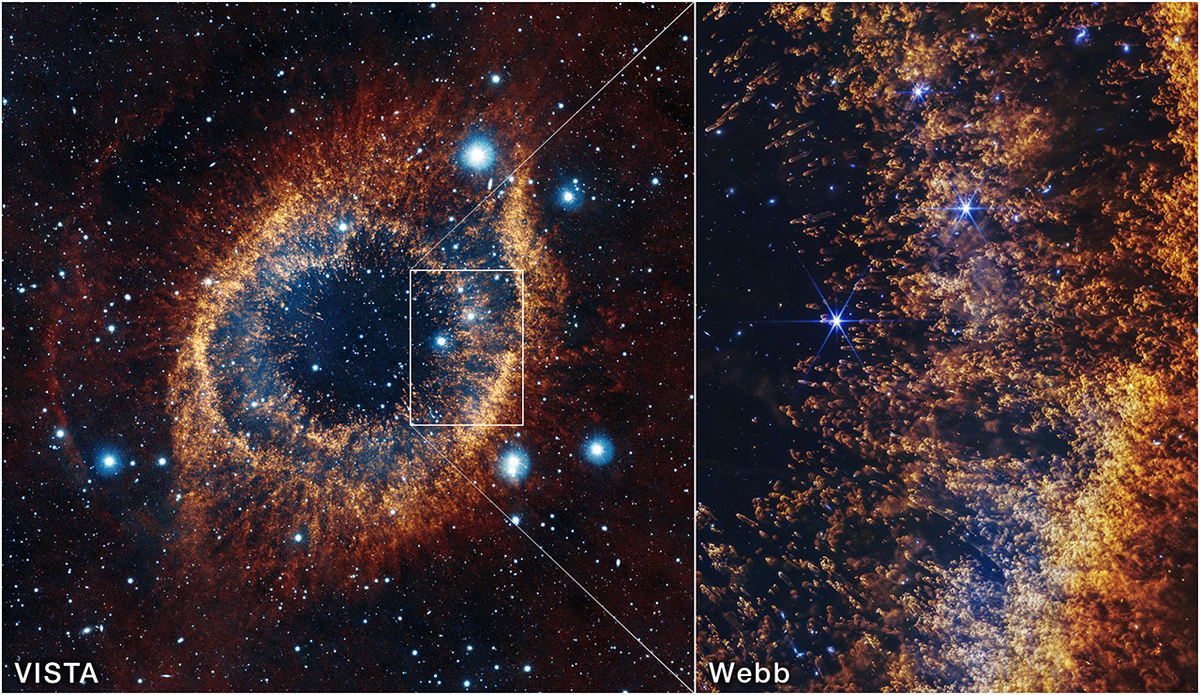
Below is a wider view of the nebula from which the image above is taken.
Image (Credit): The full view of the Helix Nebula, taken by the ground-based Visible and Infrared Telescope for Astronomy as well as the JWST’s more focused view. (ESO, VISTA, NASA, ESA, CSA, STScI, J. Emerson (ESO); Acknowledgment: CASU)
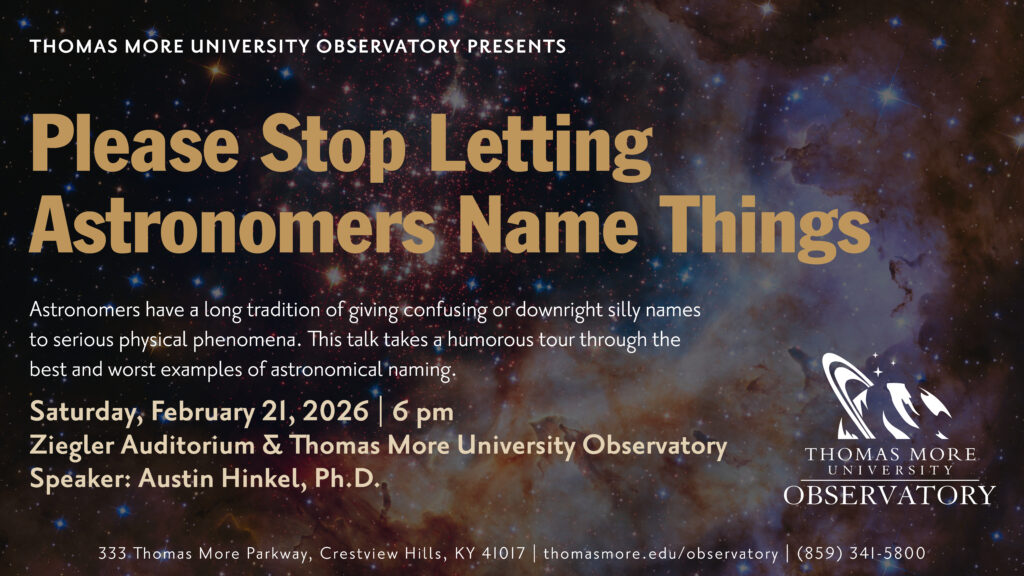
If you happen to be in Kentucky in late February, you may want to visit Thomas More University’s Observatory for a special lecture on astronomy. The lecture is titled “Please Stop Letting Astronomers Name Things,” and it will occur on Saturday, February 21st at 6pm.
Here is the write up for the talk:
From planetary nebulae to spaghettification, astronomers have a long tradition of giving confusing, misleading, or downright silly names to serious physical phenomena. This talk takes a humorous tour through the best and worst examples of astronomical naming. Along the way, we’ll see how names can clarify ideas, confuse students, and occasionally make astronomers cringe.
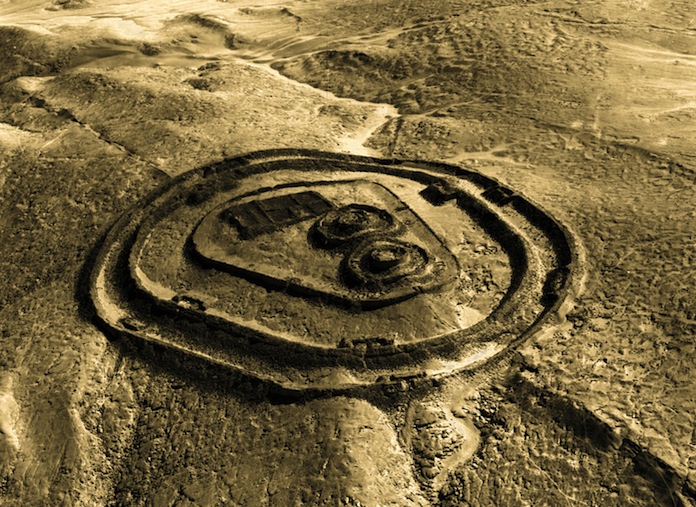
There was a time when Stonehenge was believed to be a kind of “Neolithic computer.” Archaeology has since corrected that misconception. Today, the evidence points strongly in another direction: to an arid hill in the Casma Valley on Peru’s northern coast, about 200 miles north of Lima.There stands Chankillo, a complex built around 250 B.C.E., considered the earliest known solar observatory in the Americas and the clearest known example of a monument designed to track the sun’s position throughout the entire year, according to a study in Science. Modest in appearance and largely absent from tourist posters and classic postcards, Chankillo has renewed attention as archaeologists report preliminary findings from ongoing excavations.
With a space station medical evacuation safely completed, NASA is focused on two challenging missions proceeding in parallel: launching four astronauts on a flight around the moon, at the same time as the agency is planning to send four replacement astronauts to the International Space Station...The Artemis 2 mission and Crew 12’s planned space station flight present a unique challenge for NASA. The agency has not managed two piloted spacecraft at the same time since a pair of two-man Gemini capsules tested rendezvous procedures in low-Earth orbit in 1965. The agency has never flown a deep space mission amid another launch to Earth orbit.
One of the most vivid portraits of “reborn” black hole activity – likened to the eruption of a “cosmic volcano” spreading almost one million light-years across space – has been captured in a gigantic radio galaxy. The dramatic scene was uncovered when astronomers spotted the supermassive black hole at the heart of J1007+3540 restarting its jet emission after nearly 100 million years of silence.
Note: Please ignore the previous posting for today about the Apollo 17 mission. It’s a good story, but I will need to retell it at another time (that is, on December 19th).
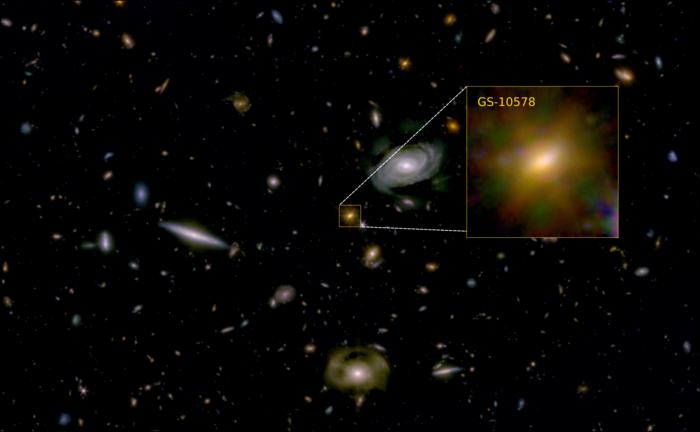
Using observations from the James Webb Space Telescope (JWST) and the Atacama Large Millimeter Array (ALMA), researchers found that a growing supermassive black hole can slowly starve a galaxy rather than destroy it outright.The galaxy, catalogued as GS-10578 and nicknamed Pablo’s Galaxy, existed just three billion years after the Big Bang. Despite this early stage in cosmic history, it is enormous – around 200 billion times the mass of the Sun. Most of its stars formed between 12.5 and 11.5 billion years ago, indicating a rapid burst of star formation before the galaxy suddenly shut down.
Astronomers may have discovered a previously unknown type of astronomical object, nicknamed “Cloud-9,” that could shed light on dark matter, one of the biggest mysteries in the universe. …Cloud-9 is thought to be a dark matter cloud that could be a remnant of galaxy formation from the early days of the universe, according to new research published Monday in The Astrophysical Journal Letters.
The first crewed moon mission in more than 50 years remains on track to launch as soon as Feb. 6. NASA announced on Friday evening (Jan. 9) that it plans to roll the Space Launch System (SLS) rocket and Orion spacecraft that will fly the Artemis 2 moon mission out to the pad for prelaunch checks on Jan. 17, weather and technical readiness permitting.
Image (Credit): The Virgo galaxy cluster as captured by the Vera C. Rubin Observatory. (NSF–DOE Vera C. Rubin Observatory)
This week’s image comes from the Planetary Society’s recent competition to find the best space exploration images. It shows the Virgo galaxy cluster, which was the winning entry. The image was released on June 23, 2025 by the Vera C. Rubin Observatory located in Chile.
The Virgo galaxy cluster is comprised of anywhere between 1,300 and 2,000 galaxies. What you can see in this image is an impressive array of galaxies, some of them intertwined. How many different worlds within this cluster may be peering back at us? Of course, the Virgo galaxy cluster is 65 million light-years away, so the image of the Milky Way appearing on their telescopes right now was from the time when dinosaurs still walked on the Earth.


 Our Awesome Universe