Space Stories: Rocket Lab Launched Japanese Satellites, Progress 95 Cargo Arrives at ISS, and Interstellar Comet Contains Surprises

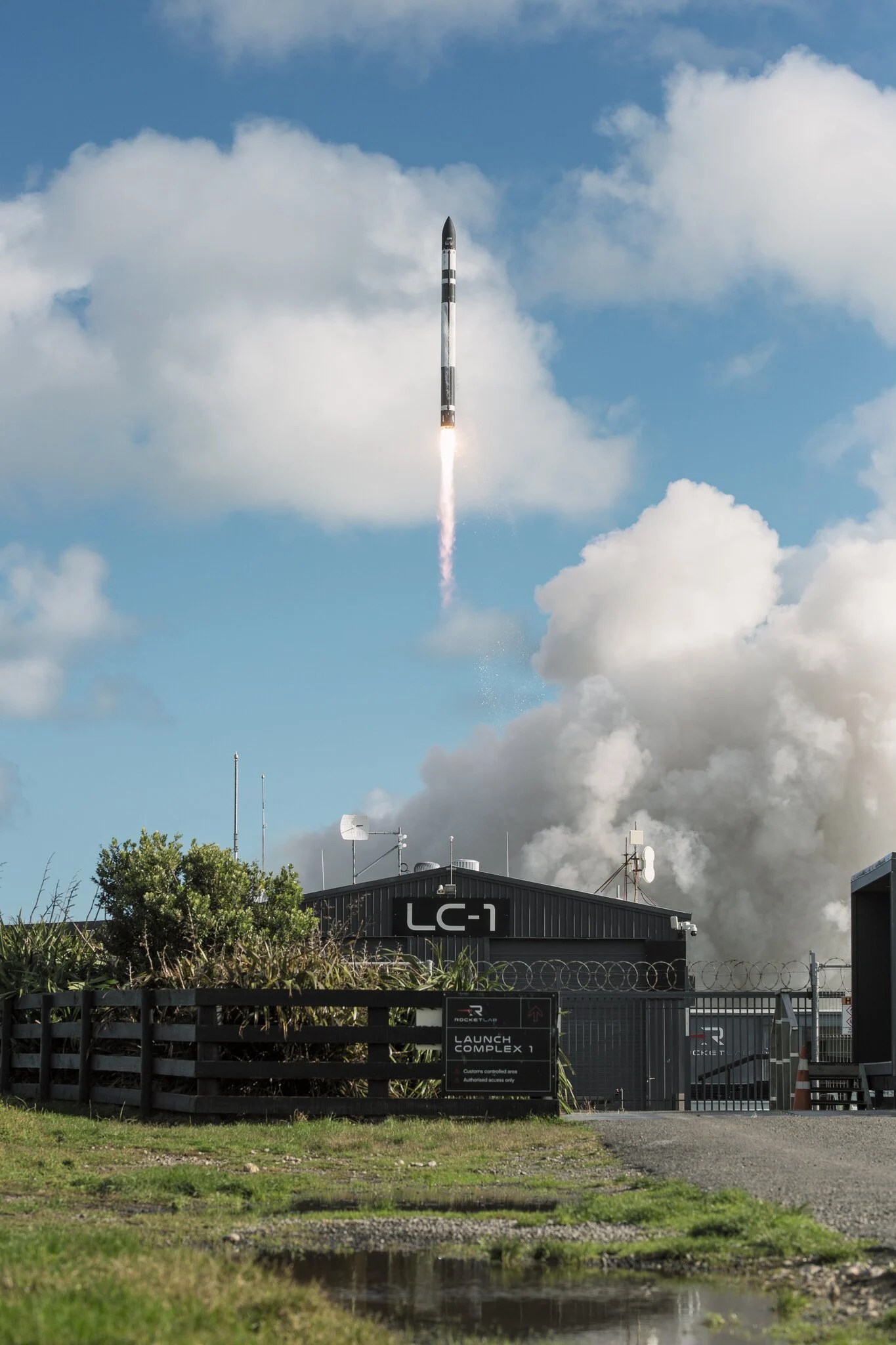
Image (Credit): The “Kakushin Rising” mission lifted off from Rocket Lab Launch Complex 1 in New Zealand on April 23, 2026. (Rocket Lab)

Here are some recent space-related stories.

—Rocket Lab: “Rocket Lab Completes Second Dedicated Launch for Japan Aerospace Exploration Agency (JAXA)“

The “Kakushin Rising” mission lifted off from Rocket Lab Launch Complex 1 in New Zealand at 3:09 p.m. NZT to successfully deploy eight spacecraft for JAXA’s Innovative Satellite Technology Demonstration Program that included educational small sats, an ocean-monitoring satellite, a demonstration satellite for ultra-small multispectral cameras, and a deployable antenna packed tightly using origami folding techniques that can unfurl up to 25 times its size. “Kakushin Rising” builds on the success of Rocket Lab’s first dedicated launch for JAXA that took place in December 2025, which saw Electron deploy the RAISE-4 spacecraft that demonstrated new aerospace technologies developed by several companies, universities, and research institutions throughout Japan.

—NASA: “Progress 95 Cargo Craft Docks to Station with Food, Fuel, and Supplies“

The uncrewed Roscosmos Progress 95 spacecraft docked to the aft port of the International Space Station’s Zvezda module at 8 p.m. EDT Monday. The spacecraft is delivering about three tons of food, fuel, and supplies for the Expedition 74 crew. It will remain docked to the orbiting laboratory for about six months before departing for a planned destructive re-entry into Earth’s atmosphere to dispose of trash loaded by the crew.

—National Radio Astronomy Observatory: “3I/ATLAS Contains 30X More Semi-Heavy Water Than Comets In Our Solar System“

New observations of the interstellar comet 3I/ATLAS include the first measurement of the abundance of deuterated water relative to ordinary water in an interstellar object. Astronomers using the Atacama Large Millimeter/submillimeter Array (ALMA) discovered that the interstellar comet 3I/ATLAS is made of an astonishingly high ratio of semi-heavy water relative to water, indicating that its system of origin likely formed under conditions far colder than our own.

Space Stories: A New Type of Telescope to Spot Exoplanets, Walking Martian Robots, and Terraforming Mars in 15 Years

Image (Credit): An artist’s rendering of the ExoLife Finder telescope. (Astronomy.com)

Here are some recent space-related stories.

—Astronomy.com: “Could this Telescope Find Life on Alien Worlds?“

The ExoLife Finder (ELF) looks like no telescope ever built. A spectacular crown of 15 five-meter mirrors perches atop a sprawling metal lattice, resembling petals on a 10-story-tall mechanical flower — more sculpture than observatory. It is a fundamentally new type of telescope, one that its designers say could discover life on Earth-like planets beyond our solar system. The radical design is the brainchild of astrophysicist Jeff Kuhn of the University of Hawai‘i. For now, it exists only in renderings. To build it, Kuhn and the team he’s assembled must first develop and perfect techniques and technologies never before used in astronomy.

—EarthSky: “Walking Robots on Mars Could Speed Up Life Search“

Robotic rovers have become the go-to way to explore our neighbor planet, Mars. And they’ve been super successful. But they’re also big, heavy and slow. They have to move carefully across the rocky and sandy terrain of Mars. Plus, communication delays between the rovers and Earth – and data transfer limitations – also affect their missions. Is there a better way? On March 31, 2026, researchers in Switzerland and the Netherlands announced a new idea: walking Mars robots. The research team said these robotic explorers would be semi-autonomous. This means they wouldn’t need regular assistance from humans back on Earth. And, their makers say, they could explore their surroundings – on both Mars or the moon – faster than rovers.

—The Times of India: “Mars Could be Warm Enough for Humans in 15 Years; A Discovery that Changes Everything“

Mars has been viewed as a multi-millennial effort to terraform since the inception of the term, but there is new evidence that the time frame has changed dramatically. A published study in Science Advances gives new hope to those wishing to terraform Mars through nanoscopic engineered aerosol-like dust particles made from iron and aluminium found abundantly in the soils of Mars. Specifically, scientists feel that if we inject these engineered aerogels into the atmosphere, the resulting greenhouse effect will raise Mars’ surface temperature by over 50 degrees Fahrenheit in only 15 years.

Space Stories: The Fate of Juno, the End of a NASA Probe, and “Extragalactic Archeology”

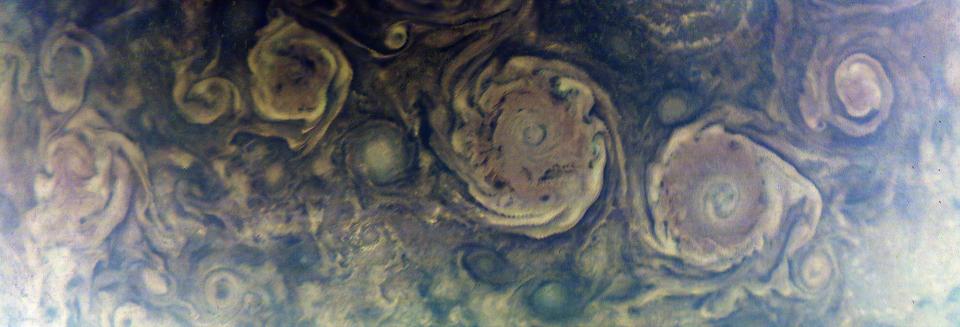
Image (Credit): Jupiter’s North Pole at minimum emission angle as captured by the Juno spacecraft. (NASA/JPL-Caltech/SwRI/MSSS/Thomas Thomopoulos)

Here are some recent space-related stories of interest.

—Ars Technica: “A Mission NASA Might Kill is Still Returning Fascinating Science from Jupiter“

Jupiter’s colossal storms generate lightning flashes at least 100 times more powerful than those on Earth, according to scientists analyzing data from NASA’s Juno spacecraft. The findings were published March 20 in the journal AGU Advances. Researchers used data recorded by Juno in 2021 and 2022, after NASA granted an extension to the spacecraft’s operations upon completing a five-year science campaign at Jupiter. Juno remains in good health, but NASA officials have not said if they will approve another extension for the mission. The issue is money.

—Astronomy.com: “NASA’s Van Allen Probe A Burns Up Over the Pacific after 14 Years in Space“

NASA’s Van Allen Probe A re-entered Earth’s atmosphere on Wednesday, March 11, at 6:37 a.m. EDT, marking the final chapter for a spacecraft that reshaped scientists’ understanding of the radiation environment around our planet. The U.S. Space Force confirmed the spacecraft came down over the eastern Pacific Ocean. NASA said most of the 1,300-pound (600 kilograms) probe burned up during reentry, though some pieces may have reached the surface. Its twin, Probe B, remains in orbit and is not expected to re-enter before 2030. The twin probes launched together on Aug. 30, 2012, on what was supposed to be a two-year mission. They operated for nearly seven years instead, circling Earth inside the Van Allen radiation belts — zones of high-energy charged particles held in place by the planet’s magnetic field. 

—Carnegie Science: ““Extragalactic Archeology” Reveals Nearby Galaxy’s Evolution“

A team of astronomers, including Carnegie Science’s Jeff Rich and other former Carnegie Observatories astronomers, have for the first time traced the history of a galaxy outside our own Milky way by studying chemical fingerprints in deep space, a new approach they are calling “extragalactic archeology.” Their findings are published in Nature Astronomy. “This is the first time that a chemical archaeology method has been used with such fine detail outside our own galaxy,” said lead author Lisa Kewley of the Center for Astrophysics | Harvard and Smithsonian.

Space Stories: Rubin Observatory Data Alerts, Upcoming Total Lunar Eclipse, and Exoplanet Astronomer Murdered

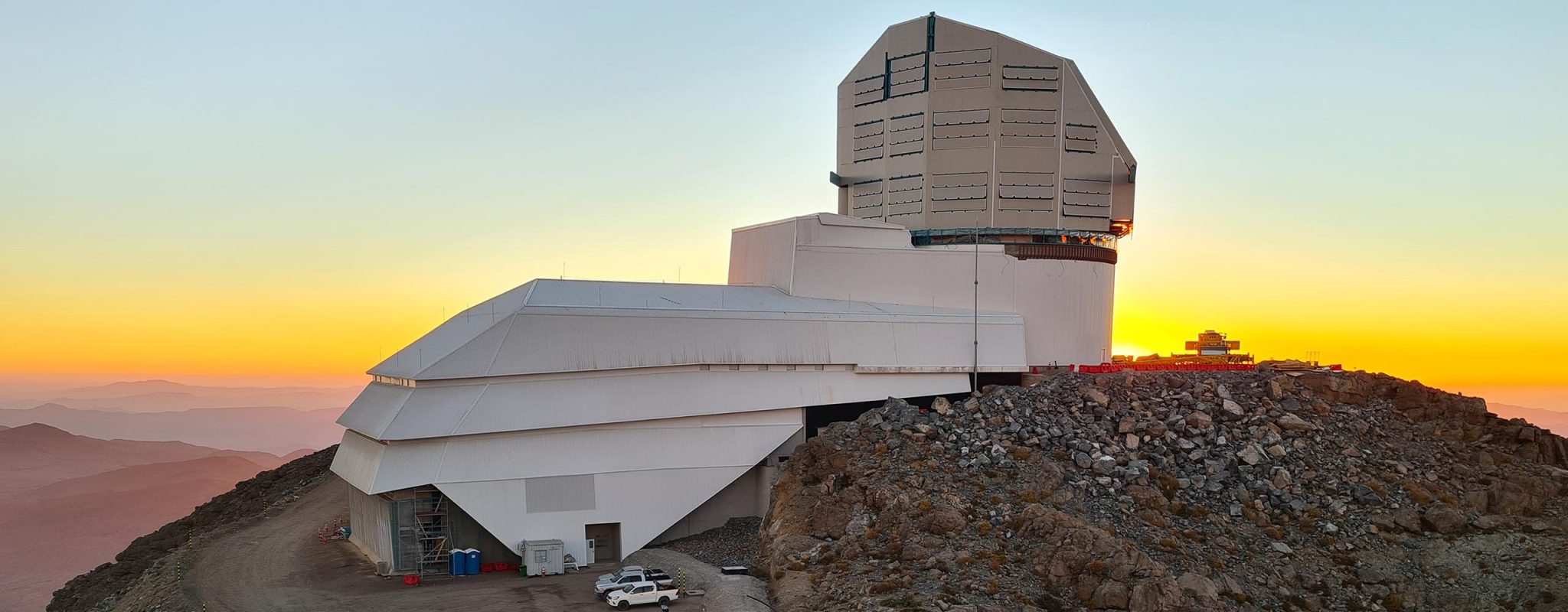
Image (Credit): The Rubin Observatory. (Rubin Obs./NSF/AURA)

Here are some recent space-related stories of interest.

—GeekWire: “Rubin Observatory Sends Out Thousands of Data Alerts with an Assist from Seattle Astronomers“

An astronomical alert system developed at the University of Washington started off with a bang this week, sending out 800,000 notifications about moving asteroids, exploding stars and other celestial changes detected by the Vera C. Rubin Observatory in Chile. Tuesday night’s surge was just the first wave of alerts. Eventually, the Alert Production Pipeline is expected to produce up to 7 million alerts per night. Astronomers around the globe will use the system to sift through the torrent of data, zeroing in on events ranging from newly detected asteroids to supernovas, variable stars and active galactic nuclei.

—Sky&Telescope: “Get Ready for the March 3, 2026, Predawn Total Lunar Eclipse“

On Tuesday, March 3rd, the full Moon glides through the darkest portion of Earth’s shadow, called the umbra, to create a dramatic total lunar eclipse. In the Western Hemisphere, the event occurs in the hours before dawn, while across Asia it happens during the evening. During the eclipse, Earth’s shadow is seen gradually edging across the face of the full Moon until the entire lunar disk glows deep orange or red. Then the sequence of events unfolds in reverse order, until the shadow leaves the lunar disk completely and the Moon returns to full brilliance.

—Futurism: “Astronomer Who Discovered Water on Distant Planet Murdered Outside Home“

A renowned Caltech astronomer who studied distant exoplanets was shot and killed outside his home in a rural area near Los Angeles, the LA Times reported…Among his most notable contributions to the field was leading research published in 2007 that, for the first time, captured enough light from distant exoplanets to identify the molecules in their atmospheres…and soon made the “monumental” discovery of detecting signs of water on another planet.

More Satellites Planned by Iran

Credit: Image by 政徳 吉田 from Pixabay

Just as we deal with more and more satellites from SpaceX, Amazon, Europe, and the Chinese, creating an increasing amount of orbital pollution, we now have to contemplate Iran adding thousands more satellites to this number.

According to the Tehran Times, Iran is looking to create its own internet satellite system similar to Starlink. Hassan Salarieh, the head of the Iranian Space Agency, stated:

To develop satellite constellations to offer ‘wideband’ services in low Earth orbit (LEO) requires a large number of satellites. Based on the altitude of the orbit and the type of design, sometimes it would be necessary to inject several thousand satellites into the orbit to achieve full coverage.

This is the same country that shut down its entire internet system recently to thwart protesters, only to find that the US was smuggling Starlink terminals into Iran. So one can only assume the government will be keeping close tabs on any internet service, be it ground-based or satellite-based.

Whatever the case, the continued proliferation of such systems will only put greater strains on Earth-based astronomy.