Image (Credit): Earlier photo of the RT-70 radio telescope. (PickPic)
The Urania newspaper Euromaiden Press recently noted the success of its navy in taking out Russian assets, including:
the Utios-T radar system;
the RT-70 radio telescope;
the GLONASS satellite navigation system in its dome;
the coastal radar station MR-10M1 “Mys” M1; and
the 96L6-AP radar of the S-400 missile system.
One of those items is not like the others, that being the Yevpatoria RT-70 radio telescope.
This Soviet-era radio telescope was one of the largest in the world, assisted with the study of Mars and Venus, and was used for messaging extraterrestrial intelligence, also known as METI.
Now it is rubble due to the ongoing war between Ukraine and Russia (the destroyed radio telescope is located in Russian-occupied Ukrainian territory).
We saw World War II introduce the power of rocket technology that sent us around the solar system, and now we are watching another war show how all that we have built can quickly crumble.
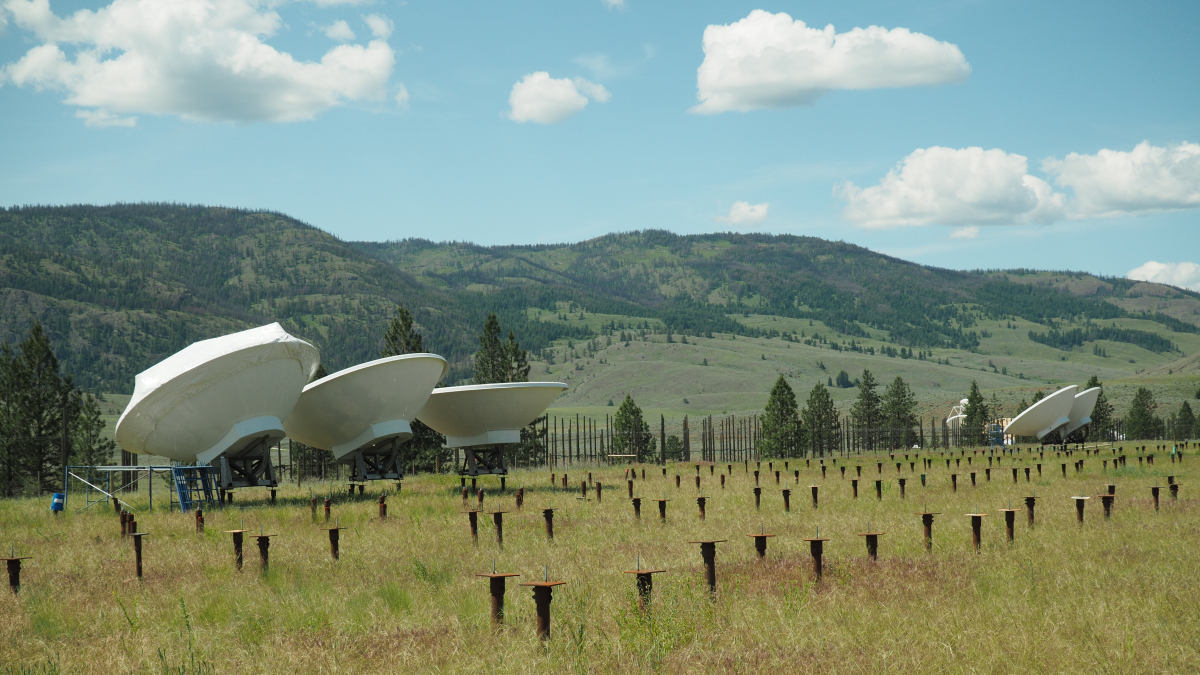
Construction is underway of CHORD, the most ambitious radio telescope project ever built on Canadian soil. Short for the Canadian Hydrogen Observatory and Radio-transient Detector, CHORD will give astronomers an unprecedented opportunity to explore some of the most exciting and mysterious questions in astrophysics and cosmology, from Fast Radio Bursts (FRBs) and dark energy to the measurements of fundamental particles, and beyond.
It’s human to feel alarmed by the sheer emptiness of space. Now, astronomers from the University of Portsmouth in the UK suggest this unsettling vastness may be worse than we thought. They reckon Earth, our entire Solar System and even our entire Milky Way sits inside a mysterious giant hole. This void, they believe, may cause the cosmos to expand more quickly in our local environment than in other parts of the Universe.
After the formation of the Solar System, it took a maximum of three million years for the chemical composition of the Earth’s precursor to be completed. This is shown by a new study by the Institute of Geological Sciences at the University of Bern. At this time, however, there were hardly any elements necessary for life such as water or carbon compounds on the young planet. Only a later planetary collision probably brought water to Earth, paving the way for life.
Image (Credit): Mar’s moon Phobos. (NASA / JPL-Caltech / University of Arizona)
On this day in 1877, American astronomer Asaph Hall discovered the Martian moon Phobos while at the US Naval Observatory in Washington, D.C. He had discovered Mar’s other moon Deimos six days earlier.
Oddly enough, the idea of two moons orbiting Mars was first proposed in 1726 by Jonathan Swift in his tale Gulliver’s Travels. In the book, astronomers on the flying island of Laputia were noted to have
… discovered two lesser stars, or satellites, which revolve around Mars, whereof the innermost is distant from the center of the primary exactly three of his diameters, and the outermost five: the former revolves in the space of ten hours, and the latter in twenty-one and a half.
All Professor Hall had to do was confirm the work of the Laputian astronomers.
A team of astronomers has found evidence of a candidate gas giant planet orbiting Alpha Centauri A, a Sun-like star in the closest stellar system to our own. Initial observations hinting at the planet’s existence were made in August 2024 using data from the James Webb Space Telescope (JWST). The Alpha Centauri system is located just 4 light-years from Earth. The findings, detailed in twopapers accepted for publication in The Astrophysical Journal Letters, could represent a major milestone. As Charles Beichman of NASA’s Jet Propulsion Laboratory noted in a JWST news release, “With this system being so close to us, any exoplanets found would offer our best opportunity to collect data on planetary systems other than our own.”
Pope Leo XIV has appointed a new head astronomer to run the Vatican Observatory, one of the oldest scientific observatories in the world. Rev. Richard D’Souza, 47, will succeed Guy Consolmagno, an American physicist who was known as the “pope’s astronomer” for ten years. Both men are members of the Jesuit Order.
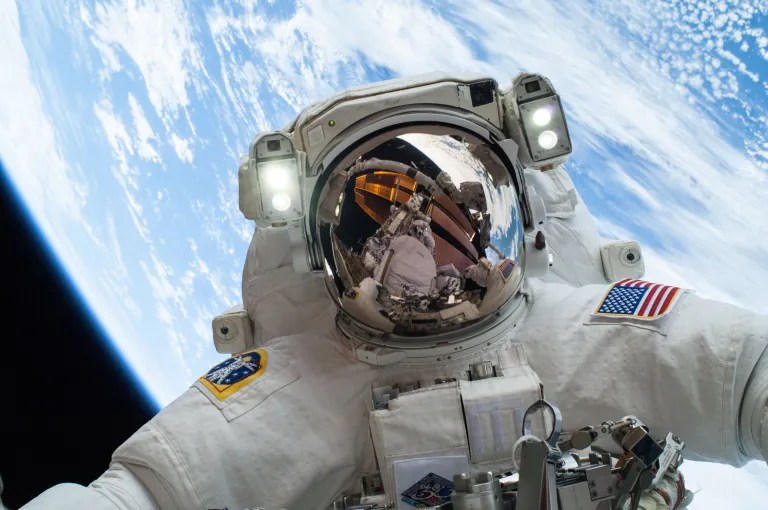
After nearly six months onboard the International Space Station (ISS), the four astronauts of NASA’s SpaceX Crew-10 mission have safely returned to Earth. This weekend’s splashdown off the coast of California concludes a long-duration science expedition that supported dozens of investigations sponsored by the ISS National Laboratory. NASA astronauts Anne McClain and Nichole Ayers, Japan Aerospace Exploration Agency (JAXA) astronaut Takuya Onishi, and Roscosmos cosmonaut Kirill Peskov played a vital role in advancing science in space, contributing to biomedical research, physical and materials sciences, technology demonstrations, and student-led experiments. Their work helped push the boundaries of discovery in low Earth orbit (LEO) The orbit around the Earth that extends up to an altitude of 2,000 km (1,200 miles) from Earth’s surface. The ISS’s orbit is in LEO, at an altitude of approximately 250 miles. to benefit life on Earth and support a sustainable and robust space economy.
NASA and its partners have supported humans continuously living and working in space since November 2000. A truly global endeavor, the International Space Station has been visited by more than 280 people from 23 countries and a variety of international and commercial spacecraft. The unique microgravity laboratory has hosted more than 4,000 experiments from more than 5,000 researchers in more than 110 countries. The space station also is facilitating the growth of a commercial market in low Earth orbit for research, technology development, and crew and cargo transportation.
Using the Atacama Large Millimeter/submillimeter Array (ALMA), a team of astronomers led by Abubakar Fadul from the Max Planck Institute for Astronomy (MPIA) has discovered complex organic molecules – including the first tentative detection of ethylene glycol and glycolonitrile – in the protoplanetary disc of the outbursting protostar V883 Orionis. These compounds are considered precursors to the building blocks of life. Comparing different cosmic environments reveals that the abundance and complexity of such molecules increase from star-forming regions to fully evolved planetary systems. This suggests that the seeds of life are assembled in space and widespread.
Curtin University researchers have undertaken the world’s biggest survey of low frequency satellite radio emissions, finding Starlink satellites are significantly interfering with radio astronomy observations, potentially impacting discovery and research. Unintended signals from satellites – leaked from onboard electronics – can drown out the faint radio waves astronomers use to study the universe.




 Our Awesome Universe