Space Stories: More Water on Mars, Senators Want Mars Sample Returned to Earth, and the ESA Considers Mission to Enceladus

Here are some recent stories of interest.

Euronews: Photos from NASA’s Curiosity Rover Suggest Mars had More Water for Longer Than Previously Thought

Scientists say Mars may have had more water and stayed wet for longer than they had previously estimated based on photos from NASA’s Curiosity rover. An international team of researchers led by Imperial College London recently found unusual formations in rock and sediment in unexpected places in the crater. The rocks allow scientists to compare the evolving geology of Mars with Earth.

U.S. Senate: Padilla, Butler Urge NASA to Fully Fund Mars Sample Return Program

Today, U.S. Senators Alex Padilla and Laphonza Butler (both D-Calif.) wrote to NASA Administrator Bill Nelson urging him to allocate the full $650 million necessary to fund the Mars Sample Return (MSR) mission in NASA’s FY24 spending plan. The Senators are issuing the letter following the passage of the FY 2024 appropriations package, which reiterated Congress’ strong commitment to the MSR mission.

European Space Agency: Saturn’s Moon Enceladus Top Target for ESA

A fresh, icy crust hides a deep, enigmatic ocean. Plumes of water burst through cracks in the ice, shooting into space. An intrepid lander collects samples and analyses them for hints of life. ESA has started to turn this scene into a reality, devising a mission to investigate an ocean world around either Jupiter or Saturn. But which moon should we choose? What should the mission do exactly? A team of expert scientists has delivered their findings...Aiming for transformational science, considering the characteristics of each moon and future planned missions to Jupiter and Saturn’s ocean worlds, the scientists identified Saturn’s moon Enceladus as the most compelling target, followed by Saturn’s moon Titan and then Jupiter’s moon Europa.

Space Stories: Satellite Returns to Earth, Watching the Moon Landing, and Kuiper Belt Surprises

Image (Credit): Artist’s rendering of the European Space Agency’s (ESA) Earth Remote Sensing satellite. (ESA/dpa/picture alliance)

Here are some recent stories of interest.

BBC: Pioneering European ERS-2 Satellite Burns Up Over Pacific

The two-tonne ERS-2 spacecraft burnt up in the atmosphere over the Pacific. So far, there have been no eyewitness accounts of the mission’s demise or of any debris reaching Earth’s surface. ERS-2 was one of a pair of missions launched by the European Space Agency in the 1990s to study the atmosphere, the land and the oceans in novel ways. The duo monitored floods, measured continental and ocean-surface temperatures, traced the movement of ice fields, and sensed the ground buckle during earthquakes.

ForbesNASA To Live-Stream Spacecraft Odie’s Moon Landing Thursday. Here’s How To Watch

Houston-based Intuitive Machines is targeting 5:49 p.m. EST on Thursday, February 22, to put its Odysseus lunar lander on the surface of the moon—and it will be streamed live on NASA TV on YouTube. The first U.S. commercial moon lander, Odysseus—also known by its nickname “Odie”—will touchdown near a crater called Malapert A in the south pole region of the moon. If successful, this IM-1 mission—which is taking a scientific payload to the moon—will be the first spacecraft from the U.S. to land on the moon since Apollo 17 in December 1972.

Science Alert: NASA’s New Horizons Discovered a Large Surprise in The Kuiper Belt

There may be a lot more than we thought to the belt of icy debris that circles the outer Solar System. Data from the New Horizons probe as it sails serenely through the Kuiper Belt hints at unexpected levels of particles where dust ought to be thinning out, suggesting the donut-shaped field extends significantly farther from the Sun than previous estimates suggest.

Space Stories: Preparing for a Commercial Space Station, Ukraine Protests New ISS Crew, and Metal 3D Printing in Space

Image (Credit): Artist’s rendering of the Starlab commercial space station in orbit. (Starlab Space)

Here are some recent stories of interest related to space stations.

SpaceNews: Starlab Commercial Space Station to Launch on Starship

Starlab Space, the joint venture developing the Starlab commercial space station, has selected SpaceX’s Starship to launch the station on a single flight. Starlab Space, a joint venture of Voyager Space and Airbus Space and Defence, announced Jan. 31 it reached an agreement with SpaceX to launch the Starlab station on Starship. The companies did not disclose terms of the agreement or a projected launch date, although a spokesperson for Starlab Space said the company was confident that Starlab would be launched before the decommissioning of the International Space Station, currently scheduled for 2030.

Kyiv Post: Ex-Russian Military Officer Joins NASA for ISS Mission; Ukrainian Outrage Follows

Alexander Grebenkin, a former Russian military officer and current Roscosmos cosmonaut, is set to travel to the International Space Station as part of the NASA team, as announced on the NASA website, where Ukrainians have commented their outrage. NASA, in collaboration with SpaceX, plans to launch Crew-8 to the International Space Station no earlier than Thursday, Feb. 22.

Aviation Week Network: European Space Agency Launches ‘First’ Metal 3D Printer To ISS

The European Space Agency (ESA) has launched what it says is the “first metal 3D printer” to be hosted on the International Space Station (ISS). While plastic 3D printers have been used aboard the ISS since 2014, a machine that prints stainless steel would be new and could allow astronauts greater self-sufficiency, including the ability to make complex metallic structures in orbit, as well as at future Moon and Mars bases, ESA said Jan. 30.

The ISS is Getting Pretty Crowded

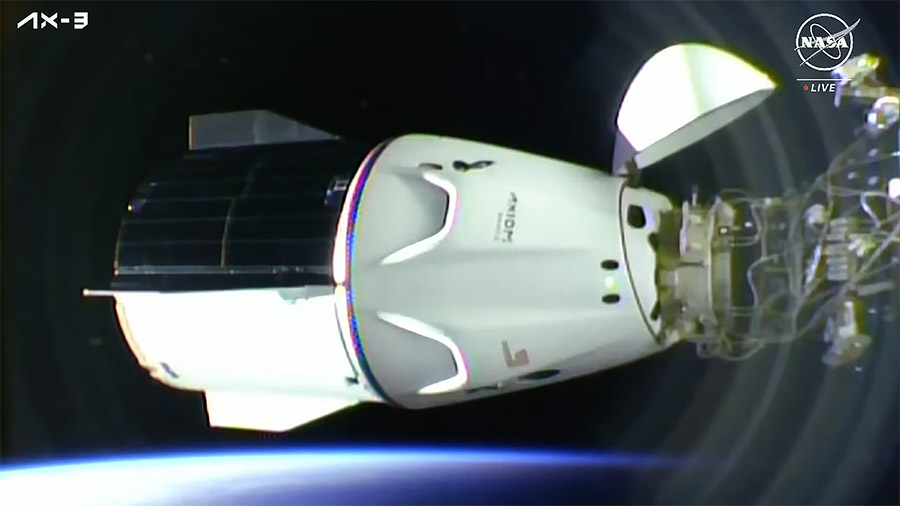
Image (Credit): The SpaceX Dragon Freedom spacecraft, which is carrying four Axiom Mission 3 crew members, docking to the space station shortly after an orbital sunrise. (NASA TV)

The seven real astronauts on the International Space Station (ISS) are now playing host to four visitors for the next two weeks after the Axiom Mission 3 crew came aboard the station earlier today.

Unlike the last two Axiom missions, all three paying members of the Axiom Mission crew are being supported by various European governments:

  • Marcus Wandt, member of the European Space Agency’s (ESA) astronaut reserve (ticket paid by ESA and the Swedish National Space Agency);
  • Walter Villadei, a member of the Italian air force (ticket paid by the Italian air force); and
  • Alper Gezeravcı, a fighter pilot with the Turkish air force (ticket paid by the Turkish government).

At the price of $55 million per seat, I am hoping the governments and space agencies feel they are getting their money’s worth versus being part of the normal 6-month astronaut rotation.

Supposedly, the extra hands will be working on 30 experiments that the normal crew did not have time for, though I would imagine they would be the less important experiments if they would otherwise not be performed at all.

If all of this is truly important work, then I expect such demand will justify the need for commercial space stations down the line to continue the work of the ISS. However, I expect a good chuck of future space interest will come from the tourist side.

In the meantime, I just hope the toilets on board the ISS can deal with the extra passengers.

Note: So as not to give all the attention to the visitors, the current Expedition 70 crew members aboard station are:

  • NASA astronauts Jasmin Moghbeli and Loral O’Hara;
  • ESA astronaut Andreas Mogensen;
  • JAXA (Japan Aerospace Exploration Agency) astronaut Furukawa Satoshi; and
  • Roscosmos cosmonauts Konstantin Borisov, Oleg Kononenko, and Nikolai Chub.

Pic of the Week: Dwarf Irregular Galaxy UGC 8091

Image (Credit): The Hubble Space Telescope’s view of Galaxy UGC 8091. ( ESA/Hubble, NASA Y. Choi (NOIRLab), K. Gilbert (Space Telescope Science Institute), J. Dalcanton (Flatiron Institute and University of Washington))

The image this week is from the NASA/European Space Agency’s (ESA) Hubble Space Telescope. It shows an irregular dwarf galaxy, UGC 8091, that is about seven million light-years away. What I see appears to be jellyfish within some cloudy water. I also the variety of other galaxies you can see throughout the image (see below).

Here is a little more about the image from ESA:

A collection of stars and galaxies fill the scene against a dark background. The image is dominated by a dense collection of stars that make up the irregular galaxy UGC 8091. The stars span a variety of colours, including blue and orange, with patches of blue occupying the central part of the galaxy. There are also visible circular regions of red/pink gas within the galaxy.

Image (Credit): Section of the above image – upper left hand corner. (ESA/Hubble, NASA Y. Choi (NOIRLab), K. Gilbert (Space Telescope Science Institute), J. Dalcanton (Flatiron Institute and University of Washington))