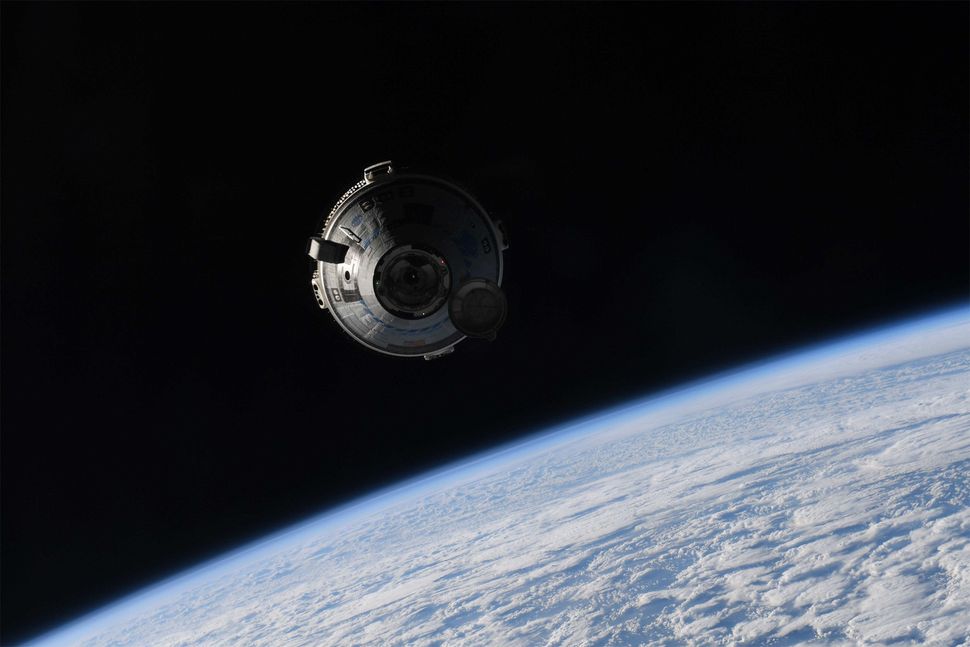
Image (Credit): Boeing’s Starliner approaching the ISS. (Samantha Cristoforetti/European Space Agency)
The return of the two astronauts from the earlier Starliner mission has been bumped a few times now, with the latest return scheduled for this Saturday (June 22).
The Boeing Starliner arrived at the International Space Station with thruster problems, and then encountered further helium leaks after that, so the need for additional time to study the issue makes some sense. NASA will address the status of the mission requirements and weather conditions at a press conference tomorrow (June 18).
It took long enough to get the two astronauts to the ISS after many delays, so maybe should not surprise anyone that we have a few delays on the return.
Boeing needs good press these days, so a quick and simple mission would have been nice. Yet this would be a bad time to throw caution into the wind when they are so close to the finish line.
Image (Credit): Frosty summit of Mar’s Olympus Mons. (ESA/DLR/FU Berlin)
This week’s image is from the European Space Agency (ESA) and shows Olympus Mons on Mars, the tallest volcano in the solar system. Captured by ESA’s Mars Express, it shows water frost close to the planet’s equator, which was unexpected.
Colin Wilson, ESA project scientist for both ExoMars Trace Gas Orbiter and Mars Express, stated:
Finding water on the surface of Mars is always exciting, both for scientific interest and for its implications for human and robotic exploration…Even so, this discovery is particularly fascinating. Mars’s low atmospheric pressure creates an unfamiliar situation where the planet’s mountaintops aren’t usually colder than its plains – but it seems that moist air blowing up mountain slopes can still condense into frost, a decidedly Earth-like phenomenon.
NASA and SpaceX are planning for the possibility of modifying the Artemis III mission. Instead of landing on the Moon, a crew would launch in the Orion spacecraft and rendezvous with Starship in low-Earth orbit. This would essentially be a repeat of the Apollo 9 mission, buying down risk and providing a meaningful stepping stone between Artemis missions. Officially, NASA maintains that the agency will fly a crewed lunar landing, the Artemis III mission, in September 2026. But almost no one in the space community regards that launch date as more than aspirational. Some of my best sources have put the most likely range of dates for such a mission from 2028 to 2032. A modified Artemis III mission, in low-Earth orbit, would therefore bridge a gap between Artemis II and an eventual landing.
The satellite galaxy Crater II (or Crater 2) of the Milky Way is located approximately 380,000 light-years away from Earth in the constellation of Crater. This galaxy is extremely cold and exceptionally diffuse, and has low surface brightness. According to new research, Crater II exists thanks to a self-interacting dark matter.
Using NASA’s Chandra X-ray Observatory and ESA’s (European Space Agency’s) XMM-Newton, astronomers are exploring whether nearby stars could host habitable exoplanets, based on whether they emit radiation that could destroy potential conditions for life as we know it. This type of research will help guide observations with the next generation of telescopes aiming to make the first images of planets like Earth. A team of researchers examined stars that are close enough to Earth that future telescopes could take images of planets in their so-called habitable zones, defined as orbits where the planets could have liquid water on their surfaces. Any images of planets will be single points of light and will not directly show surface features like clouds, continents, and oceans. However, their spectra — the amount of light at different wavelengths — will reveal information about the planet’s surface composition and atmosphere.
Image (Credit): The Dorado group in the southern hemisphere. (ESA/Euclid/Euclid Consortium/NASA)
This week’s image was captured by the European Space Agency’s (ESA) Euclid space telescope. Launched last summer to create a 3D map of the universe, it has been pretty busy sending back some impressive images. This particular image shows the Dorado group of galaxies, one of the richest group of galaxies in the southern hemisphere. The grouping of approximately 70 galaxies is about 62 million light-years away.
Image (Credit): Hubble image of a triple-star system. (NASA, ESA, G. Duchene (Universite de Grenoble I); Image Processing: Gladys Kober (NASA/Catholic University of America))
This week’s image is from the NASA/ESA Hubble Space Telescope. It shows a triple-star system that consists of the variable star HP Tau, HP Tau G2, and HP Tau G3.
HP Tau is known as a T Tauri star, a type of young variable star that hasn’t begun nuclear fusion yet but is beginning to evolve into a hydrogen-fueled star similar to our Sun. T Tauri stars tend to be younger than 10 million years old ― in comparison, our Sun is around 4.6 billion years old ― and are often found still swaddled in the clouds of dust and gas from which they formed.