Pic of the Week: Jellyfish Galaxy JO206 

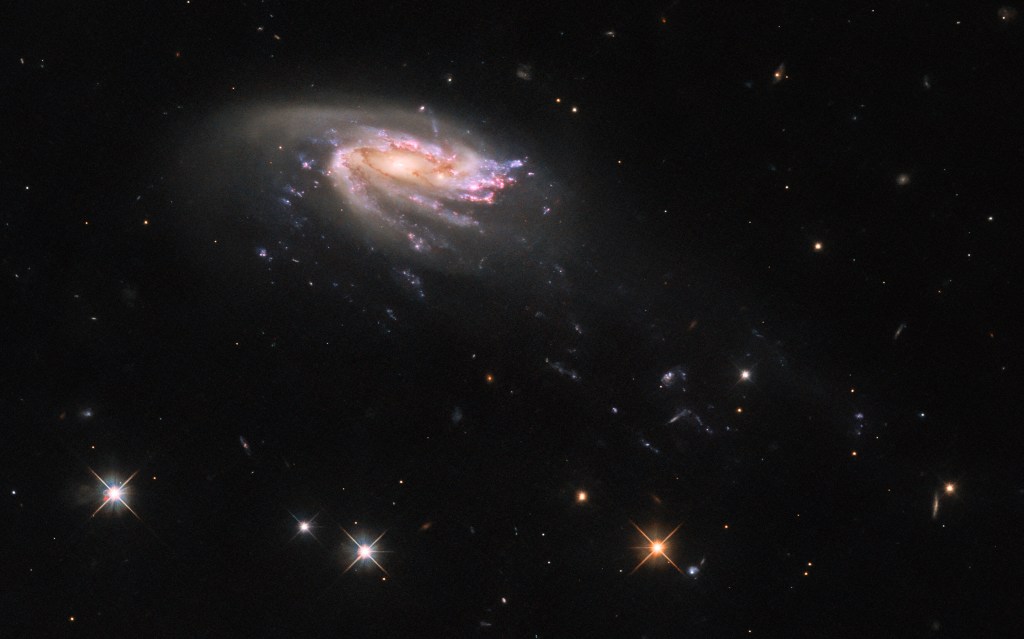
Image (Credit): The jellyfish galaxy JO206 trails across this image from the NASA/ESA Hubble Space Telescope. (ESA/Hubble & NASA, M. Gullieuszik and the GASP team)

This week’s image is from the Hubble Space Telescope. It shows the jellyfish galaxy JO206, which is about 700 million light-years away. A close-up of the galaxy iteself is provided below.

Here is more about the image from the European Space Agency (ESA):

[Galaxy JO206 is] showcasing a colorful star-forming disk surrounded by a pale, luminous cloud of dust. A handful of foreground bright stars with crisscross diffraction spikes stands out against an inky black backdrop at the bottom of the image…

Jellyfish galaxies are so-called because of their resemblance to their aquatic namesakes. In the bottom right of this image, long tendrils of bright star formation trail the disk of JO206, just as jellyfish trail tentacles behind them. The tendrils of jellyfish galaxies are formed by the interaction between galaxies and the intra-cluster medium, a tenuous superheated plasma that pervades galaxy clusters. As galaxies move through galaxy clusters, they ram into the intracluster medium, which strips gas from the galaxies and draws it into the long tendrils of star formation.

The tentacles of jellyfish galaxies give astronomers a unique opportunity to study star formation under extreme conditions, far from the influence of the galaxy’s main disk. Surprisingly, Hubble revealed that there are no striking differences between star formation in the disks of jellyfish galaxies and star formation in their tentacles, which suggests the environment of newly formed stars has only a minor influence on their formation.
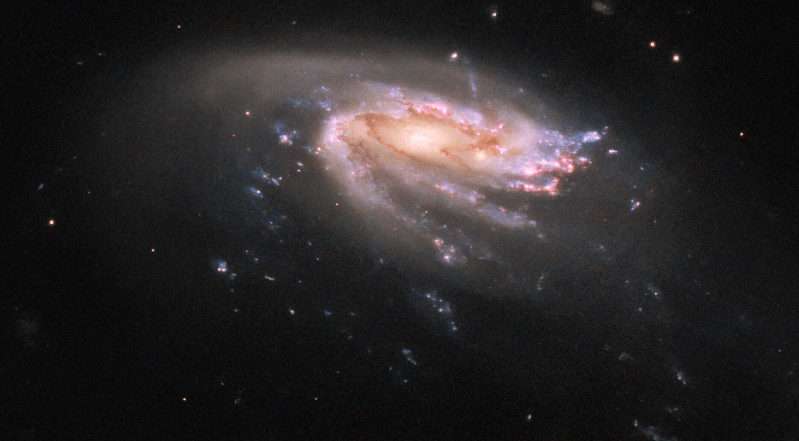
Image (Credit): Close-up of the jellyfish galaxy JO206 from the NASA/ESA Hubble Space Telescope. (ESA/Hubble & NASA, M. Gullieuszik and the GASP team)

A Day in Astronomy: The Founding of the European Space Agency

On this day in 1975, the European Space Agency (ESA) was founded after the combination of  the European Space Research Organisation (ESRO) and the European Launcher Development Organisation (ELDO). Ten countries were part of this new organization, which has since grown to 22 members (noted below). The Agency also has associate members and other cooperating partners.

You can find a list of the ESA’a past, present, and planned space missions here, which includes:

Note: According to the International Astronautical Federation, the ESA member include Austria, Belgium, the Czech Republic, Denmark, Estonia, Finland, France, Germany, Greece, Hungary, Ireland, Italy, Luxembourg, the Netherlands, Norway, Poland, Portugal, Romania, Spain, Sweden, Switzerland and the United Kingdom. Latvia, Lithuania and Slovenia are Associate Members. Canada takes part in certain programmes under a cooperation agreement. ESA has signed European Cooperating States Agreements with Bulgaria, Cyprus and Slovakia, and cooperation agreements with Croatia and Malta.

Podcast: Two Worlds Collide in This Episode

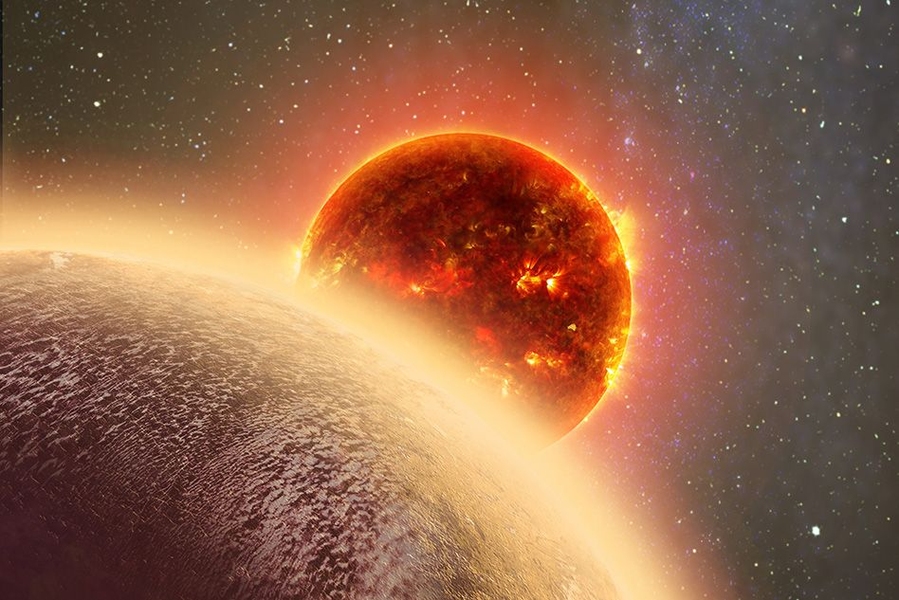
Image (Credit): Artist’s rending of exoplanet GJ 1132b. (MIT News)

If you are looking for a fun podcast this week, you cannot go wrong with Neil DeGrasse Tyson’s Startalk podcast when it hosts Cool Worlds‘ creator David Kipping. The episode, Cosmic Queries – Cool Worlds with David Kipping, covers questions related to exoplanets, exomoons, and more. It is fun to hear the two scientists play off each other.

You will also learn from this podcast that Cool Worlds should be releasing its own podcast in the near future. Its Youtube videos are already a great source of information, so I expect more of the same in these podcasts.

At the end of the podcast, Professor Kipping also mentioned a few upcoming space missions related to exoplanets, including the European PLAnetary Transits and Oscillations of stars (Plato) mission in 2026. You can learn more about the mission from this European Space Agency factsheet, which notes:

Does a second Earth exist in the Universe? Planet hunter Plato will focus on the properties of rocky planets orbiting Sun-like stars. In particular, Plato will discover and characterise planets in orbits up to the habitable zone – the ‘goldilocks’ region around a star where the temperature is just right for liquid water to exist on a planet’s surface.

Plato will characterise hundreds of rocky (including Earth twins), icy or giant planets by providing exquisite measurements of their radii (3% precision), masses (better than 10% precision) and ages (10% precision). This will revolutionise our understanding of planet formation and the evolution of planetary systems, as well as the potential habitability of these diverse worlds.

As well as looking at these planets, Plato will analyse their host stars. Using data from the mission, scientists hope to perform stellar seismology, gathering evidence of ‘starquakes’ in the imaged stars. This will give insight into the characteristics and evolution of the stars, improving our understanding of entire planetary systems.

It’s a fun, fact-filled show worth your time.

Study Findings: Direct Imaging and Astrometric Detection of a Gas Giant Planet Orbiting an Accelerating Star

Image (Credit): Artist’s rendering of Gaia mapping the stars of the Milky Way. (European Space Agency)

Science abstract:

Direct imaging of gas giant exoplanets provides information on their atmospheres and the architectures of planetary systems. However, few planets have been detected in blind surveys with direct imaging. Using astrometry from the Gaia and Hipparcos spacecraft, we identified dynamical evidence for a gas giant planet around the nearby star HIP 99770. We confirmed the detection of this planet with direct imaging using the Subaru Coronagraphic Extreme Adaptive Optics instrument. The planet, HIP 99770 b, orbits 17 astronomical units from its host star, receiving an amount of light similar to that reaching Jupiter. Its dynamical mass is 13.9 to 16.1 Jupiter masses. The planet-to-star mass ratio [(7 to 8) × 10−3] is similar to that of other directly imaged planets. The planet’s atmospheric spectrum indicates an older, less cloudy analog of the previously imaged exoplanets around HR 8799.

Citation: Thayne Currie, G. Mirek Brandt, Timothy D. Brandt, Brianna Lacy, Adam Burrows, Olivier Guyon, Motohide Tamura, Ranger Y. Liu, Sabina Sagynbayeva, Taylor Tobin, Jeffrey Chilcote, Tyler Groff, Christian Marois, William Thompson, Simon J. Murphy, Masayuki Kuzuhara, Kellen Lawson, Julien Lozi, Vincent Deo, Sebastien Vievard, Nour Skaf, Taichi Uyama, Nemanja Jovanovic, Frantz Martinache, N. Jeremy Kasdin, Tomoyuki Kudo, Michael McElwain, Markus Janson, John Wisniewski, Klaus Hodapp, Jun Nishikawa, Krzysztof Hełminiak, Jungmi Kwon, Masahiko Hayashi. Direct imaging and astrometric detection of a gas giant planet orbiting an accelerating star. Science (2023).
https://doi.org/10.1126/science.abo6192

Study-related stories:

The Juice Mission has Started

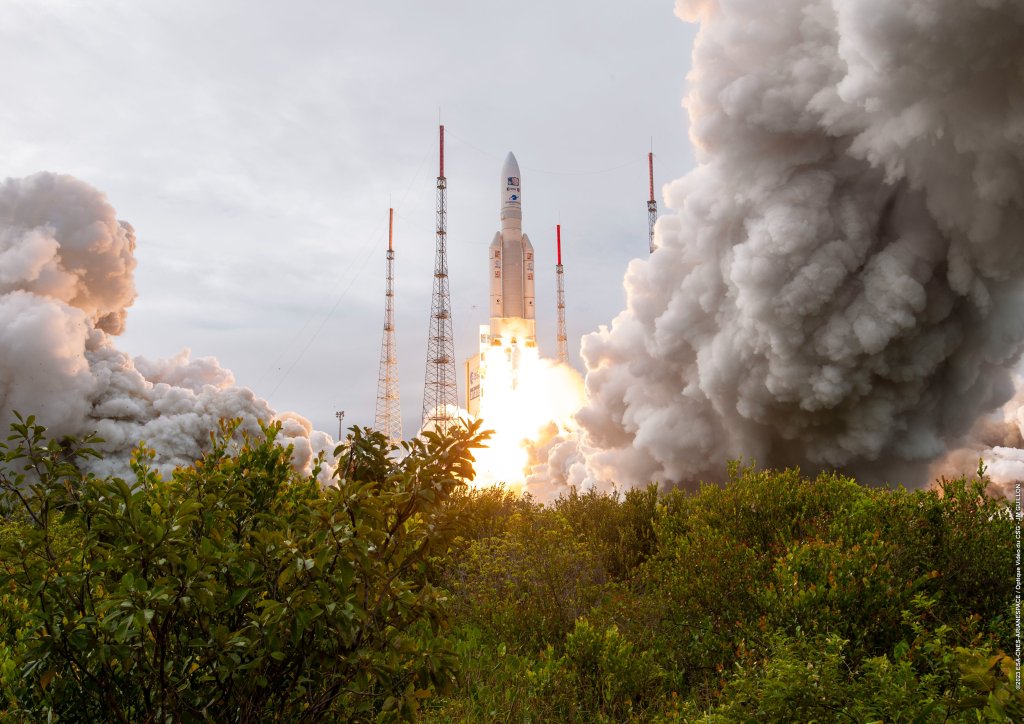
Image (Credit): The successful launch of the ESA’s Juice mission from Kourou, French Guiana on April 14, 2023. (ESA/M. Pédoussaut and ESA/CNES/Arianespace/Optique Vidéo du CSG/JM Guillon)

Earlier today, the European Space Agency’s (ESA) Jupiter Icy Moons Explorer (Juice)  mission successfully launched from French Guiana. It is the start of a long trip to the Jovian planet and its moons. The spacecraft will not reach Jupiter until July 2031. You can watch of video of the launch here. ESA has numerous other videos on the mission here.

ESA Director General Josef Aschbacher stated:

ESA, with its international partners, is on its way to Jupiter…Juice’s spectacular launch carries with it the vision and ambition of those who conceived the mission decades ago, the skill and passion of everyone who has built this incredible machine, the drive of our flight operations team, and the curiosity of the global science community. Together, we will keep pushing the boundaries of science and exploration in order to answer humankind’s biggest questions.

It is another great step forward in the exploration of our home solar system as we scan the skies for other more distant systems.

Image (Credit): Juice mission patch. (ESA)