Space Stories: Europeans Not Joining Chinese Space Station, the Milky Way is Odd, and Lucy has a New Target

Image (Credit): A computer rendering of China’s new Tiangong space station in orbit. (Alejandro Miranda/Alamy Stock Photo)

Here are some recent stories of interest.

Royal Astronomical Society: “European Space Agency Says it has No Plans to Send Astronauts to China’s Tiangong Space Station

A top official with the European Space Agency said it had no plans to send European astronauts to the newly completed Chinese space station, making it clear for the first time that the agency is no longer committed to working with China in human space flight in the near future. “We are very busy supporting and ensuring our commitments and activities on the International Space Station,” ESA director general Josef Aschbacher told a press conference in Paris on Monday.

Royal Astronomical Society: “Milky Way Found to be More Unique than Previously Thought

Is the Milky Way special, or, at least, is it in a special place in the Universe? An international team of astronomers has found that the answer to that question is yes, in a way not previously appreciated. A new study shows that the Milky Way is too big for its “cosmological wall”, something yet to be seen in other galaxies. The new research is published in Monthly Notices of the Royal Astronomical Society.

Southwest Research Institute: “SwRI-Led Lucy Team Announces New Asteroid Target

NASA’s Lucy spacecraft will add another asteroid encounter to its 4-billion-mile journey. On Nov. 1, 2023, the Southwest Research Institute-led Lucy mission will get a close-up view of a small main belt asteroid to conduct an engineering test of the spacecraft’s innovative asteroid-tracking navigation system. The Lucy mission was already on course to break records by its planned visit of nine asteroids during its 12-year mission to tour the Jupiter Trojan asteroids, which orbit the Sun at the same distance as Jupiter. Originally, Lucy was not expected to get a close-up view of any asteroids until 2025, when it will fly by the main belt asteroid (52246) Donaldjohanson. However, the SwRI-led Lucy team identified a small, as-yet unnamed asteroid in the inner main belt as a potential new and useful target for the Lucy spacecraft.
Space Quote: Starlab to Replace the ISS

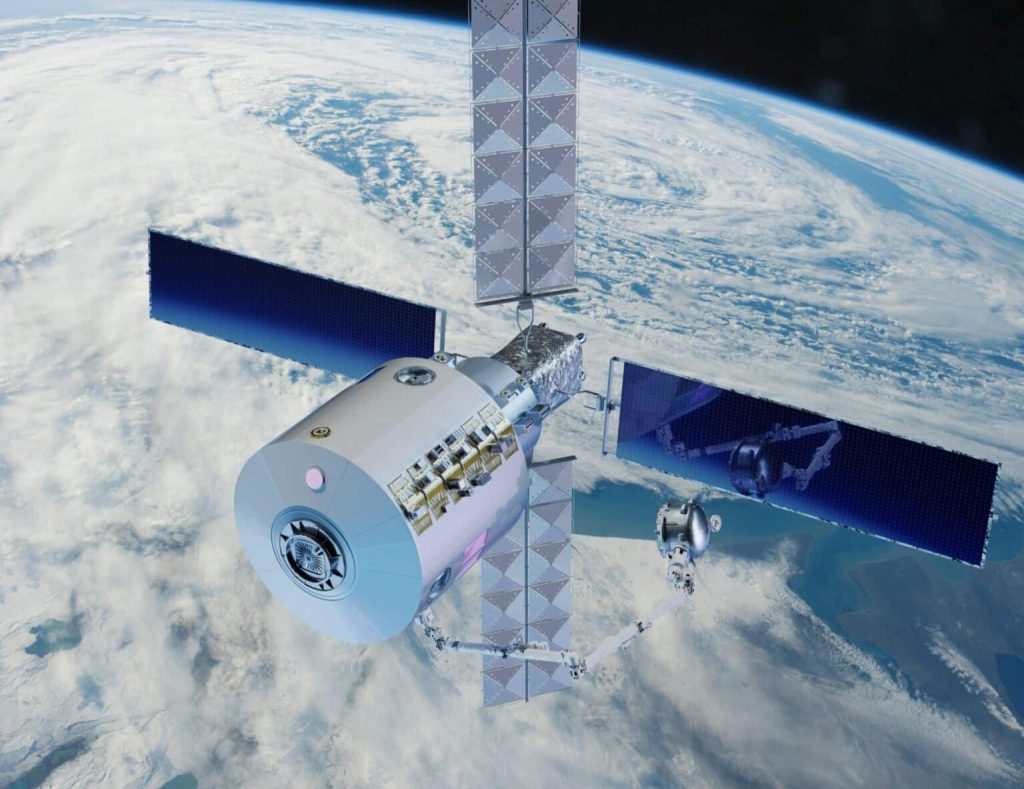
Image (Credit): Image of Starlab from the Voyager Space website. (Voyager Space)

“This partnership with Voyager Space is the first step toward fielding the next generation of space stations to serve international astronauts. We are excited to support a project aimed at changing history…This collaboration is an important step in making Starlab a reality, providing a foundation for long-lasting European and American leadership in space. Our team is looking forward to diving in on the technology and putting our best engineers to work.”

-Statement by Jean-Marc Nasr, Executive Vice President of Space Systems at Airbus Defence and Space, in a press release regarding Voyager Space and Airbus Defence and Space partnering to develop and operate Starlab in 2028. The Low-Earth Orbit space station will serve NASA, ESA, and others in the scientific community following the retirement of the International Space Station. NASA has already awarded $160 million to Voyager and Nanoracks, its operating company, to create the new space station.

Space Stories: Chinese Space Partnerships, Approaching Comet, and European Rocket Shortage

Image (Credit): Chinese space program poster. (Asia Times)

Here are some recent stories of interest.

SpaceNews.com: “China Looks to Build Space Partnerships with Gulf Nations

China is aiming to grow cooperation with emerging space nations including Saudi Arabia and the United Arab Emirates. Space was named as one of a number of priority areas for the next three to five years during the first China-Gulf Cooperation Council (GCC) Summit held in Riyadh earlier this month. “China stands ready to work with GCC countries on remote sensing and communications satellite, space utilization, aerospace infrastructure, and the selection and training of astronauts,” according to the text of the keynote speech made by Chinese President Xi Jinping at the summit, Dec. 9. The GCC intergovernmental group comprises Saudi Arabia, the United Arab Emirates, Bahrain, Kuwait, Oman and Qatar.

Newsweek: “Once-in-a-Lifetime Cosmic Event Could Be Visible to the Naked Eye

A comet zooming through the solar system could soon be visible to the naked eye from Earth in what will be a once-in-a-lifetime event. And some astronomical predictions indicate that the object may never return to our cosmic neighborhood. C/2022 E3 (ZTF) is currently located around 100 million miles away from Earth and will make a close approach to our planet in early February 2023.

Atalayar.com: Europe Runs out of Rockets for Autonomous Access to Space

Overnight, the European Space Agency (ESA) headed by Austrian Josef Aschbacher has been left without any capacity to position its own satellites in outer space. Neither Aschbacher nor his director of space transport, the Swiss Daniel Neuenschwander, have any space vector model to fulfil their commitments to the European Union to renew the Copernicus constellation and place their Sentinel environmental monitoring satellites in orbit. Much less is ESA in a position to meet the growing global demand for launch services that is knocking on its doors, those of the United States, China and India.

Pic of the Week: Stunning Auroras

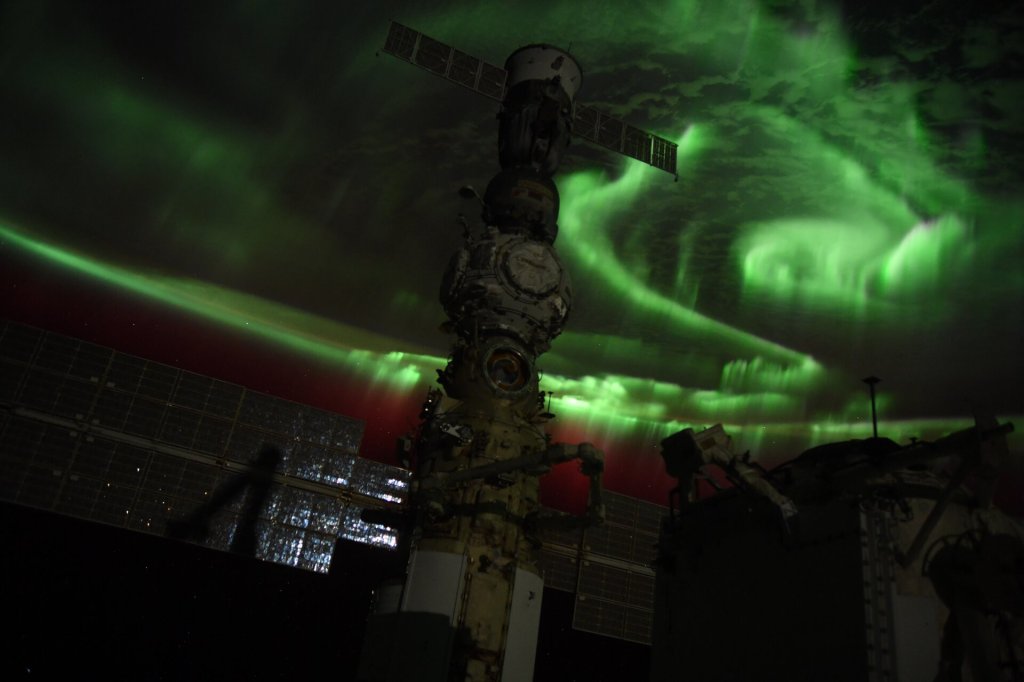
Image (Credit): View from the ISS – further description below. (ESA/NASA-S.Cristoforetti)

This week’s image is from the European Space Agency’s (ESA) Year in Images 2022 collection and shows a view from the International Space Station (ISS).

Here is the description of the image from the ESA:

Aurorae observed by ESA astronaut Samantha Cristoforetti aboard the International Space Station for her Minerva Mission. She shared these images to her social media on 21 August 2022 with the caption: “The Sun has been really active lately. Last week we saw the most stunning auroras I have ever experienced in over 300 days in space!”

You can read more about ESA astronaut Cristoforetti’s work on the ISS here.

Pic of the Week: A Wreath Just in Time for Christmas

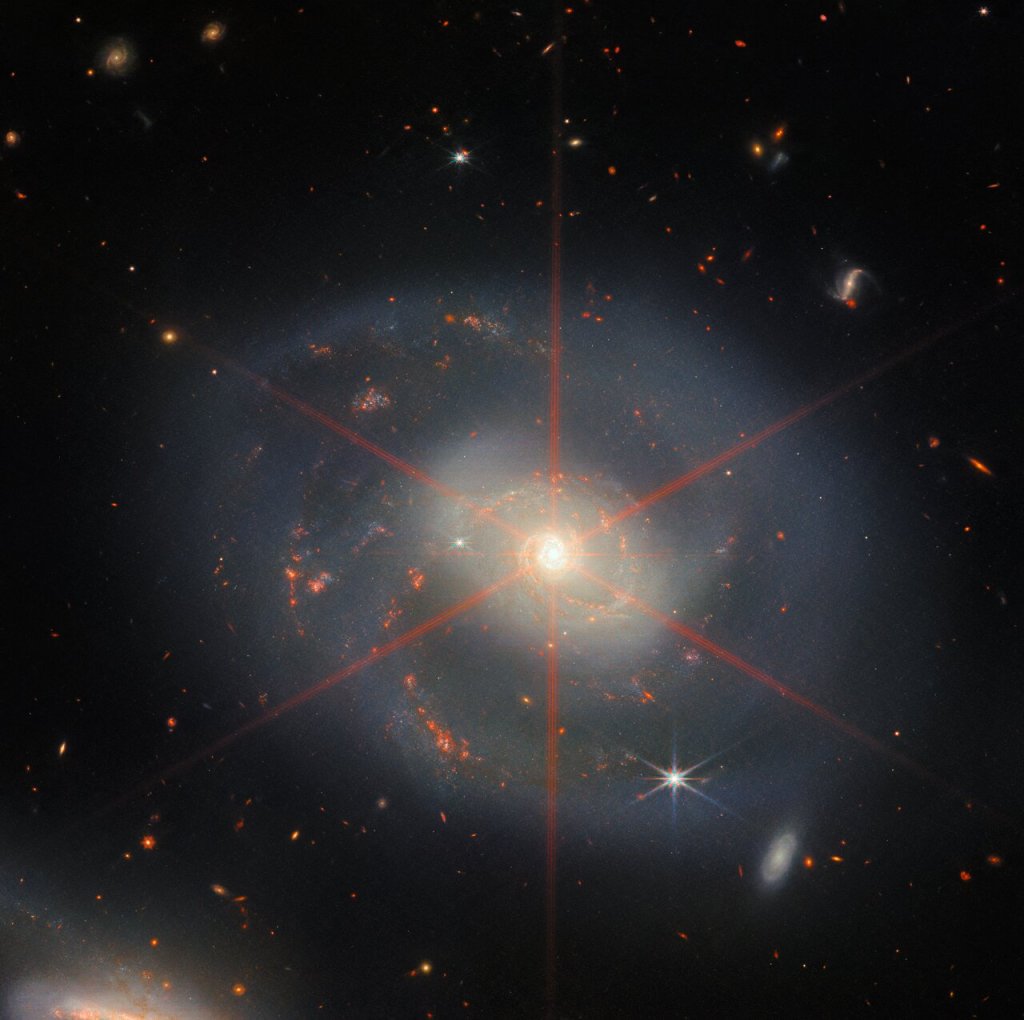
Image (Credit): Spiral galaxy NGC 7469 face-on. (NASA)

This week’s image is from the James Webb Space Telescope (JWST). It is a face-on view of wreath-like spiral galaxy NGC 7469, which is about 220 million light-years from Earth.

Here is a little more from the European Space Agency on the image:

While NGC 7469 is one of the best studied AGNs in the sky, the compact nature of this system and the presence of a great deal of dust have made it difficult for scientists to achieve both the resolution and sensitivity needed to study this relationship in the infrared. Now, with Webb, astronomers can explore the galaxy’s starburst ring, the central AGN, and the gas and dust in between. Using Webb’s MIRI, NIRCam and NIRspec instruments to obtain images and spectra of NGC 7469 in unprecedented detail, the GOALS team has uncovered a number of details about the object. This includes very young star-forming clusters never seen before, as well as pockets of very warm, turbulent molecular gas, and direct evidence for the destruction of small dust grains within a few hundred light-years of the nucleus — proving that the AGN is impacting the surrounding interstellar medium. Furthermore, highly ionised, diffuse atomic gas seems to be exiting the nucleus at roughly 6.4 million kilometres per hour — part of a galactic outflow that had previously been identified, but is now revealed in stunning detail with Webb. With analysis of the rich Webb datasets still underway, additional secrets of this local AGN and starburst laboratory are sure to be revealed.

A prominent feature of this image is the striking six-pointed star that perfectly aligns with the heart of NGC 7469. Unlike the galaxy, this is not a real celestial object, but an imaging artifact known as a diffraction spike, caused by the bright, unresolved AGN. Diffraction spikes are patterns produced as light bends around the sharp edges of a telescope. Webb’s primary mirror is composed of hexagonal segments that each contain edges for light to diffract against, giving six bright spikes. There are also two shorter, fainter spikes, which are created by diffraction from the vertical strut that helps support Webb’s secondary mirror.