Pic of the Week: Blooming Stars in the Irregular Spiral Galaxy NGC 5486

Image (Credit): Irregular Spiral Galaxy NGC 5486. (ESA/Hubble & NASA, C. Kilpatrick)

This week’s image is from the Hubble Space Telescope. It shows the irregular spiral galaxy NGC 5486 with pink areas indicating the formation of new stars.

Here is a little more from the European Space Agency (ESA):

NGC 5486 hangs against a background of dim, distant galaxies in this image from the NASA/ESA Hubble Space Telescope. The tenuous disc of the galaxy is threaded through with pink wisps of star formation, which stand out from the diffuse glow of the galaxy’s bright core. While this particular galaxy has indistinct, meandering spiral arms it lies close to the much larger Pinwheel Galaxy, one of the best known examples of ‘grand design’ spiral galaxies with prominent and well-defined spiral arms. In 2006 Hubble captured an image of the Pinwheel Galaxy which was — at the time — the largest and most detailed photo of a spiral galaxy ever taken with Hubble.

NGC 5486 lies 110 million light-years from Earth in the constellation Ursa Major. This observation comes from a selection of Hubble images exploring debris left behind by Type II supernovae. As massive stars reach the end of their lives, they cast off huge amounts of gas and dust before ending their lives in titanic supernova explosions. NGC 5486 hosted a supernova in 2004, and astronomers used the keen vision of Hubble’s Advanced Camera for Surveys to explore the aftermath in the hopes of learning more about these explosive events.
Space Stories: Ancient Water, Nearby Black Hole, and a Lunar Time Zone

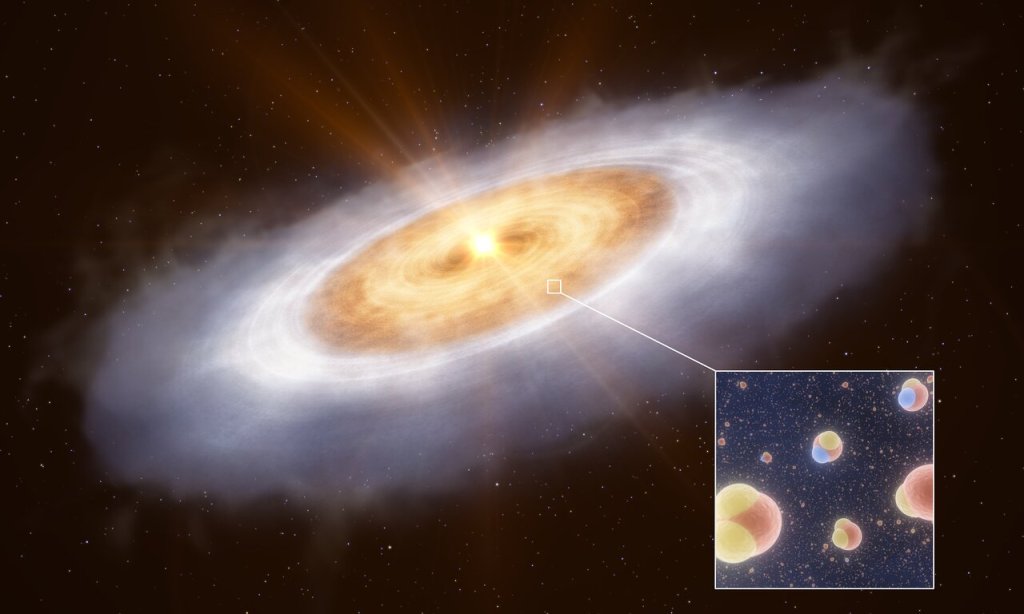
Image (Credit): Illustration showing gaseous water in the planet-forming disc around the star V883 Orionis. (European Southern Observatory)

Here are some recent stories of interest.

European Southern Observatory: “Astronomers Find Missing Link for Water in the Solar System

Using the Atacama Large Millimeter/submillimeter Array (ALMA), astronomers have detected gaseous water in the planet-forming disc around the star V883 Orionis. This water carries a chemical signature that explains the journey of water from star-forming gas clouds to planets, and supports the idea that water on Earth is even older than our Sun.

“We can now trace the origins of water in our Solar System to before the formation of the Sun,” says John J. Tobin, an astronomer at the National Radio Astronomy Observatory, USA and lead author of the study published today in Nature. 

SciTech Daily: “Astronomers Uncover Black Hole Closer to Earth Than Ever Before

Astronomers have discovered the closest black hole to Earth, the first unambiguous detection of a dormant stellar-mass black hole in the Milky Way. Its close proximity to Earth, a mere 1,600 light-years away, offers an intriguing target of study to advance understanding of the evolution of binary systems.

New York Times: “The Moon May Get Its Own Time Zone

What time is it on the moon? Since the dawn of the space age, the answer has been: It depends. For decades, lunar missions have operated on the time of the country that launched them. But with several lunar explorations heading for the launchpad, the European Space Agency has deemed the current system unsustainable. The solution, the agency said last week, is a lunar time zone.

Pic of the Week: Spiral Galaxy LEDA 2046648

Image (Credit): Spiral glaxy LEDA 2046648 as captured by the JSWT. (ESA/Webb, NASA & CSA, A. Martel)

This week’s image is from the James Webb Space Telescope (JWST). It shows a spiral galaxy that appears much like our own (bottom center), though this one is a billion light-years away. Do occupants of that galaxy also see us? Good luck communicating when it will take 2 billion years to receive a response to a message you just sent out.

Here is the full story from the European Space Agency (ESA), which posted this as its Picture of the Month just last month:

A crowded field of galaxies throngs this Picture of the Month from the NASA/ESA/CSA James Webb Space Telescope, along with bright stars crowned with Webb’s signature six-pointed diffraction spikes. The large spiral galaxy at the base of this image is accompanied by a profusion of smaller, more distant galaxies which range from fully-fledged spirals to mere bright smudges. Named LEDA 2046648, it is situated a little over a billion light-years from Earth, in the constellation Hercules.

One of Webb’s principle science goals is to observe distant galaxies in the early universe to understand the details of their formation, evolution, and composition. Webb’s keen infrared vision helps the telescope peer back in time, as the light from these distant galaxies is redshifted towards infrared wavelengths. Comparing these systems with galaxies in the local universe will help astronomers understand how galaxies grew to form the structure we see today. Webb will also probe the chemical composition of thousands of galaxies to shed light on how heavy elements were formed and built up as galaxies evolved.

Space Stories: Europeans Not Joining Chinese Space Station, the Milky Way is Odd, and Lucy has a New Target

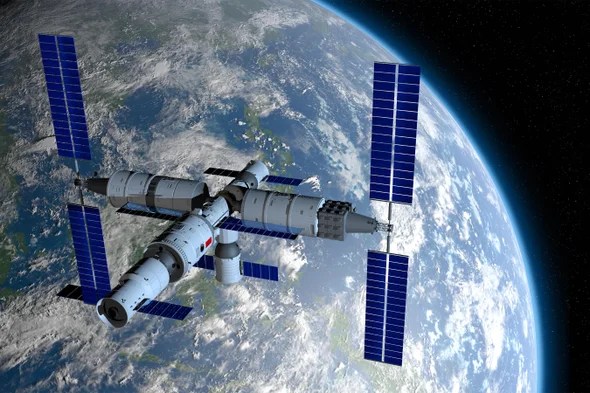
Image (Credit): A computer rendering of China’s new Tiangong space station in orbit. (Alejandro Miranda/Alamy Stock Photo)

Here are some recent stories of interest.

Royal Astronomical Society: “European Space Agency Says it has No Plans to Send Astronauts to China’s Tiangong Space Station

A top official with the European Space Agency said it had no plans to send European astronauts to the newly completed Chinese space station, making it clear for the first time that the agency is no longer committed to working with China in human space flight in the near future. “We are very busy supporting and ensuring our commitments and activities on the International Space Station,” ESA director general Josef Aschbacher told a press conference in Paris on Monday.

Royal Astronomical Society: “Milky Way Found to be More Unique than Previously Thought

Is the Milky Way special, or, at least, is it in a special place in the Universe? An international team of astronomers has found that the answer to that question is yes, in a way not previously appreciated. A new study shows that the Milky Way is too big for its “cosmological wall”, something yet to be seen in other galaxies. The new research is published in Monthly Notices of the Royal Astronomical Society.

Southwest Research Institute: “SwRI-Led Lucy Team Announces New Asteroid Target

NASA’s Lucy spacecraft will add another asteroid encounter to its 4-billion-mile journey. On Nov. 1, 2023, the Southwest Research Institute-led Lucy mission will get a close-up view of a small main belt asteroid to conduct an engineering test of the spacecraft’s innovative asteroid-tracking navigation system. The Lucy mission was already on course to break records by its planned visit of nine asteroids during its 12-year mission to tour the Jupiter Trojan asteroids, which orbit the Sun at the same distance as Jupiter. Originally, Lucy was not expected to get a close-up view of any asteroids until 2025, when it will fly by the main belt asteroid (52246) Donaldjohanson. However, the SwRI-led Lucy team identified a small, as-yet unnamed asteroid in the inner main belt as a potential new and useful target for the Lucy spacecraft.

Space Quote: Starlab to Replace the ISS

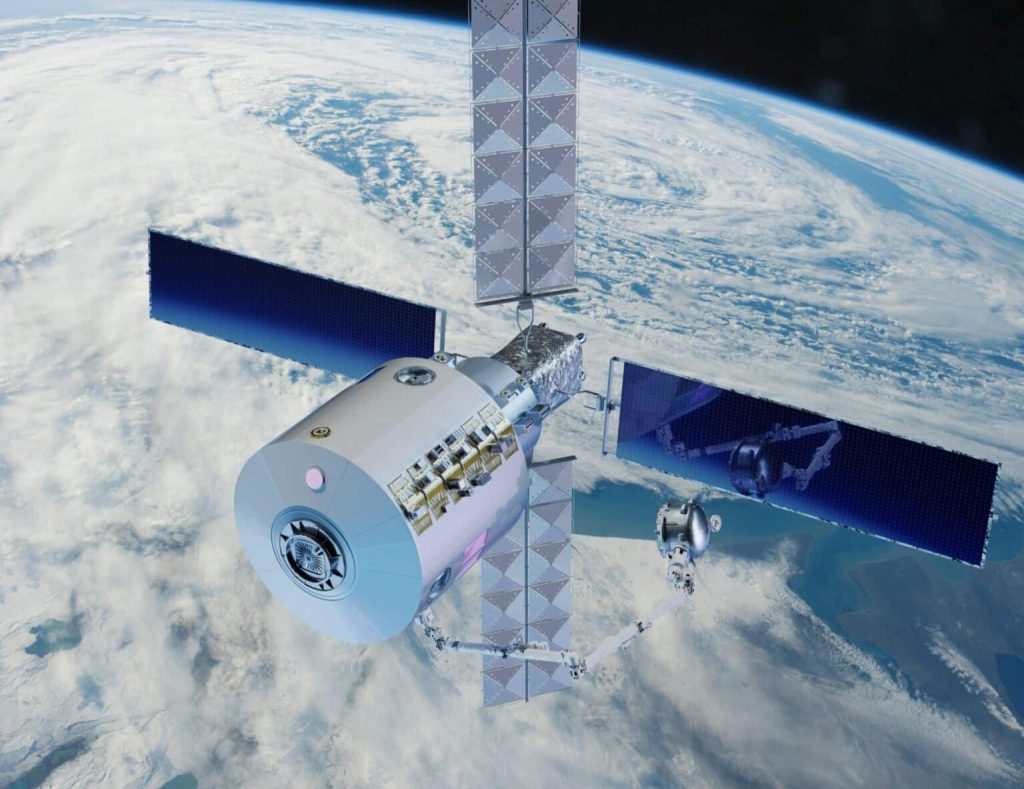
Image (Credit): Image of Starlab from the Voyager Space website. (Voyager Space)

“This partnership with Voyager Space is the first step toward fielding the next generation of space stations to serve international astronauts. We are excited to support a project aimed at changing history…This collaboration is an important step in making Starlab a reality, providing a foundation for long-lasting European and American leadership in space. Our team is looking forward to diving in on the technology and putting our best engineers to work.”

-Statement by Jean-Marc Nasr, Executive Vice President of Space Systems at Airbus Defence and Space, in a press release regarding Voyager Space and Airbus Defence and Space partnering to develop and operate Starlab in 2028. The Low-Earth Orbit space station will serve NASA, ESA, and others in the scientific community following the retirement of the International Space Station. NASA has already awarded $160 million to Voyager and Nanoracks, its operating company, to create the new space station.