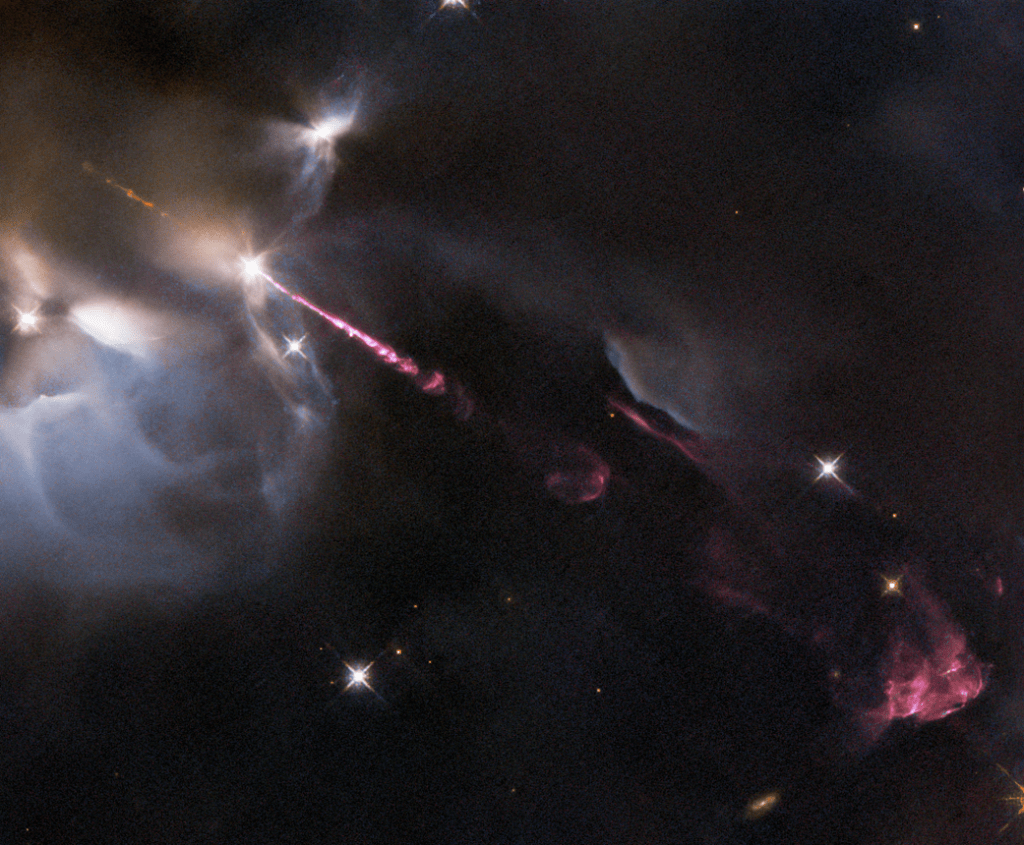
Pic of the Week: Stellar Tantrum

Image (Credit): Hubble image of an outburst from an infant star. (ESA/Hubble & NASA, B. Nisini)

This week’s image is from the NASA/ESA Hubble Space Telescope. While it may look like an enormous interstellar stingray, it actually shows gas streaming from a newly-formed star. Here is the story from the European Space Agency (ESA):

An energetic outburst from an infant star streaks across this image from the NASA/ESA Hubble Space Telescope. This stellar tantrum – produced by an extremely young star in the earliest phase of formation – consists of an incandescent jet of gas travelling at supersonic speeds. As the jet collides with material surrounding the still-forming star, the shock heats this material and causes it to glow. The result is the colorfully wispy structures, which astronomers refer to as Herbig–Haro objects, billowing across the lower right of this image.

Herbig–Haro objects are seen to evolve and change significantly over just a few years. This particular object, called HH34, was previously captured by Hubble between 1994 and 2007, and again in glorious detail in 2015. HH34 resides approximately 1,250 light-years from Earth in the Orion Nebula, a large region of star formation visible to the unaided eye. The Orion Nebula is one of the closest sites of widespread star formation to Earth, and as such has been pored over by astronomers in search of insights into how stars and planetary systems are born. 

Hubble: SpaceX to the Rescue

Image (Credit): The Hubble Space Telescope orbiting Earth. (Hubblesite.org)

The Washington Post reports that NASA and SpaceX are looking into the idea of extending the life of the NASA/ESA Hubble Space Telescope, which has already been in service more than 30 years. The space telescope’s orbit has been deteriorating since 2009, when it was last visited for repairs. The current orbit should be okay until the mid-2030s, and then it will fall to Earth.

To keep the Hubble in service for even more years, it would need to be pushed into a higher orbit. This is where SpaceX comes in. It can assist NASA by moving Hubble just 40 miles higher in order to get another 15 to 20 years out of the space telescope.

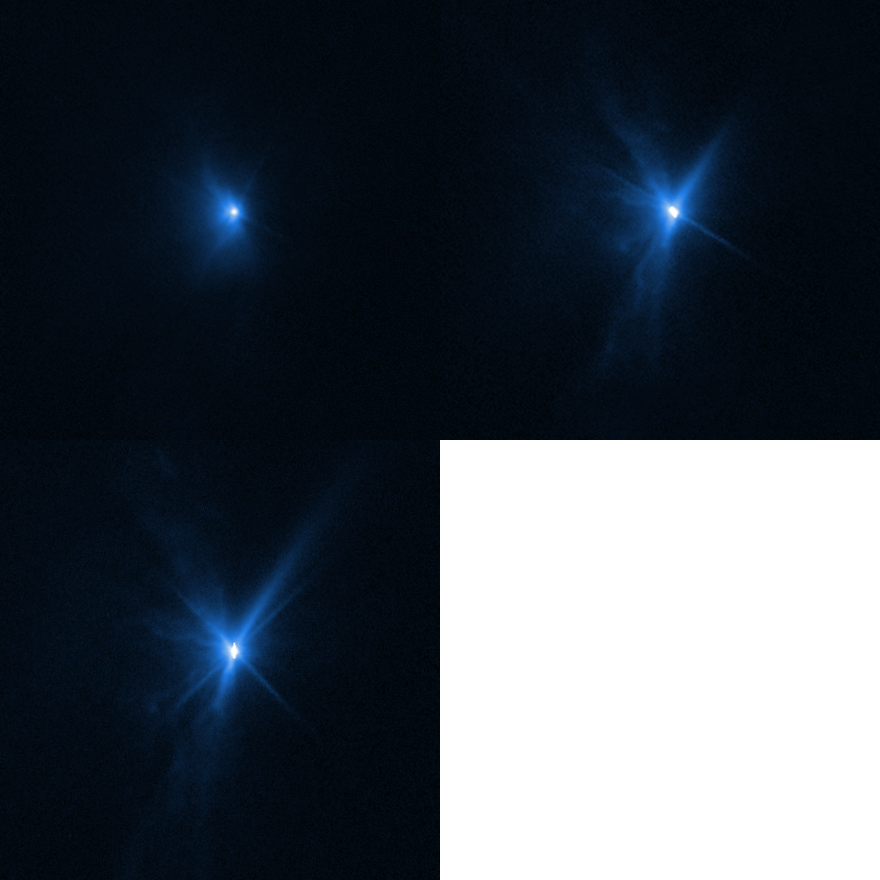
The article notes that the James Webb Space Telescope (JWST) was not developed to replace Hubble but rather to complement it. Hence, the extra life for Hubble means more and better astronomical observations over additional years in conjunction with the JWST. For instance, we will get more shots like the one below where the Hubble captured the Double Asteroid Redirection Test (DART) mission before and after it struck the asteroid.

Update: I have also included the JWST DART image below just to show the two space telescopes can work in tandem.

Image (Credit): This animated GIF combines three of the images NASA’s Hubble Space Telescope captured after NASA’s DART spacecraft intentionally impacted Dimorphos, a moonlet asteroid in the double asteroid system of Didymos. The animation spans from 22 minutes after impact to 8.2 hours after the collision took place. As a result of the impact, the brightness of the Didymos-Dimorphos system increased by 3 times. The brightness also appears to hold fairly steady, even eight hours after impact. (NASA, ESA, Jian-Yang Li (PSI); animation: Alyssa Pagan (STScI))
Image (Credit): This animation gif is a timelapse of images from NASA’s JWST. It covers the time spanning just before impact at 7:14 p.m. EDT, Sept. 26, through 5 hours post-impact. Plumes of material from a compact core appear as wisps streaming away from where the impact took place. An area of rapid, extreme brightening is also visible in the animation. (NASA, ESA, CSA, Cristina Thomas (Northern Arizona University), Ian Wong (NASA-GSFC); Joseph DePasquale (STScI))

Pic of the Week: Interacting Galaxy Pair

Image (Credit): Hubble image of colliding galaxies – NGC 169 (bottom) and IC 1559 (top). (ESA/Hubble & NASA, J. Dalcanton, Dark Energy Survey, DOE, FNAL/DECam, CTIO/NOIRLab/NSF/AURA, SDSS)

This week’s image comes again from the Hubble Space Telescope, which is keeping us entertained as the James Webb Space Telescope cycles through its required observations and spins off images from time to time.

While an earlier image appeared to show colliding galaxies, though it was believed to be an optical illusion, the collision above is real. Below is more on the image from the European Space Agency’s (ESA) Hubble site:

Galaxies can merge, collide, or brush past one another — each of which has a significant impact on their shapes and structures. As common as these interactions are thought to be in the Universe, it is rare to capture an image of two galaxies interacting in such a visibly dynamic way. This image, from the NASA/ESA Hubble Space Telescope, feels incredibly three-dimensional for a piece of deep-space imagery. 

The subject of this image is named Arp 282, an interacting galaxy pair that is composed of the Seyfert galaxy NGC 169 (bottom) and the galaxy IC 1559 (top). If you’re interested in learning more about Seyfert galaxies, you can read about the Seyfert galaxy NGC 5728 here. Interestingly, both of the galaxies comprising Arp 282 have monumentally energetic cores, known as active galactic nuclei (AGN), although it is difficult to tell that from this image. This is actually rather fortunate, because if the full emission of two AGNs was visible in this image, then it would probably obscure the beautifully detailed tidal interactions occurring between NGC 169 and IC 1559. Tidal forces occur when an object’s gravity causes another object to distort or stretch. The direction of the tidal forces will be away from the lower-mass object and towards the higher mass object. When two galaxies interact, gas, dust and even entire solar systems will be drawn away from one galaxy towards the other by these tidal forces. This process can actually be seen in action in this image — delicate streams of matter have formed, visibly linking the two galaxies.

Astronomy Ideas on Borrowed Time?

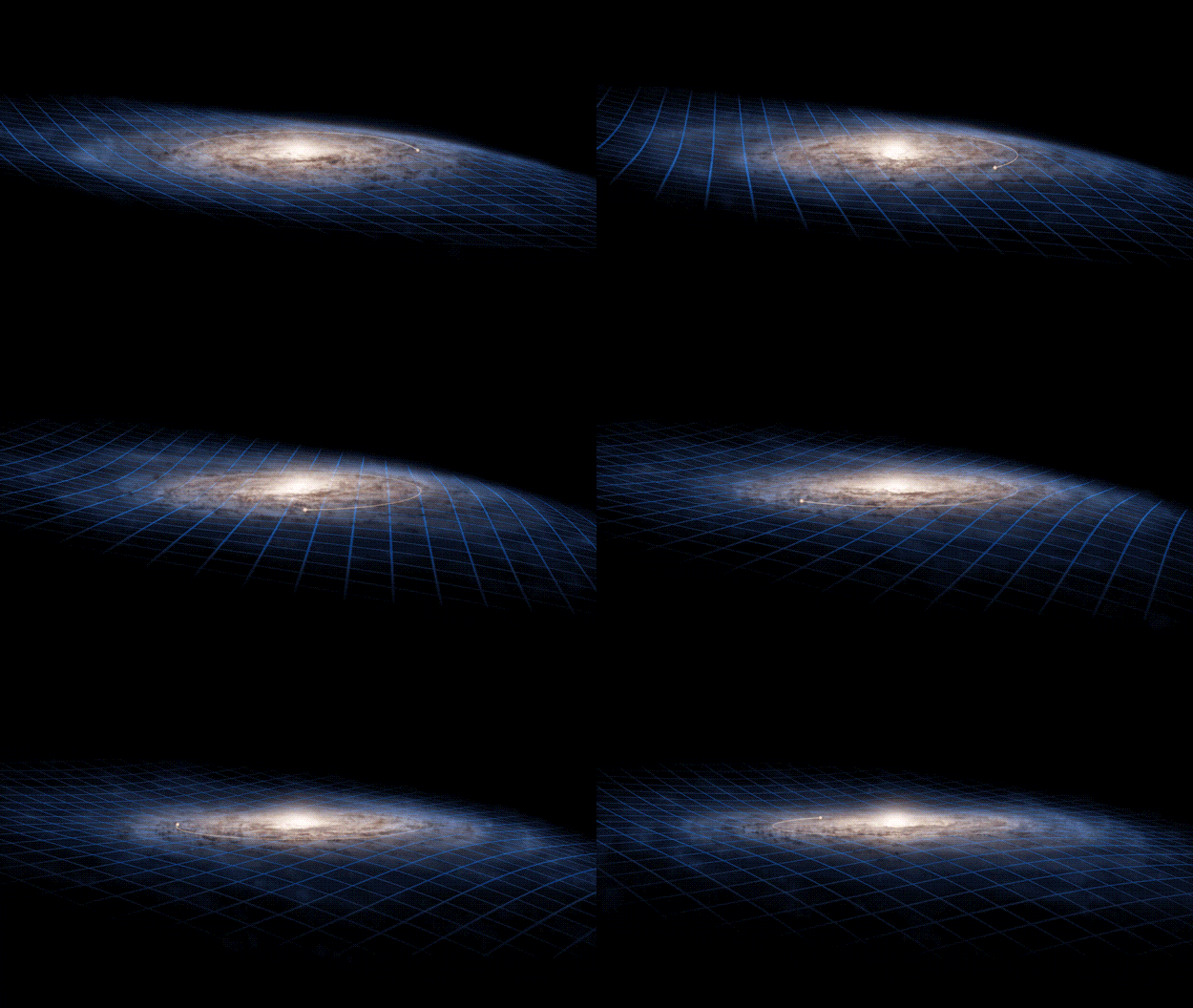
Image (Credit): The position of our Sun as it orbits the Milky Way’s center. (Stefan Payne-Wardenaar)

A recent Big Think story, “5 Consensus Ideas in Astronomy That Might Soon be Overturned,” comes as a good time as we reach further into space and back into time using the James Webb Space Telescope (JWST) and contemplate other telescopes that should come online shortly.

The story highlights these five ideas:

  • Dark energy is a cosmological constant;
  • Stars predate black holes;
  • Jovian planets protect terrestrial ones;
  • Most of the galaxy is uninhabitable; and
  • Globular clusters are planet-free.

For instance, regarding the uninhabitable areas of the galaxy, the Big Think story states:

Among its many discoveries, the ESA’s Gaia mission has found that the Milky Way galaxy not only has a warp to its galactic disk, but that the warp in the disk precesses and wobbles, completing a full rotation for roughly every three revolutions of the Sun [shown in yellow above] around the galactic center. Most astronomers assume that regions with too many stellar cataclysms in them, like the centers of galaxies, may be completely uninhabitable. But this picture is far from certain.

It is worth reading through the list and keeping these ideas in mind, and then following the JWST stories as they unfold. I bet you will be able to make a much longer list as old consensus ideas come apart and new ideas quickly follow.

Pic of the Week: Spiraling Optical Illusion

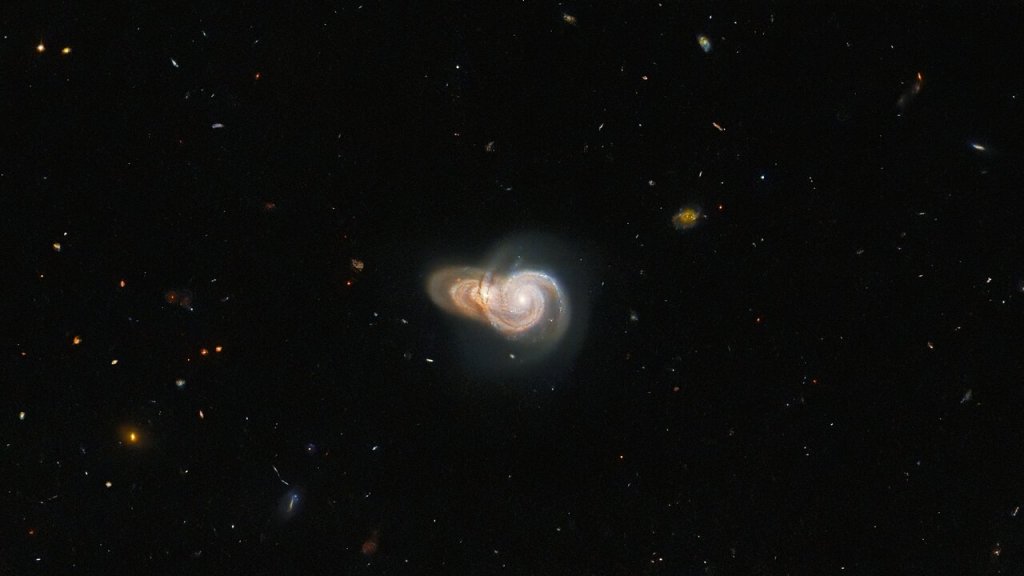
Image (Credit): Two spiral galaxies about 1 billion light-years away captured by the Hubble. (European Space Agency)

This week’s fascinating image from the NASA/ESA Hubble Space Telescope shows what appears to be two colliding spiral galaxies. A cropped version is shown below to highlight the colors. Here is more from ESA:

The two galaxies, which have the uninspiring names SDSS J115331 and LEDA 2073461, lie more than a billion light-years from Earth. Despite appearing to collide in this image, the alignment of the two galaxies is likely just by chance — the two are not actually interacting. While these two galaxies might simply be ships that pass in the night, Hubble has captured a dazzling array of interacting galaxies in the past.