Image (Credit): Multiple galaxies captured by the NASA/ESA Space Telescope – noted below. (ESA/Hubble & NASA, W. Keel)
With all the excitement about the James Webb Space Telescope, let’s not forget about the ongoing great work being performed by the Hubble Space Telescope. This recently released Hubble image shows multiple galaxies as well as multiple types of galaxies.
This luminescent image features multiple galaxies, perhaps most noticeably LEDA 58109, the lone galaxy in the upper right. LEDA 58109 is flanked by two further galactic objects to its lower left — an active galactic nucleus (AGN) called SDSS J162558.14+435746.4 that partially obscures the galaxy SDSS J162557.25+435743.5, which appears to poke out to the right behind the AGN.
Galaxy classification is sometimes presented as something of a dichotomy: spiral and elliptical. However, the diversity of galaxies in this image alone highlights the complex web of galaxy classifications that exist, including galaxies that house extremely luminous AGNs at their cores, and galaxies whose shapes defy the classification of either spiral or elliptical.
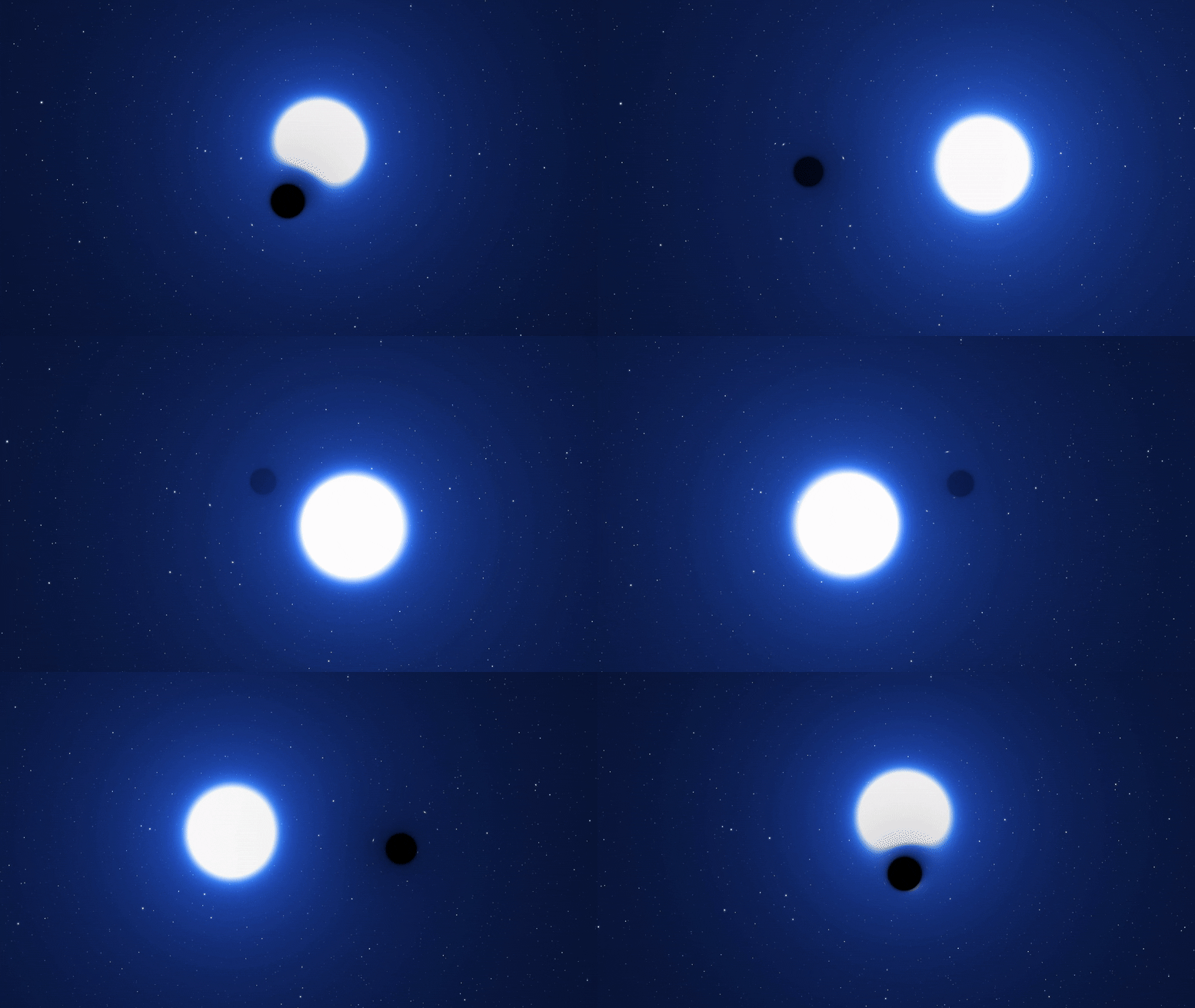
VFTS 243 is a binary system, which means it is composed of two objects that orbit a common center of mass. The first object is a very hot, blue star with 25 times the mass of the Sun, and the second is a black hole nine times more massive than the Sun. VFTS 243 is located in the Tarantula Nebula within the Large Magellanic Cloud, a satellite galaxy of the Milky Way located about 163,000 light-years from Earth.
Faced within increasing costs, the European Space Agency is looking for ways to revise the design of a large X-ray space telescope, an effort that could have implications for NASA’s own astrophysics programs…That effort will involve potential changes to its instrument configuration as well as creation of a science “redefinition” team to reconsider science objectives. The goal will be to develop a revised concept, called a minimum disrupted mission, that will cost ESA no more than 1.3 billion euros but still perform science expected of a flagship-class mission.
A NASA-funded sounding rocket mission will observe the remnants of an exploded star, uncovering new details about the eruption event while testing X-ray detector technologies for future missions. The High-Resolution Microcalorimeter X-ray Imaging, or Micro-X, experiment will launch Aug. 21 from the White Sands Missile Range in New Mexico. The mission’s target of study is some 11,000 light-years away from Earth, off the edge of the W-shaped constellation known as Cassiopeia. There, a massive bubble of radiant material known as Cassiopeia A, or Cas A for short, marks the site of a brilliant stellar death.
Image (Credit): The Cartwheel Galaxy, located about 500 million light-years away, as captured by the JWST. (NASA, ESA, CSA, STScI)
This week’s picture is one of the latest images from the James Webb Space Telescope (JWST). It shows the Cartwheel Galaxy, which is about 500 million light-years away. The Hubble’s view of this same galaxy is provided below.
NASA’s James Webb Space Telescope has peered into the chaos of the Cartwheel Galaxy, revealing new details about star formation and the galaxy’s central black hole. Webb’s powerful infrared gaze produced this detailed image of the Cartwheel and two smaller companion galaxies against a backdrop of many other galaxies. This image provides a new view of how the Cartwheel Galaxy has changed over billions of years.
The Cartwheel Galaxy, located about 500 million light-years away in the Sculptor constellation, is a rare sight. Its appearance, much like that of the wheel of a wagon, is the result of an intense event – a high-speed collision between a large spiral galaxy and a smaller galaxy not visible in this image. Collisions of galactic proportions cause a cascade of different, smaller events between the galaxies involved; the Cartwheel is no exception.
The collision most notably affected the galaxy’s shape and structure. The Cartwheel Galaxy sports two rings — a bright inner ring and a surrounding, colorful ring. These two rings expand outwards from the center of the collision, like ripples in a pond after a stone is tossed into it. Because of these distinctive features, astronomers call this a “ring galaxy,” a structure less common than spiral galaxies like our Milky Way.
The bright core contains a tremendous amount of hot dust with the brightest areas being the home to gigantic young star clusters. On the other hand, the outer ring, which has expanded for about 440 million years, is dominated by star formation and supernovas. As this ring expands, it plows into surrounding gas and triggers star formation.
Image (Credit): An image of the Cartwheel Galaxy taken with the NASA/ESA Hubble Space Telescope. (ESA/Hubble & NASA)
Image (Credit): Recent JWST analysis of exoplanet WASP-96 b. (NASA, ESA, CSA, and STScI)
The recent James Webb Space Telescope (JWST) images included hot gas giant exoplanet WASP-96 b, with NASA noting that the space telescope “…has captured the distinct signature of water, along with evidence for clouds and haze, in the atmosphere surrounding a hot, puffy gas giant planet orbiting a distant Sun-like star.”
The same NASA article also noted that the Hubble Space Telescope had found the first evidence of water on a exoplanet back in 2013. So I thought I would dig out that earlier from the European Space Agency, titled “Hubble Finds Water Vapour on Habitable-Zone Exoplanet for the First Time“:
With data from the NASA/ESA Hubble Space Telescope, water vapour has been detected in the atmosphere of a super-Earth within the habitable zone by University College London (UCL) researchers in a world first. K2-18b, which is eight times the mass of Earth, is now the only planet orbiting a star outside the Solar System, or exoplanet, known to have both water and temperatures that could support life.
The parent star, K2-18, is 110 light years from Earth in the constellation of Leo. Maybe we can convince the ESA and others to take another look with the JWST, assuming it is not already on the list of many upcoming projects.
Image (Credit): Stephan’s Quintet, representing a grouping of five galaxies, as captured by the JWST. (NASA, ESA, CSA, and STScI)
I think we are all eager for more amazing photos from the James Webb Space Telescope, but we need to remember that the space telescope has a long list of priorities and these were not simply random images. An international committee with representatives from NASA, the European Space Agency (ESA), the Canadian Space Agency (CSA), and the Space Telescope Science Institute (STScI) decided on the future work of the space telescope.
The committee has shared these five missions represented by the images already released to the public, indicating the JWST has been pretty busy already:
Carina Nebula: The Carina Nebula is one of the largest and brightest nebulae in the sky, located approximately 7,600 light-years away in the southern constellation Carina. Nebulae are stellar nurseries where stars form. The Carina Nebula is home to many massive stars several times larger than the Sun.
WASP-96b (spectrum): WASP-96b is a giant planet outside our solar system, composed mainly of gas. The planet, located nearly 1,150 light-years from Earth, orbits its star every 3.4 days. It has about half the mass of Jupiter, and its discovery was announced in 2014.
Southern Ring Nebula: The Southern Ring, or “Eight-Burst” nebula, is a planetary nebula – an expanding cloud of gas surrounding a dying star. It is nearly half a light-year in diameter and is located approximately 2,000 light-years away from Earth.
Stephan’s Quintet: About 290 million light-years away, Stephan’s Quintet is located in the constellation Pegasus. It is notable for being the first compact galaxy group ever discovered in 1787. Four of the five galaxies within the quintet are locked in a cosmic dance of repeated close encounters.
SMACS 0723: Massive foreground galaxy clusters magnify and distort the light of objects behind them, permitting a deep field view into both the extremely distant and intrinsically faint galaxy populations.
So what else is planned? NASA believes the JWST can stay in operation for the next 5 to 10 years, so it has a fair amount of time to allocate to scientists. This link takes you to the 266 approved projects for the telescope’s first year, representing approximately 6,000 hours of JWST prime time and up to 1,231 hours of parallel time. For instance, during the first year you have “Exoplanets and Disks” projects such as:
Icy Kuiper Belts in Exoplanetary Systems;
Unlocking the Mysteries of the Archetype Sub-Neptune GJ1214b with a Full-Orbit Phase Curve;
A Search for the Giant Planets that Drive White Dwarf Accretion;
Tell Me How I’m Supposed To Breathe With No Air: Measuring the Prevalence and Diversity of M-Dwarf Planet Atmospheres; and
Diamonds are Forever: Probing the Carbon Budget and Formation History of the Ultra-Puffy Hot Jupiter WASP-127b.
That is just a sample, but you can see from some of that titles that the scientists are having fun. Expect hundreds of new discoveries this year resulting from these observations.




 Our Awesome Universe