Space Stories: Chinese Space Partnerships, Approaching Comet, and European Rocket Shortage

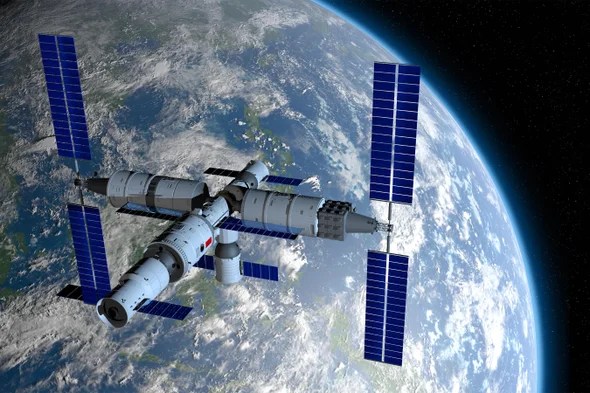
Image (Credit): Chinese space program poster. (Asia Times)

Here are some recent stories of interest.

SpaceNews.com: “China Looks to Build Space Partnerships with Gulf Nations

China is aiming to grow cooperation with emerging space nations including Saudi Arabia and the United Arab Emirates. Space was named as one of a number of priority areas for the next three to five years during the first China-Gulf Cooperation Council (GCC) Summit held in Riyadh earlier this month. “China stands ready to work with GCC countries on remote sensing and communications satellite, space utilization, aerospace infrastructure, and the selection and training of astronauts,” according to the text of the keynote speech made by Chinese President Xi Jinping at the summit, Dec. 9. The GCC intergovernmental group comprises Saudi Arabia, the United Arab Emirates, Bahrain, Kuwait, Oman and Qatar.

Newsweek: “Once-in-a-Lifetime Cosmic Event Could Be Visible to the Naked Eye

A comet zooming through the solar system could soon be visible to the naked eye from Earth in what will be a once-in-a-lifetime event. And some astronomical predictions indicate that the object may never return to our cosmic neighborhood. C/2022 E3 (ZTF) is currently located around 100 million miles away from Earth and will make a close approach to our planet in early February 2023.

Atalayar.com: Europe Runs out of Rockets for Autonomous Access to Space

Overnight, the European Space Agency (ESA) headed by Austrian Josef Aschbacher has been left without any capacity to position its own satellites in outer space. Neither Aschbacher nor his director of space transport, the Swiss Daniel Neuenschwander, have any space vector model to fulfil their commitments to the European Union to renew the Copernicus constellation and place their Sentinel environmental monitoring satellites in orbit. Much less is ESA in a position to meet the growing global demand for launch services that is knocking on its doors, those of the United States, China and India.

Pic of the Week: Stunning Auroras

Image (Credit): View from the ISS – further description below. (ESA/NASA-S.Cristoforetti)

This week’s image is from the European Space Agency’s (ESA) Year in Images 2022 collection and shows a view from the International Space Station (ISS).

Here is the description of the image from the ESA:

Aurorae observed by ESA astronaut Samantha Cristoforetti aboard the International Space Station for her Minerva Mission. She shared these images to her social media on 21 August 2022 with the caption: “The Sun has been really active lately. Last week we saw the most stunning auroras I have ever experienced in over 300 days in space!”

You can read more about ESA astronaut Cristoforetti’s work on the ISS here.

Pic of the Week: A Wreath Just in Time for Christmas

Image (Credit): Spiral galaxy NGC 7469 face-on. (NASA)

This week’s image is from the James Webb Space Telescope (JWST). It is a face-on view of wreath-like spiral galaxy NGC 7469, which is about 220 million light-years from Earth.

Here is a little more from the European Space Agency on the image:

While NGC 7469 is one of the best studied AGNs in the sky, the compact nature of this system and the presence of a great deal of dust have made it difficult for scientists to achieve both the resolution and sensitivity needed to study this relationship in the infrared. Now, with Webb, astronomers can explore the galaxy’s starburst ring, the central AGN, and the gas and dust in between. Using Webb’s MIRI, NIRCam and NIRspec instruments to obtain images and spectra of NGC 7469 in unprecedented detail, the GOALS team has uncovered a number of details about the object. This includes very young star-forming clusters never seen before, as well as pockets of very warm, turbulent molecular gas, and direct evidence for the destruction of small dust grains within a few hundred light-years of the nucleus — proving that the AGN is impacting the surrounding interstellar medium. Furthermore, highly ionised, diffuse atomic gas seems to be exiting the nucleus at roughly 6.4 million kilometres per hour — part of a galactic outflow that had previously been identified, but is now revealed in stunning detail with Webb. With analysis of the rich Webb datasets still underway, additional secrets of this local AGN and starburst laboratory are sure to be revealed.

A prominent feature of this image is the striking six-pointed star that perfectly aligns with the heart of NGC 7469. Unlike the galaxy, this is not a real celestial object, but an imaging artifact known as a diffraction spike, caused by the bright, unresolved AGN. Diffraction spikes are patterns produced as light bends around the sharp edges of a telescope. Webb’s primary mirror is composed of hexagonal segments that each contain edges for light to diffract against, giving six bright spikes. There are also two shorter, fainter spikes, which are created by diffraction from the vertical strut that helps support Webb’s secondary mirror.

Space Stories: Bezos on the Moon, Strange Oort Objects, and Europe Visits Venus

Image (Credit): Artist’s rending of the Blue Origin lunar cargo lander. (Blue Origin)

Here are some recent stories of interest.

Reuters: “Bezos’ Space Company Teams with Lockheed, Boeing for NASA Moon Lander Pitch

Jeff Bezos’ space company Blue Origin is partnering with Boeing Co and Lockheed Martin Corp to pitch a lunar lander to NASA as the agency seeks to send humans to the moon again, the companies announced on Tuesday. The joint moon lander proposal, led by Blue Origin, marks the companies’ second attempt to win a coveted moon lander contract as NASA seeks more options for getting astronauts to the lunar surface under its multibillion dollar Artemis program.

Western University: “‘Unexpected’ Space Traveller Defies Theories About Origin of Solar System

Researchers from Western have shown that a fireball that originated at the edge of the Solar System was likely made of rock, not ice, challenging long-held beliefs about how the Solar System was formed. Just at the edge of our Solar System and halfway to the nearest stars is a collection of icy objects sailing through space, known as the Oort Cloud. Passing stars sometimes nudge these icy travellers towards the Sun, and we see them as comets with long tails. Scientists have yet to observe any objects in the Oort Cloud directly, but everything detected so far coming from its direction has been made of ice. Theoretically, the very basis of understanding our Solar System’s beginnings is built upon the foundation that only icy objects exist in these outer reaches and certainly, nothing made of rock.

Universe Today: “ESA’s Upcoming Mission Will Tell us if Venus is Still Volcanically Active

The EnVision mission is ESA’s fifth medium-class mission to Venus. It’s being planned in a partnership between NASA and ESA, and NASA will be providing the synthetic aperture radar instrument, which will map the surface (much as Magellan did). In addition to the two radars, the orbiter will carry spectrometers to study the atmosphere and surface. They will monitor trace gases in the atmosphere and analyze surface composition. The idea is to look for surface changes that might be linked to signs of active volcanism. Along with the VERITAS and DAVINCI missions, EnVision should reveal all we need to know about volcanic activity on Venus.

Pic of the Week: Distant Stellar Nursery

Image (Credit): CB 130-3 as captured by the Hubble Space Telescope. (ESA/Hubble, NASA & STScI, C. Britt, T. Huard, A. Pagan)

This week’s image comes from the Hubble Space Telescope. It shows a distant cloud of gas and dust known as CB 130-3. Such clouds can create new stars, as explained by the European Space Agency:

CB 130-3 is an object known as a dense core, a compact agglomeration of gas and dust. This particular dense core is in the constellation Serpens and seems to billow across a field of background stars.

Dense cores like CB 130-3 are the birthplaces of stars and are of particular interest to astronomers. During the collapse of these cores enough mass can accumulate in one place to reach the temperatures and densities required to ignite hydrogen fusion, marking the birth of a new star. While it may not be obvious from this image, a compact object teetering on the brink of becoming a star is embedded deep within CB 130-3.

Astronomers used Hubble’s Wide Field Camera 3 to better understand the environment surrounding this fledgling star. As this image shows, the density of CB 130-3 isn’t constant; the outer edges of the cloud consist of only tenuous wisps, whereas at its core CB 130-3 blots out background light entirely. The gas and dust making up CB 130-3 affect not only the brightness but also the apparent color of background stars, with stars toward the cloud’s center appearing redder than their counterparts at the outskirts of this image. Astronomers used Hubble to measure this reddening effect and chart out the density of CB 130-3, providing insights into the inner structure of this stellar nursery.