Image (Credit): The Expedition 1 crew of Yuri P. Gidzenko (left), William M. Shepherd, and Sergei K. Krikalev in the ISS’s Zvezda Service Module. (NASA)
It was 25 years ago on this day that the Expedition 1 crew arrived at the International Space Station (ISS), which marked the beginning of very successful space collaboration between five space agencies from the United States, Russia, the European Union, Japan, and Canada.
The Expedition 1 crew, arriving at the ISS aboard a Russian Soyuz capsule, consisted of NASA astronaut William M. Shepherd and Russian cosmonauts Yuri P. Gidzenko and Sergei K. Krikalev. This first mission of four months focused on the continued assembly of the station, with the Expedition 2 crew arriving in March 2001 aboard Space Shuttle Discovery.
In 24 hours, the space station makes 16 orbits of Earth, traveling through 16 sunrises and sunsets.
The living and working space in the station is larger than a six-bedroom house (and has six sleeping quarters, two bathrooms, a gym, and a 360-degree view bay window).
A spacecraft can arrive at the space station as soon as four hours after launching from Earth.
The space station travels an equivalent distance to the Moon and back in about a day.
Image (Credit): Drawing of the International Space Station with all of the elements labeled. (NASA)
Within the next 18 months, the space shuttle Discovery may be disassembled in Washington D.C., transported more than 1,000 miles to Houston and reassembled. But not if grassroots group Keep The Shuttle has anything to say about it. The plan to move a shuttle, notably an unnamed shuttle, was part of President Donald Trump’s “Big Beautiful Bill” passed this summer. The Smithsonian and others have dug in against the move, saying the research institute actually owns the Discovery in a trust for the American people, nothing that it’s unclear if Congress even has the authority to order the Smithsonian transfer an artifact.
Thanks to the huge spate of exoplanet discoveries, multiple rocky planets have been found orbiting within the habitable zones (HZs) of red dwarf stars. For decades, there has been an ongoing debate as to whether these systems could be our best bet for finding evidence of life beyond Earth. In a recent study, Professor David Kipping addresses two key facts that could mean humanity is an outlier. Based on the age of the Universe and the relatively rare nature of our Sun, he concludes that astrobiologists examining red dwarf planets may be looking in the wrong place.
A rare interstellar comet — only the third ever confirmed to enter our solar system — was photographed last week, closely approaching Mars, the European Space Agency said Tuesday. The images taken on Friday by two Mars orbiters show a bright, fuzzy white dot of the comet, also known as 3I/ATLAS, appearing to move against a backdrop of distant stars as it was about 18,641,135 miles away from Mars. The comet poses no threat to Earth, NASA has previously said.
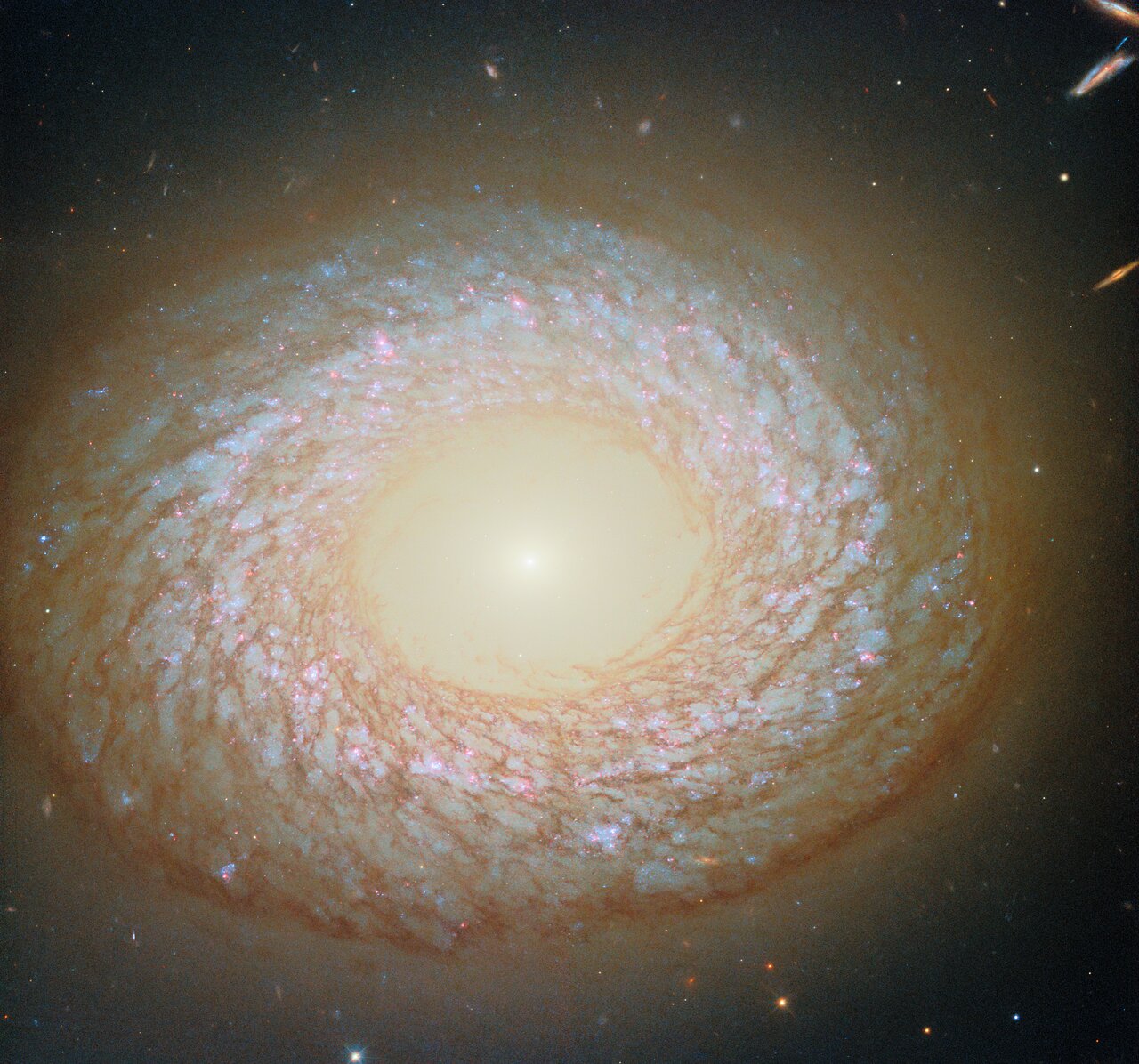
Image (Credit): NGC 2775, which is 67 million light-years away, as captured by the NASA/ESA Hubble Space Telescope. (ESA/Hubble & NASA, F. Belfiore, J. Lee and the PHANGS-HST Team)
This week’s image is from the NASA/European Space Agency (ESA) Hubble Space Telescope. It shows the odd galaxy NGC 2275 that is hard to describe. Is it an elliptical galaxy, a spiral galaxy, or something else?
NGC 2775 sports a smooth, featureless centre that is devoid of gas, resembling an elliptical galaxy. It also has a dusty ring with patchy star clusters, like a spiral galaxy. Which is it, then: spiral or elliptical — or neither?
Because we can only view NGC 2775 from one angle, it’s difficult to say for sure. Some researchers have classified NGC 2775 as a spiral galaxy because of its feathery ring of stars and dust, while others have classified it as a lenticular galaxy. Lenticular galaxies have features common to both spiral and elliptical galaxies.
It’s not yet known exactly how lenticular galaxies come to be, and they might form in a variety of ways. Lenticular galaxies might be spiral galaxies that have merged with other galaxies, or that have mostly run out of star-forming gas and lost their prominent spiral arms. They also might have started out more similar to elliptical galaxies, then collected gas into a disk around them.
Some evidence suggests that NGC 2775 has merged with other galaxies in the past. Invisible in this Hubble image, NGC 2775 has a tail of hydrogen gas that stretches almost 100 000 light-years around the galaxy. This faint tail could be the remnant of one or more galaxies that wandered too close to NGC 2775 before being stretched apart and absorbed. If NGC 2775 merged with other galaxies in the past, it could explain the galaxy’s strange appearance today.
Image (Credit): The protostar IRAS 04302. (ESA/Webb, NASA & CSA, M. Villenave et al.)
This week’s image comes from the James Webb Space Telescope (JWST). It shows the beginning of exoplanets about 525 light-years away. Labeled the ever appealing name of IRAS 04302+2247, or better yet the Butterfly Star, the young star with its protoplanetary disc provides astronomers with plenty of information about the development of a protostar and its solar system.
In stellar nurseries across the galaxy, baby stars are forming in giant clouds of cold gas. As young stars grow, the gas surrounding them collects in narrow, dusty protoplanetary discs. This sets the scene for the formation of planets, and observations of distant protoplanetary discs can help researchers understand what took place roughly 4.5 billion years ago in our own Solar System, when the Sun, Earth, and the other planets formed.
IRAS 04302+2247, or IRAS 04302 for short, is a beautiful example of a protostar – a young star that is still gathering mass from its environment – surrounded by a protoplanetary disc in which baby planets might be forming. Webb is able to measure the disc at 65 billion km across – several times the diameter of our Solar System. From Webb’s vantage point, IRAS 04302’s disc is oriented edge-on, so we see it as a narrow, dark line of dusty gas that blocks the light from the budding protostar at its centre. This dusty gas is fuel for planet formation, providing an environment within which young planets can bulk up and pack on mass.
When seen face-on, protoplanetary discs can have a variety of structures like rings, gaps and spirals. These structures can be signs of baby planets that are burrowing through the dusty disc, or they can point to phenomena unrelated to planets, like gravitational instabilities or regions where dust grains are trapped. The edge-on view of IRAS 04302’s disc shows instead the vertical structure, including how thick the dusty disk is. Dust grains migrate to the midplane of the disc, settle there and form a thin, dense layer that is conducive to planet formation; the thickness of the disc is a measure of how efficient this process has been.
The dense streak of dusty gas that runs vertically across this image cocoons IRAS 04302, blotting out its bright light such that Webb can more easily image the delicate structures around it. As a result, we’re treated to the sight of two gauzy nebulas on either side of the disc. These are reflection nebulas, illuminated by light from the central protostar reflecting off of the nebular material. Given the appearance of the two reflection nebulas, IRAS 04302 has been nicknamed the ‘Butterfly Star’.
Image (Credit): International partners empowering NASA’s mission on Mars. (US Embassy & Consulates in Italy)
While spreading out the manned missions to the International Space Station (ISS) among various private sector partners sounded like a great idea, it has proven less than perfect. First we had to worry about the emotional stability of SpaceX’s CEO, and now we need to worry about the financial viability of Boeing, the only other company on a path to bring astronauts to the ISS.
…faced challenges including labor actions, production delays, quality control problems, and financial losses on government contracts. Given Boeing’s importance to the defense industrial base, Congress may assess whether or not these developments have implications for U.S. national security…Some analysts have speculated that Boeing could declare bankruptcy or seek to sell elements of its space or defense business.
One of the author’s suggestions is for the US government to expand its contracting efforts with “trusted international companies.” While the article is focused on the defense realm, it sounds like a good idea for the space realm as well.
The major US space goals already include our trusted international partners, such as the ISS, Artemis and Mars programs, so none of this much of a stretch. Maybe it just needs to be more of the focus as the current US firms show their vulnerabilities when poorly managed. I would add to this list the need to offer greater support to other, newer US-based space companies to further diversity the workload.
This may not be a time to call for greater international coordination led by NASA when the agency is also showing its vulnerabilities when poorly managed, yet we need to plan for future days when the craziness dies down. In the meantime, as Europe prepares for NASA cuts to joint programs, we have a lot of convincing to do if we want a deeper international space industry.
A new administrator for NASA may help, as well as a Congress that does its job and protects the future of our space programs.
I don’t care if you call it “Make the Moon the Goal Again.” Just get started.






 Our Awesome Universe