Yesterday, the European Space Agency (ESA) announced that another space program has been impacted by the Russia’s invasion of Ukraine:
Regarding the ExoMars programme continuation, the sanctions and the wider context make a launch in 2022 very unlikely. ESA’s Director General will analyse all the options and prepare a formal decision on the way forward by ESA Member States.
The ESA website on the Exomars program notes that it is a two part mission searching for life on Mars: the Trace Gas Orbiter launched in 2016 and the Exomars rover and surface platform planned for launch in 2022. NASA also contributed to this latest mission:
NASA’s participation in the 2022 ExoMars Rover mission includes providing critical elements to the premier astrobiology instrument on the rover, the Mars Organic Molecule Analyzer (MOMA). By studying organic molecules, the chemical building blocks of life, MOMA is designed to help answer questions about whether life ever existed on Mars, along with its potential origin, evolution and distribution on the Red Planet.
The list of impacted space missions will only grow.
Source/Credit: Guiana Space Center launch pads from the ESA.
Be prepared. With the ongoing Russian invasion of Ukraine and the related U.S. and European sanctions, we can expect some delays and cancellations in upcoming space missions. The latest news story is Russia’s pull out of the Guiana Space Center in Kourou, French Guiana, leading to the delayed launch of two European Space Agency (ESA) Galileo navigation satellites that were to be sent into orbit on Soyuz rockets.
Director General of Russia’s Roscosmos tweeted:
In response to EU sanctions against our enterprises, Roscosmos is suspending cooperation with European partners in organizing space launches from the Kourou cosmodrome and withdrawing its technical personnel, including the consolidated launch crew, from French Guiana.
Luckily, the world is becoming less and less reliant on Russian rockets. Nonetheless, it would be better for Russia to focus on scientific missions again rather than military missions. Rockets should be aimed at the stars instead of the Ukrainian people.
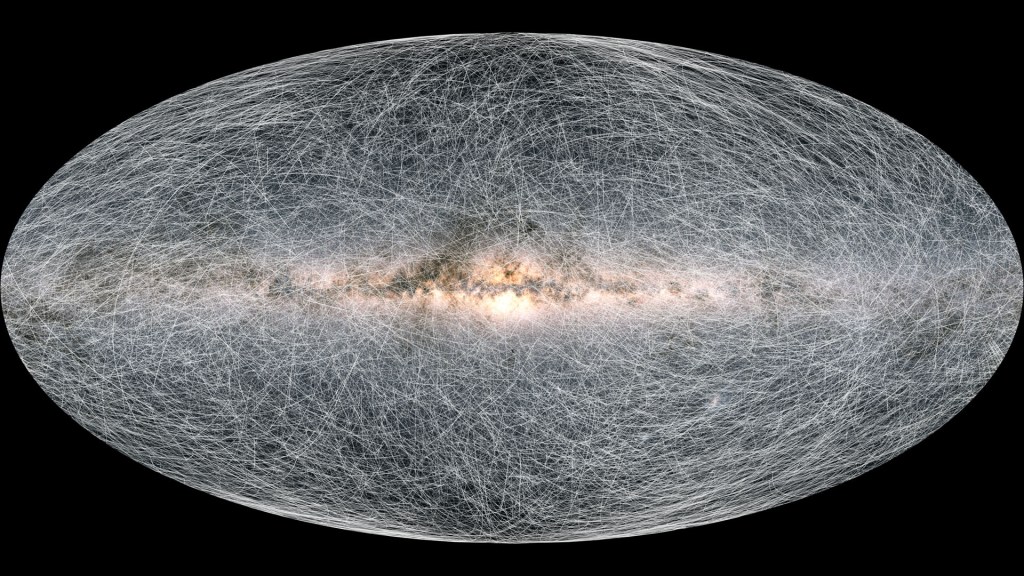
Source/Credit: Gaia spacecraft map of the Milky Way from ESA.
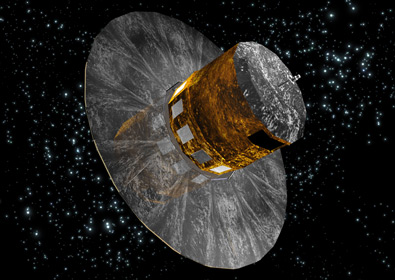
The European Space Agency (ESA) reported scientists found the remnants of another galaxy that collides with our galaxy 8-10 billion years ago. This would be the sixth such grouping or galaxy to be found within the Milky Way. We commonly hear about merging planets in the early stages of our solar system, but that is small stuff by comparison. Observations from ESA’s Gaia spacecraft led to this discovery. This merged galaxy is called “Pontus,” the name of one of the first children of Gaia, the Greek goddess of the Earth.
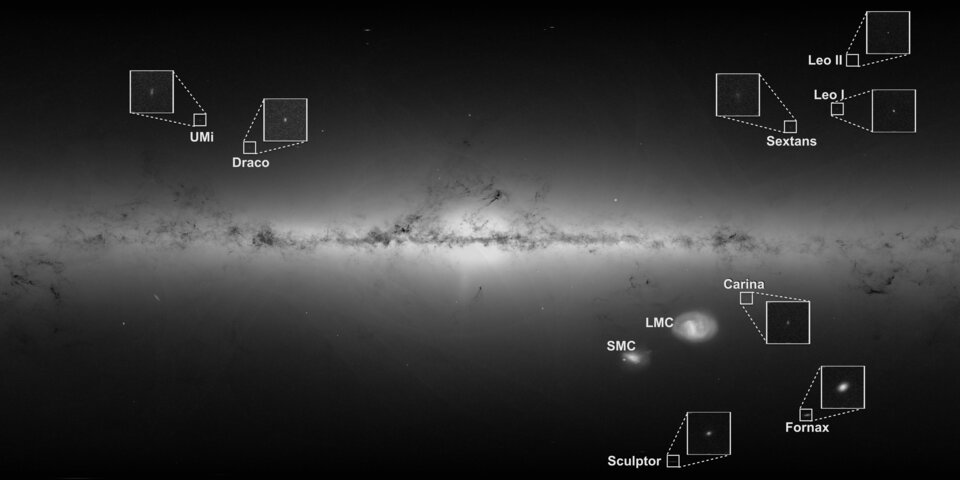
An earlier ESA release discussed the number of galaxies that arrived more recently and may pass us by or be caught by the Milky Way and pulled apart like Pontus and the others:
François Hammer, Observatoire de Paris – Université Paris Sciences et Lettres, France, and colleagues from across Europe and China, used the Gaia data to calculate the movements of 40 dwarf galaxies around the Milky Way. They did this by computing a set of quantities known as the three-dimensional velocities for each galaxy, and then using those to calculate the galaxy’s orbital energy and the angular (rotational) momentum.
They found that these galaxies are moving much faster than the giant stars and star clusters that are known to be orbiting the Milky Way. So fast, that they couldn’t be in orbit yet around the Milky Way, where interactions with our galaxy and its contents would have sapped their orbital energy and angular momentum…
So will these newcomers settle into orbit or simply pass us by? “Some of them will be captured by the Milky Way and will become satellites,” says François.
I wonder what is would be like sitting in one of those smaller galaxies awaiting your fate. Of course, it will be a very long wait.
Source/Credit: Dwarf galaxies around the Milky Way from ESA.
Source/credit: Gaia spacecraft from the ESA/- C. Carreau.
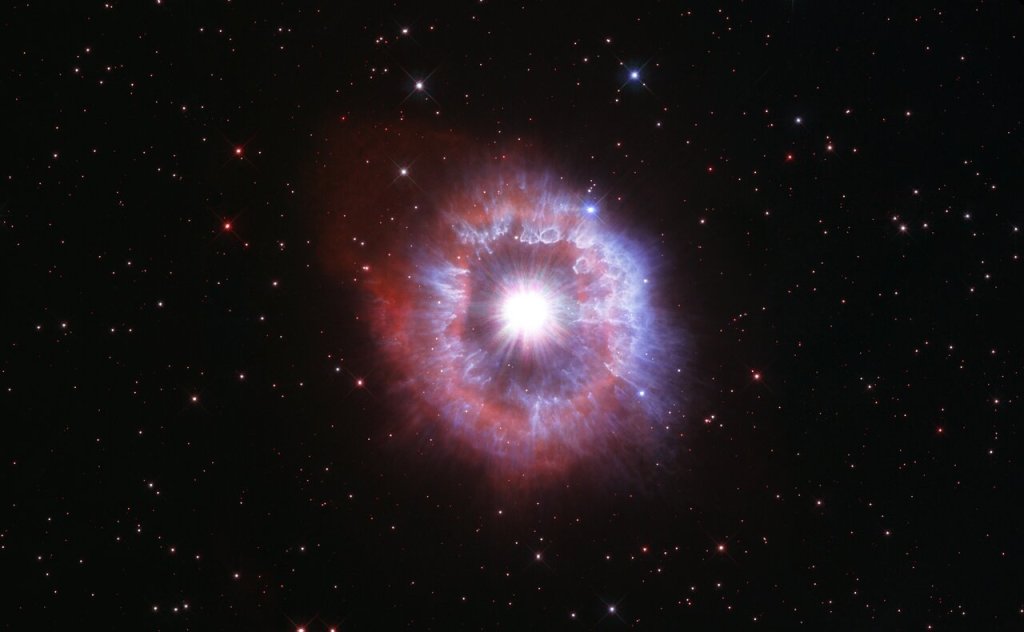
The giant star…is waging a tug-of-war between gravity and radiation to avoid self-destruction. The star, called AG Carinae, is surrounded by an expanding shell of gas and dust — a nebula — that is shaped by the powerful winds of the star. The nebula is about five light-years wide, which equals the distance from here to our nearest star, Alpha Centauri.
The huge structure was created from one or more giant eruptions several thousand years ago. The star’s outer layers were blown into space, the expelled material amounting to roughly 10 times the mass of our Sun. These outbursts are typical in the life of a rare breed of star called a Luminous Blue Variable (LBV), a brief unstable phase in the short life of an ultra-bright, glamorous star that lives fast and dies young. These stars are among the most massive and brightest stars known. They live for only a few million years, compared to the roughly 10-billion-year lifetime of our own Sun. AG Carinae is a few million years old and resides 20,000 light-years away inside our Milky Way galaxy. The star’s expected lifetime is between 5 million and 6 million years.
With all the previous posts about NASA’s Artemis mission, I should have outlined the three stages ahead as we return to the Moon:
Artemis I: This stage involves an uncrewed flight test around the Moon. The new Space Launch System carrying the empty Orion spacecraft will launch from NASA’s Kennedy Space Center in Florida. The mission will last from four to six weeks. The European Space Agency has supplied a key piece for this mission – a service module, which will supply the spacecraft’s main propulsion system and power (and also house air and water for astronauts on future missions).
Artemis II: This next stage will confirm all of the Orion spacecraft’s systems operate as designed with crew aboard in the actual environment of deep space as the spacecraft circles the Moon. The mission is expected to last just over 10 days
Artemis III: This third and final stage will land a crew on the surface of the Moon. NASA has awarded Human Landing System contracts to Blue Origin, Dynetics, and SpaceX. This final stage will be followed by annual crewed missions to the Moon.
The ultimate goal of Artemis is to establish a presence on the Moon as well as build an orbiting Gateway that can serve as a multi-purpose outpost providing essential support for long-term human return to the lunar surface. The Gateway will also serve as a staging points for deep space exploration, such as travel to Mars.
This is a broad and hopeful mission. The only thing that seems a bit odd is the website mission statement for Artemis:
With Artemis missions, NASA will land the first woman and first person of color on the Moon, using innovative technologies to explore more of the lunar surface than ever before. We will collaborate with commercial and international partners and establish the first long-term presence on the Moon. Then, we will use what we learn on and around the Moon to take the next giant leap: sending the first astronauts to Mars.
I think the first focus of this multi-billion dollar lunar mission should be space exploration, which should also include a diverse crew. Maybe it is better to stick to the more universal statement in the earlier Artemis Plan:
Under the Artemis program, humanity will explore regions of the Moon never visited before, uniting people around the unknown, the never seen, and the once impossible. We will return to the Moonrobotically beginning next year, send astronauts to the surface within four years, and build a longterm presence on the Moon by the end of the decade…we will use the Moon as the stepping stone for our next greatest leap—human exploration of Mars.
You say potato and I say spuds.
Source/Credit: Artemis I mission map from NASA.
Note: NASA’s Artemis page was somewhat out of date when I posted this summary. For instance, in April 2021, SpaceX was chosen to provide the lunar lander.
Update: On March 31st, NASA announced it was looking for “…other U.S. companies to provide new lander development and demonstration missions from lunar orbit to the surface of the Moon.”




 Our Awesome Universe