Pic of the Week: Barred Spiral Galaxy NGC 5335

Image (Credit): Barred Spiral Galaxy NGC 5335 (NASA, ESA, STScI)

This week’s image looks like something ginned up by AI, but it is from the Hubble Space Telescope. Just the number of stray galaxies in the image is amazing.

Here is the description of the image from the European Space Agency’s (ESA) Hubble page:

Barred spiral galaxy NGC 5335 observed by the Hubble Space Telescope takes up the majority of the view. At its center is a milky yellow, flattened oval that extends bottom left to top. Within the oval is a bright central region that looks circular, with the very center the brightest. In the bright central region is what looks like a bar, extending from top left to bottom right. Around this is a thick swath of blue stars speckled with white regions. Multiple arms wrap up and around in a counterclockwise direction, becoming fainter the farther out they are. Both the white core and the spiral arms are intertwined with dark streaks of dust. The background of space is black. Thousands of distant galaxies in an array of colors are speckled throughout.

Pic of the Week: The Eagle Nebula

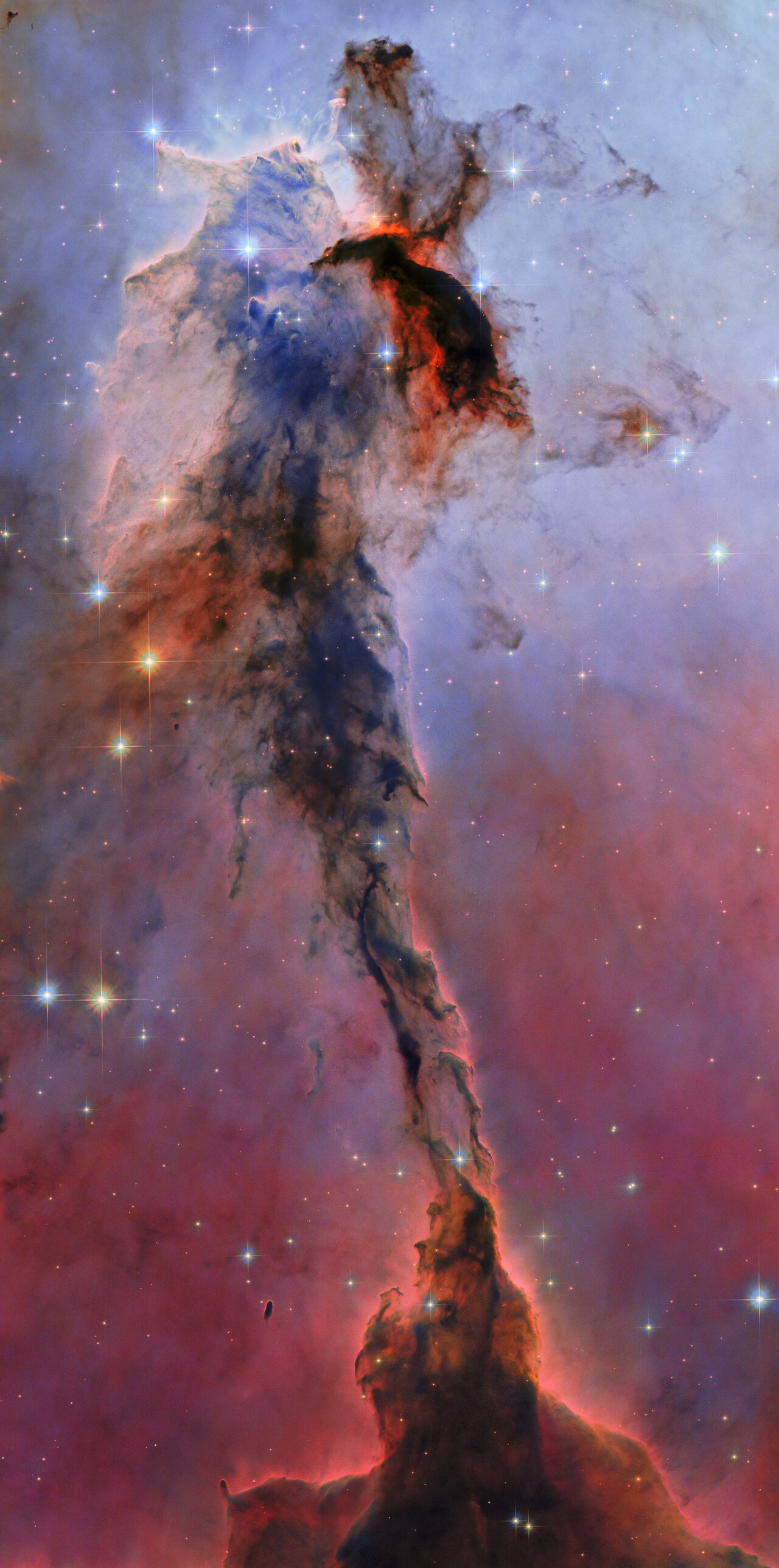
Image (Credit): Messier 16, or the Eagle Nebula. (ESA/Hubble & NASA, K. Noll)

This week’s updated image is from the Hubble Space Telescope. It shows the Eagle Nebula in all its glory, located not too far from the Pillars of Creation.

For more on this spectacular image, we turn to the European Space Agency’s (ESA) Hubble page:

Unfurling along the length of the image is a pillar of cold gas and dust that is 9.5 light-years tall. As enormous as this dusty pillar is, it’s just one small piece of the greater Eagle Nebula, which is also called Messier 16. The name Messier 16 comes from the French astronomer Charles Messier, a comet hunter who compiled a catalogue of deep-sky objects that could be mistaken for comets.

The name Eagle Nebula was inspired by the nebula’s appearance. The edge of this shining nebula is shaped by dark clouds like this one, giving it the appearance of an eagle spreading its wings.

Not too far from the region pictured here are the famous Pillars of Creation, which Hubble has photographed multiple times, with images released in 1995 and 2015.

The heart of the nebula, which is located beyond the edge of this image, is home to a cluster of young stars. These stars have excavated an immense cavity in the centre of the nebula, shaping otherworldly pillars and globules of dusty gas. This particular feature extends like a pointing finger toward the centre of the nebula and the rich young star cluster embedded there.

The Eagle Nebula is one of many nebulae in the Milky Way that are known for their sculpted, dusty clouds. Nebulae take on these fantastic shapes when exposed to powerful radiation and winds from infant stars. Regions with denser gas are more able to withstand the onslaught of radiation and stellar winds from young stars, and these dense areas remain as dusty sculptures like the starry pillar shown here.

Pic of the Week: Happy Birthday Hubble!

Image (Credit): The Hubble Space Telescope in low-Earth orbit. (NASA)

This year marks the 35th anniversary of the Hubble Space Telescope. It was launched on April 24, 1990 aboard the Space Shuttle Discovery. The telescope was expected to have a service life of 35 years, though it is still going strong with various proposals to update the telescope and keep it operating for years to come.

To mark the occasion, NASA put together a video highlighting missions and related images. The celebration will continue throughout the year with new images and other selected items.

Here are a few interesting facts related to the Hubble:

  • Hubble is currently located 326 miles (525 km) above Earth’s surface. If you could drive straight up, you could reach it in about the same time it would take you to drive from Baltimore, Maryland to Boston, Massachusetts. 
  • Hubble races through its orbit at about 17,000 miles per hour (27,000 kph), completing an orbit about every 95 minutes. That means it sees 15 sunrises every day.
  • While Hubble is speeding around Earth, it can lock onto a target without deviating more than 7/1000th of an arcsecond, or about the width of a human hair seen at a distance of one mile.
Image (Credit): Hubble 35th Anniversary Graphic. (NASA)

Pic of the Week: The Starburst Galaxy

Image (Credit): Starburst Galaxy Messier 94. (ESA/Hubble and NASA)

This week’s image is from the Hubble Space Telescope. It was shared on NASA’s Astronomy Picture of the Week website last month. The sparkling galaxy, Messier 94, is about 15 million light-years away.

Here is NASA’s description of what you are seeing above:

Beautiful island universe Messier 94 lies a mere 15 million light-years distant in the northern constellation of the hunting dogs, Canes Venatici. A popular target for earth-based astronomers, the face-on spiral galaxy is about 30,000 light-years across, with spiral arms sweeping through the outskirts of its broad disk. But this Hubble Space Telescope field of view spans about 7,000 light-years or so across M94’s central region. The sharp close-up examines the galaxy’s compact, bright nucleus and prominent inner dust lanes, surrounded by a remarkable bluish ring of young, massive stars. The massive stars in the ring appear to be less than about 10 million years old, indicating the galaxy experienced a corresponding well-defined era of rapid star formation. As a result, while the small, bright nucleus is typical of the Seyfert class of active galaxies, M94 is also known as a starburst galaxy. Because M94 is relatively nearby, astronomers can explore in detail reasons for the galaxy’s burst of star formation.

Note: I swapped out the earlier protostar image for this one when I realized I was duplicating an earlier entry.

Pic of the Week: Swan Song for Stars

Image (Credit): A planetary nebula named Kohoutek 4-55. (ESA/Hubble & NASA, K. Noll)

This image is from the ESA/Hubble Picture of the Week website. It shows a colorful planetary nebula called Kohoutek 4-55, which is about 4600 light-years away.

The ESA/Hubble website defines what you are seeing in this way:

A planetary nebula, a glowing shell of material thrown off by a star. A small central region of greenish clouds is encircled by a glowing, jagged ring, like a hole torn in fabric. A band of silvery-blue clouds outside this is again encircled by a larger, fainter yellow ring of gas. Puffy, smoky clouds of orange and red gas billow out from there into a large oval nebula, fading into the dark background of space.