Do We Need to Worry About Boeing as a Space Partner?

Image (Credit): International partners empowering NASA’s mission on Mars. (US Embassy & Consulates in Italy)

While spreading out the manned missions to the International Space Station (ISS) among various private sector partners sounded like a great idea, it has proven less than perfect. First we had to worry about the emotional stability of SpaceX’s CEO, and now we need to worry about the financial viability of Boeing, the only other company on a path to bring astronauts to the ISS.

At least that is the argument of Sophia Pappalardo in a Reason magazine article titled “America’s Reliance on Boeing Is a National Security Liability.” She cites a Congressional Research Service report on Boeing that states that since 2018 the company has:

…faced challenges including labor actions, production delays, quality control problems, and financial losses on government contracts. Given Boeing’s importance to the defense industrial base, Congress may assess whether or not these developments have implications for U.S. national security…Some analysts have speculated that Boeing could declare bankruptcy or seek to sell elements of its space or defense business.

One of the author’s suggestions is for the US government to expand its contracting efforts with “trusted international companies.” While the article is focused on the defense realm, it sounds like a good idea for the space realm as well.

The major US space goals already include our trusted international partners, such as the ISS, Artemis and Mars programs, so none of this much of a stretch. Maybe it just needs to be more of the focus as the current US firms show their vulnerabilities when poorly managed. I would add to this list the need to offer greater support to other, newer US-based space companies to further diversity the workload.

This may not be a time to call for greater international coordination led by NASA when the agency is also showing its vulnerabilities when poorly managed, yet we need to plan for future days when the craziness dies down. In the meantime, as Europe prepares for NASA cuts to joint programs, we have a lot of convincing to do if we want a deeper international space industry.

A new administrator for NASA may help, as well as a Congress that does its job and protects the future of our space programs.

I don’t care if you call it “Make the Moon the Goal Again.” Just get started.

Pic of the Week: The Third Interstellar Visitor

Image (Credit): Interstellar comet 3I/Atlas captured by the Hubble Space Telescope. (NASA, ESA, D. Jewitt (UCLA), J. DePasquale (STScI))

This week’s image is from the NASA/European Space Agency’s (ESA) Hubble Space Telescope. It shows an image of interstellar comet 3I/Atlas from July 21, 2025. The comet was about 365 million kilometers from Earth. First identified by a telescope in Chile last month, this is the third such object to be observed by astronomers.

Here is a little more from the ESA about this unusual object:

Hubble also captured a dust plume ejected from the Sun-warmed side of the comet, and the hint of a dust tail streaming away from the nucleus. Hubble’s data yields a dust-loss rate consistent with comets that are first detected around 480 million kilometres from the Sun. This behaviour is much like the signature of previously seen Sun-bound comets originating within our Solar System. The big difference is that this interstellar visitor originated in some other Solar System elsewhere in our Milky Way galaxy. 3I/ATLAS is traveling through our Solar System at roughly 210,000 kilometres per hour, the highest velocity ever recorded for a Solar System visitor. This breathtaking sprint is evidence that the comet has been drifting through interstellar space for many billions of years. The gravitational slingshot effect from innumerable stars and nebulae the comet passed added momentum, ratcheting up its speed. The longer 3I/ATLAS was out in space, the higher its speed grew.

Budget Cuts: A Graphic Portrayal of the NASA Betrayal

Image (Credit): Graphic showing NASA missions either eliminated (red x) or severely cut (red !) in the most recent White House budget request. (Astronomy Magazine)

Astronomy magazine did us all a great service by clearly demonstrating the impact of the White House’s FY 2026 budget request on NASA space missions.

In a graphic covering the solar system and everything else, you can visualize for yourself the enormous impact of the proposed cuts. Very few programs are safe, including those we share with the European Space Agency (ESA) and others. In fact, only the “Biological and Physical” missions (shown in orange) seem to be mostly untouched.

For example, under “Planetary” missions (shown in purple), we see the end of:

Some of this may have made sense if there was a good discussion of existing missions and a thoughtful process to wind some of them down. But that is not how this White House works, and we are all the poorer for it.

In addition to many in NASA and the public at large, some in Congress are pushing back on these excessive losses. This is still somewhat early in the budget process for FY 2026, but did anyone really expect this to be the starting point in NASA’s budget discussions?

The greatest space agency in the world is being hacked to pieces, along with many other US scientific programs. The costs will be felt for generations to come. Just as Apollo helped to lift a nation, these cuts are designed to harm that legacy and ultimately the nation.

Note: If you cannot see the image clearly here, you can go to this link.

The European Space Agency is Staying Busy with Sunshine

Image (Credit): A radiance map of the sun’s south pole as recorded by the Solar Orbiter spacecraft. (ESA & NASA/Solar Orbiter/PHI Team, J. Hirzberger (MPS))

While NASA is going crazy over budget cuts, the European Space Agency (ESA) is focused on new images from the Solar Orbiter spacecraft showing the sun’s south pole from a distance of about 40 million miles (shown above).

Launched in February 2020, Solar Orbiter is an ESA-led cooperative mission with NASA designed to answer a number of questions:

  • What drives the Sun’s 11-year cycle of rising and subsiding magnetic activity?
  • What heats up the upper layer of its atmosphere, the corona, to millions of degrees Celsius?
  • How does solar wind form, and what accelerates it to speeds of hundreds of kilometres per second?
  • How does it all affect our planet?

Professor Carole Mundell, ESA’s Director of Science, stated:

Today we reveal humankind’s first-ever views of the Sun’s pole…The Sun is our nearest star, giver of life and potential disruptor of modern space and ground power systems, so it is imperative that we understand how it works and learn to predict its behaviour. These new unique views from our Solar Orbiter mission are the beginning of a new era of solar science.

We all need a diversion from the ongoing budget news, so it is good to read about ongoing science and a successful mission.

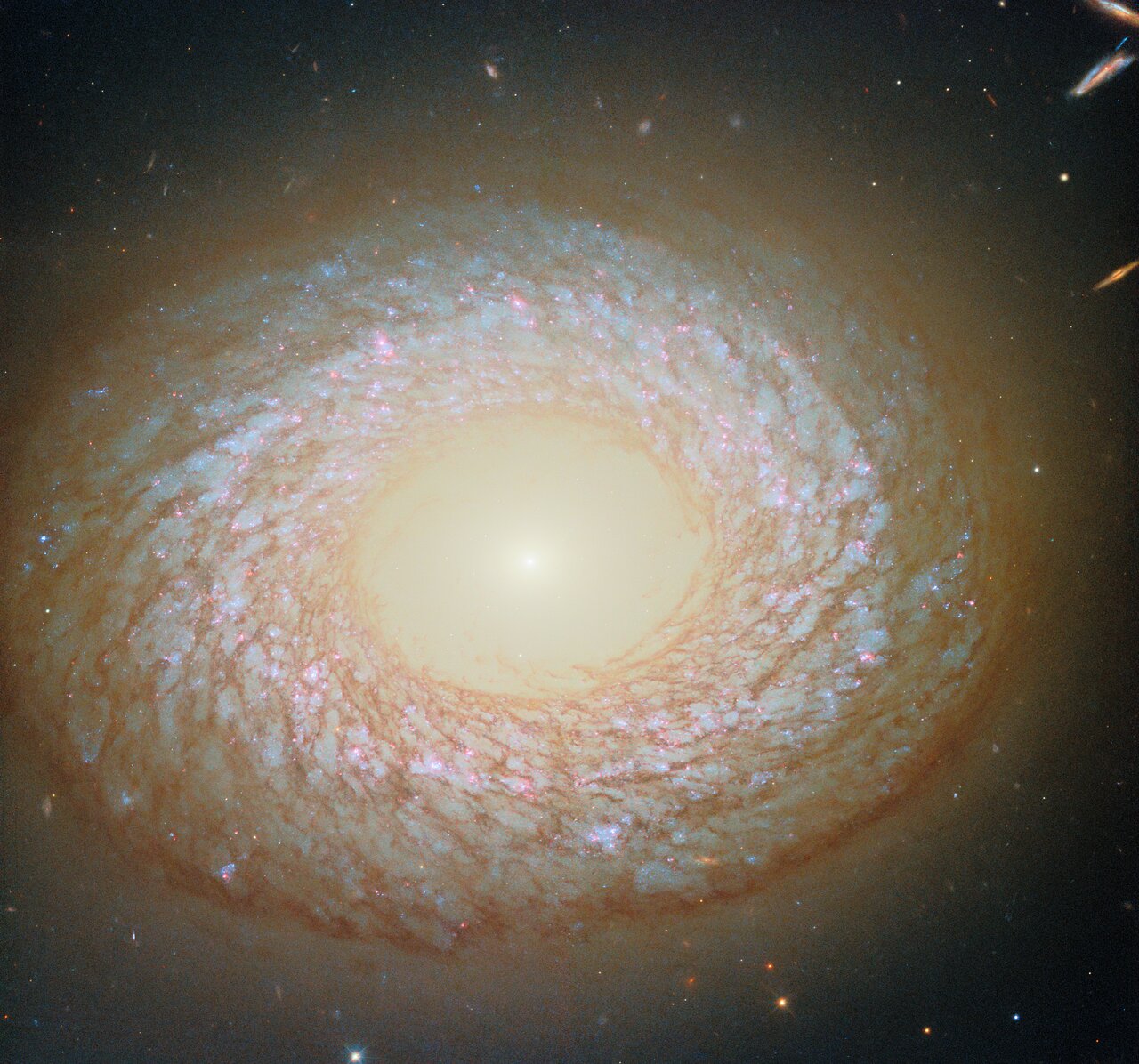
Pic of the Week: Barred Spiral Galaxy NGC 5335

Image (Credit): Barred Spiral Galaxy NGC 5335 (NASA, ESA, STScI)

This week’s image looks like something ginned up by AI, but it is from the Hubble Space Telescope. Just the number of stray galaxies in the image is amazing.

Here is the description of the image from the European Space Agency’s (ESA) Hubble page:

Barred spiral galaxy NGC 5335 observed by the Hubble Space Telescope takes up the majority of the view. At its center is a milky yellow, flattened oval that extends bottom left to top. Within the oval is a bright central region that looks circular, with the very center the brightest. In the bright central region is what looks like a bar, extending from top left to bottom right. Around this is a thick swath of blue stars speckled with white regions. Multiple arms wrap up and around in a counterclockwise direction, becoming fainter the farther out they are. Both the white core and the spiral arms are intertwined with dark streaks of dust. The background of space is black. Thousands of distant galaxies in an array of colors are speckled throughout.