Space Stories: Truncated Artemis III Mission, Origins of a Local Galaxy, and Chandra X-ray Observatory Exoplanet Efforts

Image (Credit): The launch of a Starship. (SpaceX)

Here are some recent stories of interest.

Ars Technica: As NASA Watches Starship Closely, Here’s What the Agency Wants to See Next

NASA and SpaceX are planning for the possibility of modifying the Artemis III mission. Instead of landing on the Moon, a crew would launch in the Orion spacecraft and rendezvous with Starship in low-Earth orbit. This would essentially be a repeat of the Apollo 9 mission, buying down risk and providing a meaningful stepping stone between Artemis missions. Officially, NASA maintains that the agency will fly a crewed lunar landing, the Artemis III mission, in September 2026. But almost no one in the space community regards that launch date as more than aspirational. Some of my best sources have put the most likely range of dates for such a mission from 2028 to 2032. A modified Artemis III mission, in low-Earth orbit, would therefore bridge a gap between Artemis II and an eventual landing.

Sci.News: Astrophysicists Offer Explanation for Origin of One of Milky Way’s Largest Satellites

The satellite galaxy Crater II (or Crater 2) of the Milky Way is located approximately 380,000 light-years away from Earth in the constellation of Crater. This galaxy is extremely cold and exceptionally diffuse, and has low surface brightness. According to new research, Crater II exists thanks to a self-interacting dark matter.

Harvard-Smithsonian Center for Astrophysics: Coming in Hot: NASA’s Chandra Checks Habitability of Exoplanets

Using NASA’s Chandra X-ray Observatory and ESA’s (European Space Agency’s) XMM-Newton, astronomers are exploring whether nearby stars could host habitable exoplanets, based on whether they emit radiation that could destroy potential conditions for life as we know it. This type of research will help guide observations with the next generation of telescopes aiming to make the first images of planets like Earth. A team of researchers examined stars that are close enough to Earth that future telescopes could take images of planets in their so-called habitable zones, defined as orbits where the planets could have liquid water on their surfaces. Any images of planets will be single points of light and will not directly show surface features like clouds, continents, and oceans. However, their spectra — the amount of light at different wavelengths — will reveal information about the planet’s surface composition and atmosphere.

Pic of the Week: The Dorado Group

Image (Credit): The Dorado group in the southern hemisphere. (ESA/Euclid/Euclid Consortium/NASA)

This week’s image was captured by the European Space Agency’s (ESA) Euclid space telescope. Launched last summer to create a 3D map of the universe, it has been pretty busy sending back some impressive images. This particular image shows the Dorado group of galaxies, one of the richest group of galaxies in the southern hemisphere. The grouping of approximately 70 galaxies is about 62 million light-years away.

Pic of the Week: A Triple-Star System

Image (Credit): Hubble image of a triple-star system. (NASA, ESA, G. Duchene (Universite de Grenoble I); Image Processing: Gladys Kober (NASA/Catholic University of America))

This week’s image is from the NASA/ESA Hubble Space Telescope. It shows a triple-star system that consists of the variable star HP Tau, HP Tau G2, and HP Tau G3.

NASA explains:

HP Tau is known as a T Tauri star, a type of young variable star that hasn’t begun nuclear fusion yet but is beginning to evolve into a hydrogen-fueled star similar to our Sun. T Tauri stars tend to be younger than 10 million years old ― in comparison, our Sun is around 4.6 billion years old ― and are often found still swaddled in the clouds of dust and gas from which they formed.

Pic of the Week: Little Dumbbell Nebula

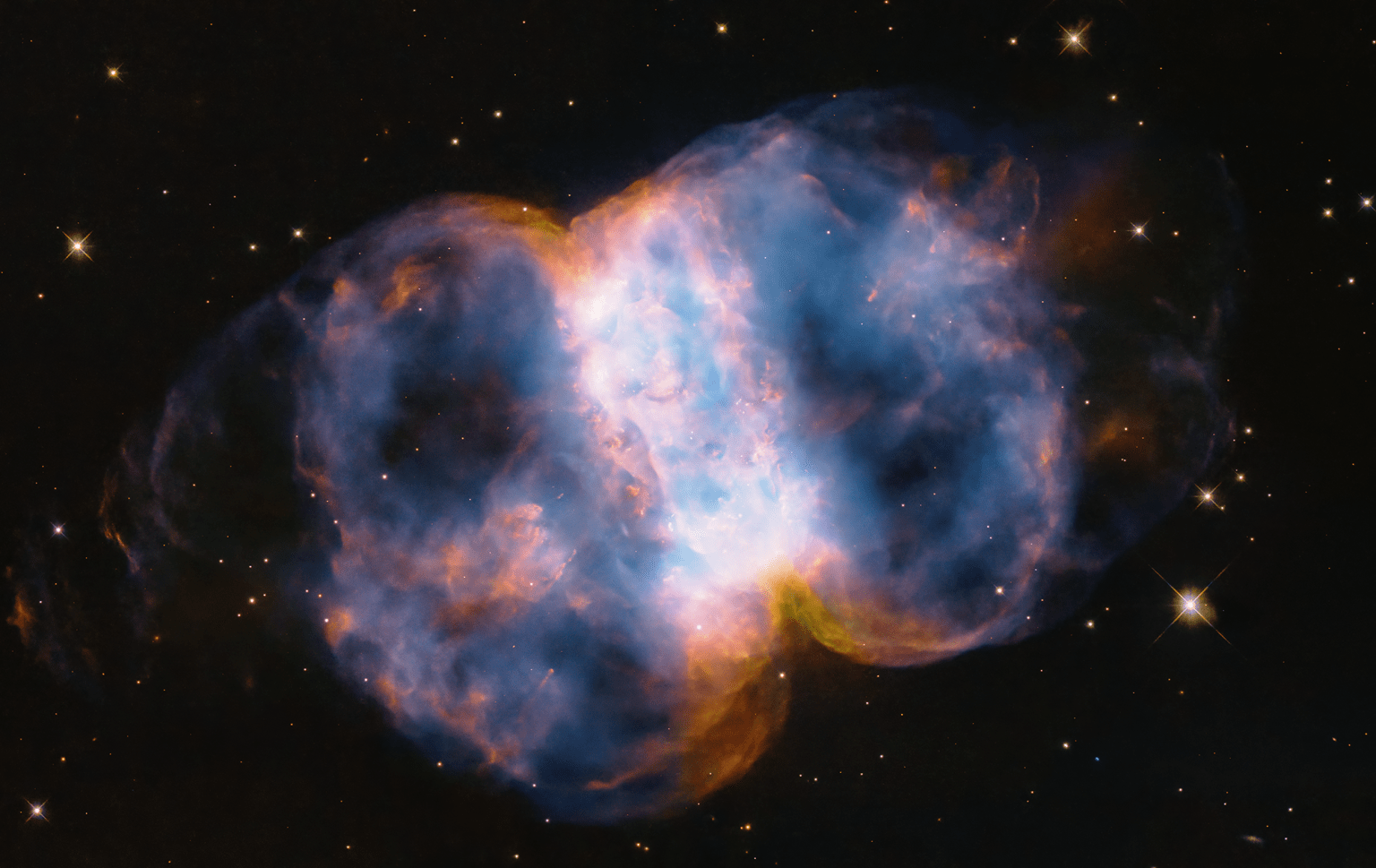
Image (Credit): The Little Dumbell Nebula as captured by the Hubble Space Telescope. (NASA, ESA, STScI)

This week’s image comes from the NASA/European Space Agency’s Hubble Space Telescope. It shows what is called the Little Dumbbell Nebula, more formally called  Messier 76, M76, or NGC 650/651, which is about 3,400 light-years away. The image is being shared as part of the celebration of Hubble’s 34th anniversary, which is discussed in this video.

Here is more on the nebula from NASA:

M76 is classified as a planetary nebula, an expanding shell of glowing gases that were ejected from a dying red giant star. The star eventually collapses to an ultra-dense and hot white dwarf. A planetary nebula is unrelated to planets, but have that name because astronomers in the 1700s using low-power telescopes thought this type of object resembled a planet.

M76 is composed of a ring, seen edge-on as the central bar structure, and two lobes on either opening of the ring. Before the star burned out, it ejected the ring of gas and dust. The ring was probably sculpted by the effects of the star that once had a binary companion star. This sloughed off material created a thick disk of dust and gas along the plane of the companion’s orbit. The hypothetical companion star isn’t seen in the Hubble image, and so it could have been later swallowed by the central star. The disk would be forensic evidence for that stellar cannibalism.

The primary star is collapsing to form a white dwarf. It is one of the hottest stellar remnants known at a scorching 250,000 degrees Fahrenheit, 24 times our Sun’s surface temperature. 
The sizzling white dwarf can be seen as a pinpoint in the center of the nebula. A star visible in projection beneath it is not part of the nebula.


Pinched off by the disk, two lobes of hot gas are escaping from the top and bottom of the “belt,” along the star’s rotation axis that is perpendicular to the disk. They are being propelled by the hurricane-like outflow of material from the dying star, tearing across space at two million miles per hour. That’s fast enough to travel from Earth to the Moon in a little over seven minutes! This torrential “stellar wind” is plowing into cooler, slower-moving gas that was ejected at an earlier stage in the star’s life, when it was a red giant. Ferocious ultraviolet radiation from the super-hot star is causing the gases to glow. The red color is from nitrogen, and blue is from oxygen.


Given our solar system is 4.6 billion years old, the entire nebula is a flash in the pan by cosmological timekeeping. It will vanish in about 15,000 years.

Space Stories: Detailed Views of Mars, Plummeting ISS Space Junk, and Time Zones on the Moon

Image (Credit): Recent high-altitude view of Mars taken by Mars Express’s High Resolution Stereo Camera (HRSC). ( ESA)

Here are some recent stories of interest.

Astrobiology: Mars Express Celebrates 25,000 Orbits

ESA’s Mars Express recently looped around Mars for the 25,000th time – and the orbiter has captured yet another spectacular view of the Red Planet to mark the occasion. The new high-altitude view was taken by Mars Express’s High Resolution Stereo Camera (HRSC). It features many of Mars’s towering volcanoes and even includes a surprise appearance from the planet’s largest moon, Phobos.

Daily Mail: Piece of 5,800lb Battery Pallet Tossed from NASA’s ISS Crashes Through Florida Home – and Nearly Kills Homeowner’s Son

A piece of metal came crashing through a home in Florida that is believed to be from a 5,800-pound battery pallet discarded by the International Space Station (ISS). Naples homeowner Alejandro Otero was on vacation when he received a call from his son, saying he heard a ‘tremendous sound’ and there were gaping holes in the ceiling and floor – while explaining whatever fell almost hit him. The two-pound, cylinder object has since been recovered by NASA to determine its origin and if found to be space junk, the agency could be liable for damages.

Reuters: White House Directs NASA to Create Time Standard for the Moon

The White House on Tuesday directed NASA to establish a unified standard of time for the moon and other celestial bodies, as the United States aims to set international norms in space amid a growing lunar race among nations and private companies. The head of the White House Office of Science and Technology Policy (OSTP), according to a memo seen by Reuters, instructed the space agency to work with other parts of the U.S. government to devise a plan by the end of 2026 for setting what it called a Coordinated Lunar Time (LTC).