Good News: Hurricane Milton Had Little Impact on NASA Facilities

Image (Credit): View of the Kennedy Space Center following Hurricane Milton. (NASA)

NASA has reported that it has so far detected little damage from Hurricane Milton at the Kennedy Space Center.

Here is what NASA shared today via Twitter/X:

Kennedy is now OPEN!

The Damage Assessment and Recovery Team has completed their assessment of the center and its facilities, and determined that employees can safely return on-site to resume working.

The damage identified is manageable and in-line with the items the Ride Out Teams previously identified, including minor impacts such as ripped awning, and damage to doors and traffic lights.

It is interesting that NASA is using DART in a whole way here compared to yesterday’s story about the European Space Agency’s Hera mission. I just hope that the DART mission never leads to a DART event here on Earth.

Pic of the Week: The Launch of Hera

Image (Credit): Visitors at ESA’s control center in Germany watching the Hera launch. (ESA / J.Mai)

This week’s image shows a crowd in Germany watching the launch of the European Space Agency’s (ESA) Hera mission on October 7, 2024. The launch itself took place from Cape Canaveral Space Force Station in Florida via a SpaceX Falcon 9.

Hera’s goal is to study how binary asteroid systems like Didymos form and function to learn more about to defend the Earth from approaching asteroids. You may remember Didymos from the earlier NASA Double Asteroid Redirection Test (DART) mission.

Here is more from the ESA on the mission:

Hera’s first deep space manoeuvre will begin in late October and put the spacecraft on course for its next major milestone, a flyby of Mars in March 2025. During this flyby, Hera will use its instruments to study Deimos, the smaller and more enigmatic of Mars’s two moons. This will serve as an important test for many of the spacecraft’s instruments, ensuring they are fully operational before the spacecraft arrives at its final destination, Didymos.

Hera will perform a second deep space manoeuvre in February 2026. An ‘impulsive rendezvous’ in October 2026 will bring Hera into the vicinity of the Didymos asteroid system. The spacecraft will begin its detailed survey of the moonlet Dimorphos in 2027, which will turn the 151 m asteroid into one of the most studied objects in the Solar System.

Space Stories: NASA’s Probe Explorers, Finding Exoplanet Atmospheres, and an Australian Space Antenna

Here are some recent stories of interest.

Universe TodayNASA Announces a New Class of Space Missions: Probe Explorers

NASA has sent a whole host of spacecraft across the Solar System and even beyond. They range from crewed ships to orbit and to the Moon to robotic explorers. Among them are a range of mission classes from Flagships to Discovery Class programs. Now a new category has been announced: Probe Explorers. This new category will fill the gap between Flagship and smaller missions. Among them are two proposed missions; the Advanced X-ray Imaging Satellite and the Probe Far-Infrared Mission for Astrophysics.

uChicago News: “UChicago Researchers Use New Method of Finding Atmospheres in Distant Planets

It is a major goal of astronomical research to find planets other than Earth that might be suitable for sustaining life. There are a number of factors which many scientists agree are essential to a planet being habitable, but an important one is whether or not a planet has an atmosphere. Scientists have found other rocky, Earth-like exoplanets, but none that we can definitively say have atmospheres. Finding these planets will reveal insights into how such atmospheres are formed and retained, so that we can better predict which planets could be habitable. A study conducted by University of Chicago PhD student Qiao Xue with Prof. Jacob Bean’s group has demonstrated a new way to determine if faraway exoplanets have an atmosphere—and showed that it was simpler and more efficient than previous methods. The new technique, when applied to more planets, has the potential to help us learn more about patterns in atmosphere formation.

European Space Agency: “ESA Crowns New Deep Space Antenna in Australia

A giant wakes as the Sun sets in Western Australia. The workers can finally rest easy after more than a day spent using an enormous crane to lift the colossal 122-tonne, 35-metre diameter reflector dish and crown ESA’s newest deep space communication antenna. With the dish and its quadrupole now installed, ESA is on track to inaugurate its fourth deep-space antenna, and second at the New Norcia site in Australia, by the end of 2025. Referred to as NNO3, the New Norcia 3 antenna will allow spacecraft to send and receive more valuable data collected from onboard scientific instruments and vital flight instructions for mission operations.

Pic of the Week: Peeking into Perseus

Image (Credit): The star-forming cluster NGC 1333 as seen by the JWST. (ESA/Webb, NASA & CSA, A. Scholz, K. Muzic, A. Langeveld, R. Jayawardhana)

This week’s image of a distant nebula with new stars was captured by the James Webb Space Telescope (JWST). The nebula, NGC 1333, is located in the Perseus molecular cloud, which is about 960 light-years away.

Here is more information on the image from the European Space Agency:

The centre of the image presents a deep peek into the heart of the NGC 1333 cloud. Across the image we see large patches of orange, which represent gas glowing in the infrared. These so-called Herbig-Haro objects form when ionised material ejected from young stars collides with the surrounding cloud. They are hallmarks of a very active site of star formation.

Many of the young stars in this image are surrounded by discs of gas and dust, which may eventually produce planetary systems. On the right hand side of the image, we can glimpse the shadow of one of these discs oriented edge-on — two dark cones emanating from opposite sides, seen against a bright background.

Similarly to the young stars in this mosaic, our own Sun and planets formed inside a dusty molecular cloud, 4.6 billion years ago. Our Sun didn’t form in isolation but as part of a cluster, which was perhaps even more massive than NGC 1333. The cluster in the mosaic, only 1–3 million years old, presents us with an opportunity to study stars like our Sun, as well as brown dwarfs and free-floating planets, in their nascent stages.

Pic of the Week: Picture Perfect Spiral Galaxy

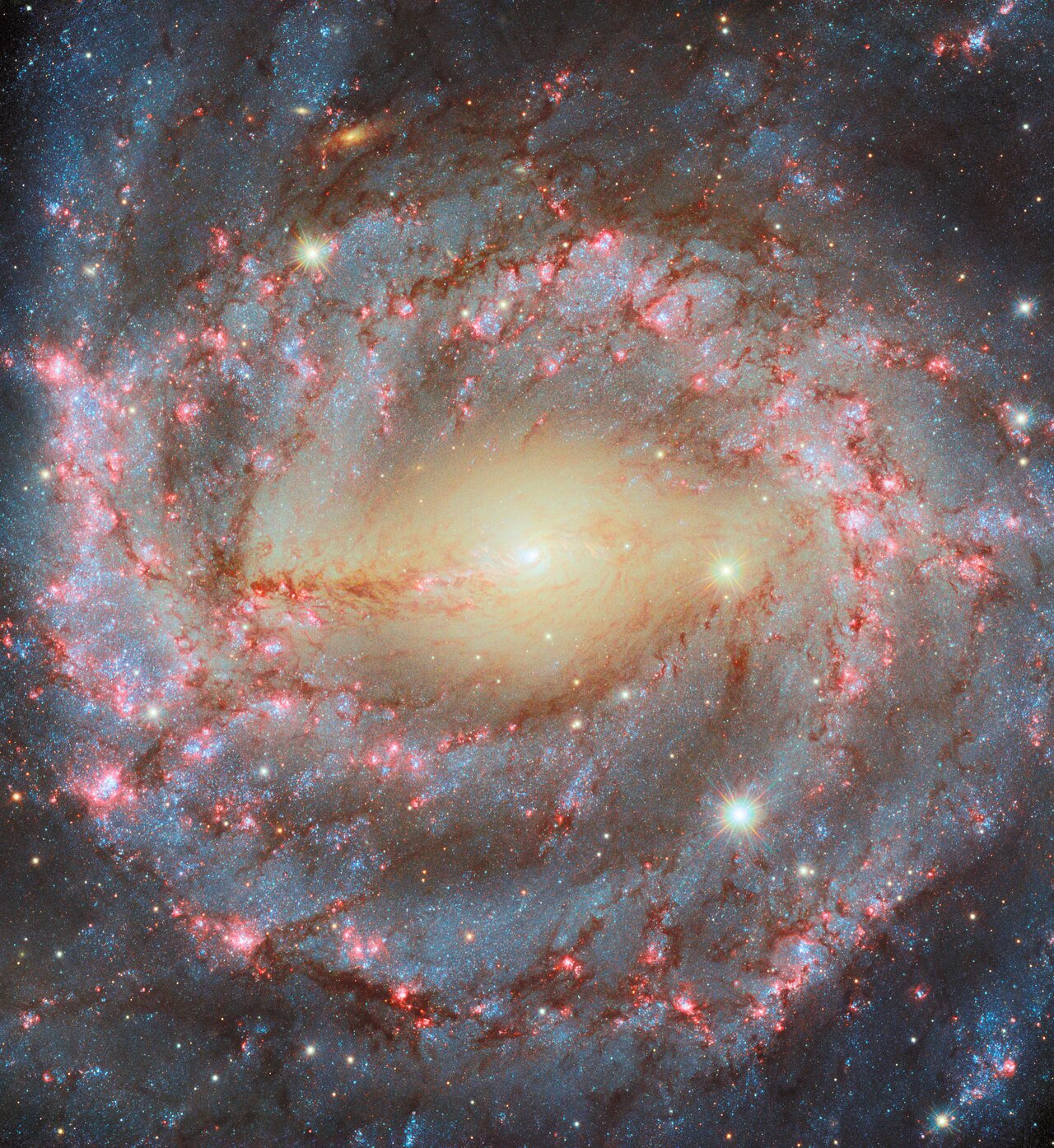
Image (Credit): Hubble’s view of spiral galaxy IC 4709. (ESA/Hubble & NASA, M. Koss, A, Barth)

This week’s image comes from the Hubble Space Telescope. It shows an almost too perfect spiral galaxy that might have come from AI software, but it is a real image from NASA and ESA. You are looking at spiral galaxy IC 4709, which is about 240 million light-years away.

Here is more information on the image from the ESA’s Hubble site:

Its view here is studded with stars, many of which appear particularly large and bright thanks to their nearby locations in our own galaxy, and which feature the characteristic diffraction patterns caused by Hubble’s optics. Much further away — around 240 million light-years distant in fact, in the southern constellation Telescopium — is the spiral galaxy IC 4709. Its swirling disc filled with stars and dust bands is beautifully captured, as is the faint halo surrounding it. The compact region at its core might be the most remarkable sight, however: this is an active galactic nucleus (AGN).