Space Stories: Tom Hanks Returns to the Moon, Exomoons are Questioned, and Our Moon Enters a New Phase

Image (Credit): Tom Hanks at the opening of his new show in London. (Apollo Remastered)

Here are some recent stories of interest.

Reuters: “Tom Hanks Brings Love of Space to New Immersive London Show

Archive footage of space rockets taking off beam across giant walls in a new immersive show in London, as Hollywood actor Tom Hanks narrates the story of human voyages to the moon. “The Moonwalkers: A Journey With Tom Hanks” looks at the first moon landings of the Apollo missions from 1969 to 1972 and their successor, NASA’s human spaceflight program, Artemis. The next mission – the Artemis II lunar flyby – is planned for next year and interviews with the four-member team are also projected on the walls at the Lightroom gallery space in London’s King Cross area.

Max Planck Institute for Solar System Research: “Giant Doubts About Giant Exomoons

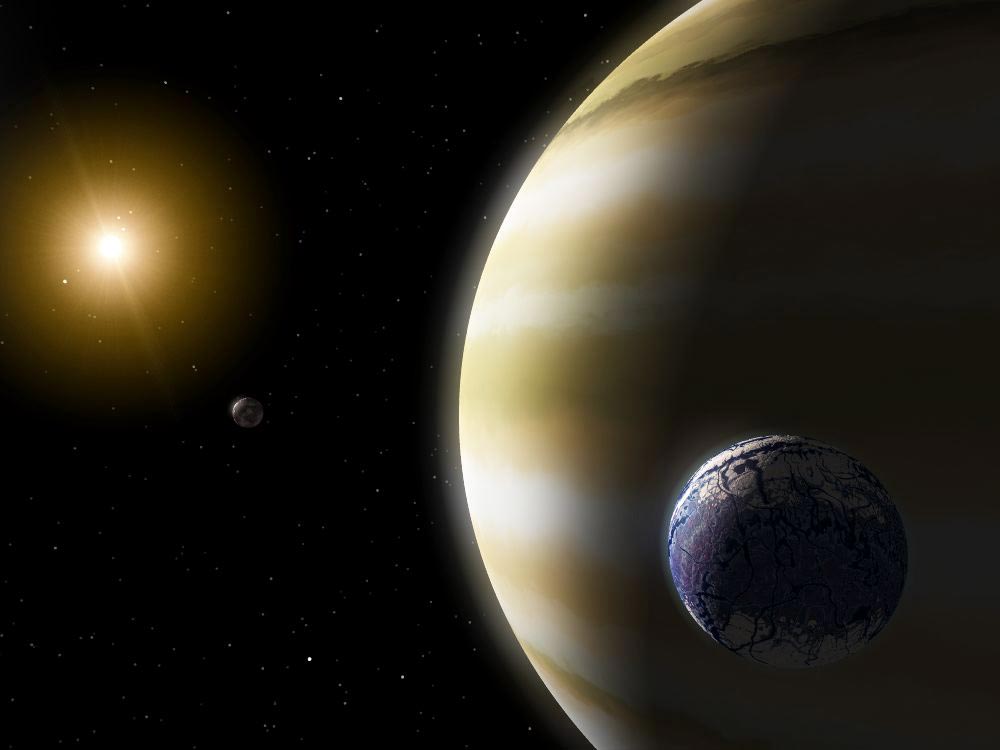
Just as it can be assumed that the stars in our Milky Way are orbited by planets, moons around these exoplanets should not be uncommon. This makes it all the more difficult to detect them. So far, only two of the more than 5300 known exoplanets have been found to have moons. A new data analysis now demonstrates that scientific statements are rarely black or white, that behind every result there is a greater or lesser degree of uncertainty and that the path to a statement often resembles a thriller. In observations of the planets Kepler-1625b and Kepler-1708b from the Kepler and Hubble space telescopes, researchers had discovered traces of such moons for the first time. A new study now raises doubts about these previous claims. As scientists from the Max Planck Institute for Solar System Research and the Sonnenberg Observatory, both in Germany, report in the journal Nature Astronomy, “planet-only” interpretations of the observations are more conclusive.

The University of Kansas: “Scholars Say it’s Time to Declare a New Epoch on the Moon, The ‘Lunar Anthropocene’

Human beings first disturbed moon dust Sept. 13, 1959, when the USSR’s unmanned spacecraft Luna 2 alighted on the lunar surface. In the following decades, more than a hundred other spacecraft have touched the moon — both crewed and uncrewed, sometimes landing and sometimes crashing. The most famous of these were NASA’s Apollo Lunar Modules, which transported humans to the moon’s surface to the astonishment of humankind. In the coming years, missions and projects already planned will change the face of the moon in more extreme ways. Now, according to anthropologists and geologists at the University of Kansas, it’s time to acknowledge humans have become the dominant force shaping the moon’s environment by declaring a new geological epoch for the moon: the Lunar Anthropocene.

Space Stories: Mad Rush for the Moon, An Unusual Exoplanet, and Flinging the Earth

Image (Credit): Crescent Moon as seen from the International Space Station. (NASA)

Here are some recent stories of interest.

Science.org: “Moon’s Scientifically Important Sites could be ‘Lost Forever’ in Mining Rush

Science and commerce may be headed for a clash on remote terrain: the Moon. For the first time in half a century, NASA is sending a craft to the lunar surface, with the launch at the end of this year of Peregrine Mission 1, a lander built by the private company Astrobotic Technology. Dozens of other craft will soon follow, many as part of NASA’s Artemis program to return astronauts to the Moon. Most researchers are looking forward to a new golden age of exploration and science. But some are worried. They foresee that the advent of private landers will lead to a “Moon rush,” as companies race to grab valuable minerals and resources while trampling over scientifically important lunar sites. With space law offering little or no protection to these areas, researchers are starting to lobby governments and international agencies to do something before it’s too late.

SciTechDaily: “Unusually Massive” – Astronomers Discover a Planet That Shouldn’t Exist

Researchers at Penn State have discovered an unusually massive planet, LHS 3154b, orbiting an ultracool dwarf star. This finding, contradicting current theories, prompts a reassessment of star and planet formation processes. The discovery of a planet that is far too massive for its sun is calling into question what was previously understood about the formation of planets and their solar systems, according to Penn State researchers. In a paper published on November 30 in the journal Science, researchers report the discovery of a planet more than 13 times as massive as Earth orbiting the “ultracool” star LHS 3154, which itself is nine times less massive than the sun. The mass ratio of the newly found planet with its host star is more than 100 times higher than that of Earth and the sun.

New Scientist: “Passing Star Could Fling Earth Out Past Pluto into the Oort Cloud

If a passing star came near the solar system, Earth would probably be fine – but there is a small chance our entire world could get thrown to the outer reaches of the solar system, crash into another planet or even get stolen by the wandering star. The other planets in the solar system could suffer similar fates, and Mercury in particular would be at risk of falling into the sun.

Podcast: The Search for Planet Nine

Image (Credit): Artist’s rendering of a proposed Planet Nine. (NASA/JPL-Caltech)

I listened to a recent Cool Worlds Lab podcast where Professor David Kipping interviewed Professor Malena Rice from Yale University’s Department of Astronomy. The episode, titled  Planet Nine, Oumuamua, Misaligned Exoplanets, covered a good range of topics, as the title suggests.

Of greatest interest to me was the continued search for a ninth planet in our solar system (sorry, Pluto). Professor Rice was noncommittal on the likelihood of such a planet, but she is hoping NASA’s Transiting Exoplanet Survey Satellite (TESS) can help to bring more light to the topic.

She discussed how this ninth planet is estimated to be a sub-Neptune sized planet, which appears to be common in many other solar systems we have observed. Planet Nine is estimated to be a gas giant about 5-10 times the mass of Earth yet smaller than Neptune lying 300-800 astronomical units from the Sun (or about 10 times more distant that Pluto).

Professor Rice noted that it is pretty amazing that we can discover distant galaxies but not potential planets in our backyard. She attributes this difficulty to the lack of light on such a planet.

The podcast episode dives deep in this topic, and then continues into other fascinating topics such as visitors to our solar system and strange solar systems elsewhere. It is a lot to take in, but well worth the time even if you need to play it more than once.

Note: Of course, it may not be a planet at all. One theory is that it is a black hole at the edge of our solar system. I would like to hear that podcast as well.

Study Findings: A Resonant Sextuplet of Sub-Neptunes Transiting the Bright Star HD 110067

Image (Credit): Neptune as captured by the James Webb Space Telescope’s near-infrared camera. (NASA, ESA, CSA, and STScI)

Nature abstract of the study findings:

Planets with radii between that of the Earth and Neptune (hereafter referred to as ‘sub-Neptunes’) are found in close-in orbits around more than half of all Sun-like stars. However, their composition, formation and evolution remain poorly understood. The study of multiplanetary systems offers an opportunity to investigate the outcomes of planet formation and evolution while controlling for initial conditions and environment. Those in resonance (with their orbital periods related by a ratio of small integers) are particularly valuable because they imply a system architecture practically unchanged since its birth. Here we present the observations of six transiting planets around the bright nearby star HD 110067. We find that the planets follow a chain of resonant orbits. A dynamical study of the innermost planet triplet allowed the prediction and later confirmation of the orbits of the rest of the planets in the system. The six planets are found to be sub-Neptunes with radii ranging from 1.94R to 2.85R. Three of the planets have measured masses, yielding low bulk densities that suggest the presence of large hydrogen-dominated atmospheres.

Citation: Luque, R., Osborn, H.P., Leleu, A. et al. A resonant sextuplet of sub-Neptunes transiting the bright star HD 110067. Nature 623, 932–937 (2023).
https://doi.org/10.1038/s41586-023-06692-3

Study-related stories:

Space Stories: Curiosity Continues, Exoplanets with Dinosaurs, and Nasty Jupiters

Image (Credit): Curiosity’s view of the Martian surface. (NASA)

Here are some recent stories of interest.

NASA JPL: “NASA’s Curiosity Rover Clocks 4,000 Days on Mars

Four thousand Martian days after setting its wheels in Gale Crater on Aug. 5, 2012, NASA’s Curiosity rover remains busy conducting exciting science. The rover recently drilled its 39th sample then dropped the pulverized rock into its belly for detailed analysis. To study whether ancient Mars had the conditions to support microbial life, the rover has been gradually ascending the base of 3-mile-tall (5-kilometer-tall) Mount Sharp, whose layers formed in different periods of Martian history and offer a record of how the planet’s climate changed over time.

Cornell University: “‘Jurassic Worlds’ Might be Easier to Spot than Modern Earth

Things may not have ended well for dinosaurs on Earth, but Cornell University astronomers say the “light fingerprint” of the conditions that enabled them to emerge here provide a crucial missing piece in our search for signs of life on planets orbiting alien stars. Their analysis of the most recent 540 million years of Earth’s evolution, known as the Phanerozoic Eon, finds that telescopes could better detect potential chemical signatures of life in the atmosphere of an Earth-like exoplanet more closely resembling the age the dinosaurs inhabited than the one we know today.

UC Riverside: “Giant Planets Cast a Deadly Pall

Jupiter, by far the biggest planet in our solar system, plays an important protective role. Its enormous gravitational field deflects comets and asteroids that might otherwise hit Earth, helping create a stable environment for life. However, giant planets elsewhere in the universe do not necessarily protect life on their smaller, rocky planet neighbors. A new Astronomical Journal paper details how the pull of massive planets in a nearby star system are likely to toss their Earth-like neighbors out of the “habitable zone.” This zone is defined as the range of distances from a star that are warm enough for liquid water to exist on a planet’s surface, making life possible.