Podcast/Book Review: Jesuits Find an Exoplanet to Explore

If you are looking for a new podcast as well as a new book, the two come together via the podcast Alienating the Audience. Comedian Andrew Heaton and his buddies have plenty of fun poking various science fiction topics, including Star Wars and Star Trek.

One of the recent episodes discussed a new book, The Sparrow, by author Mary Doria Russell. The story is about a group of Jesuits exploring a new planet with all of the mayhem that follows.

Here is a quick summary from the book itself:

A visionary work that combines speculative fiction with deep philosophical inquiry, The Sparrow tells the story of a charismatic Jesuit priest and linguist, Emilio Sandoz, who leads a scientific mission entrusted with a profound task: to make first contact with intelligent extraterrestrial life. The mission begins in faith, hope, and beauty, but a series of small misunderstandings brings it to a catastrophic end.

You can listen for yourself to this episode here at Jesuits in Space. But be careful, because there are a number of spoilers. You can always start with the book first, which is part of a series.

Credit: Ballantine Books

Podcast: Two Worlds Collide in This Episode

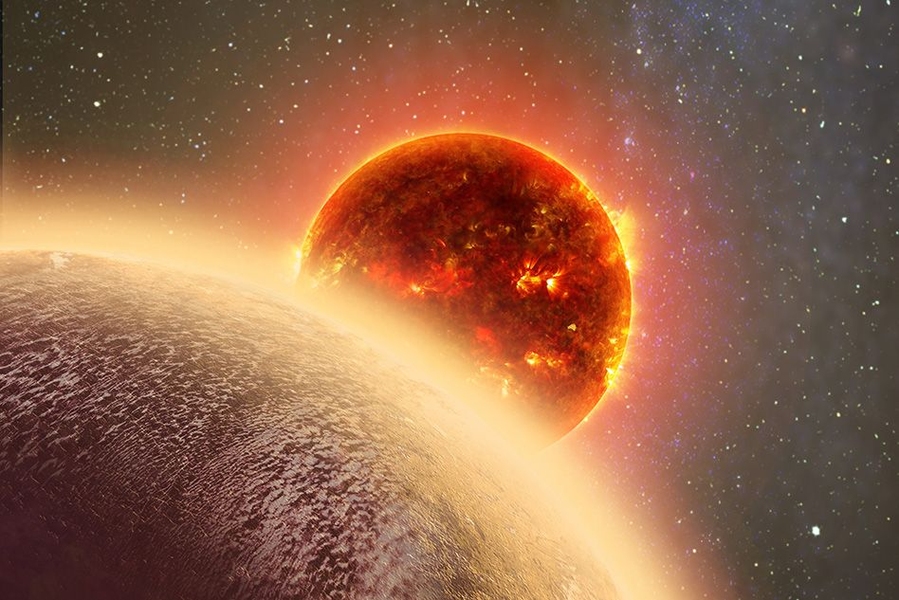
Image (Credit): Artist’s rending of exoplanet GJ 1132b. (MIT News)

If you are looking for a fun podcast this week, you cannot go wrong with Neil DeGrasse Tyson’s Startalk podcast when it hosts Cool Worlds‘ creator David Kipping. The episode, Cosmic Queries – Cool Worlds with David Kipping, covers questions related to exoplanets, exomoons, and more. It is fun to hear the two scientists play off each other.

You will also learn from this podcast that Cool Worlds should be releasing its own podcast in the near future. Its Youtube videos are already a great source of information, so I expect more of the same in these podcasts.

At the end of the podcast, Professor Kipping also mentioned a few upcoming space missions related to exoplanets, including the European PLAnetary Transits and Oscillations of stars (Plato) mission in 2026. You can learn more about the mission from this European Space Agency factsheet, which notes:

Does a second Earth exist in the Universe? Planet hunter Plato will focus on the properties of rocky planets orbiting Sun-like stars. In particular, Plato will discover and characterise planets in orbits up to the habitable zone – the ‘goldilocks’ region around a star where the temperature is just right for liquid water to exist on a planet’s surface.

Plato will characterise hundreds of rocky (including Earth twins), icy or giant planets by providing exquisite measurements of their radii (3% precision), masses (better than 10% precision) and ages (10% precision). This will revolutionise our understanding of planet formation and the evolution of planetary systems, as well as the potential habitability of these diverse worlds.

As well as looking at these planets, Plato will analyse their host stars. Using data from the mission, scientists hope to perform stellar seismology, gathering evidence of ‘starquakes’ in the imaged stars. This will give insight into the characteristics and evolution of the stars, improving our understanding of entire planetary systems.

It’s a fun, fact-filled show worth your time.

Space Stories: Lost Lunar Lander, Exoplanet Elements, and the Molten Middle of Mars

Image (Credit): Artist’s rendering of the HAKUTO-R Mission 1 Lunar Lander orbiting the Moon. (ispace)

Here are some recent stories of interest.

Astronomy.com:Japanese Lunar Lander Loses Contact Moments Before Touchdown

The Japanese start-up ispace attempted to become the first private company to successfully soft-land a commercial spacecraft on the Moon today (Tuesday, April 25). However, it now appears that the landing attempt — like several other such attempts in recent years — has failed…Ispace currently plans to attempt at least two more lunar landings over the next few years, applying lessons learned during today’s landing attempt to increase their odds of success.

Phys.com:Scientists Discover Rare Element in Exoplanet’s Atmosphere

The rare metal terbium has been found in an exoplanet’s atmosphere for the first time. The researchers at Lund University in Sweden have also developed a new method for analyzing exoplanets, making it possible to study them in more detail…”Detecting heavy elements in the atmospheres of ultra-hot exoplanets is another step towards learning how the atmospheres of planets work. The better we get to know these planets, the greater chance we have of finding Earth 2.0 in the future,” concludes Nicholas Borsato.

NASA:NASA InSight Study Provides Clearest Look Ever at Martian Core

While NASA retired its InSight Mars lander in December, the trove of data from its seismometer will be pored over for decades to come. By looking at seismic waves the instrument detected from a pair of temblors in 2021, scientists have been able to deduce that Mars’ liquid iron core is smaller and denser than previously thought.

Study Findings: Direct Imaging and Astrometric Detection of a Gas Giant Planet Orbiting an Accelerating Star

Image (Credit): Artist’s rendering of Gaia mapping the stars of the Milky Way. (European Space Agency)

Science abstract:

Direct imaging of gas giant exoplanets provides information on their atmospheres and the architectures of planetary systems. However, few planets have been detected in blind surveys with direct imaging. Using astrometry from the Gaia and Hipparcos spacecraft, we identified dynamical evidence for a gas giant planet around the nearby star HIP 99770. We confirmed the detection of this planet with direct imaging using the Subaru Coronagraphic Extreme Adaptive Optics instrument. The planet, HIP 99770 b, orbits 17 astronomical units from its host star, receiving an amount of light similar to that reaching Jupiter. Its dynamical mass is 13.9 to 16.1 Jupiter masses. The planet-to-star mass ratio [(7 to 8) × 10−3] is similar to that of other directly imaged planets. The planet’s atmospheric spectrum indicates an older, less cloudy analog of the previously imaged exoplanets around HR 8799.

Citation: Thayne Currie, G. Mirek Brandt, Timothy D. Brandt, Brianna Lacy, Adam Burrows, Olivier Guyon, Motohide Tamura, Ranger Y. Liu, Sabina Sagynbayeva, Taylor Tobin, Jeffrey Chilcote, Tyler Groff, Christian Marois, William Thompson, Simon J. Murphy, Masayuki Kuzuhara, Kellen Lawson, Julien Lozi, Vincent Deo, Sebastien Vievard, Nour Skaf, Taichi Uyama, Nemanja Jovanovic, Frantz Martinache, N. Jeremy Kasdin, Tomoyuki Kudo, Michael McElwain, Markus Janson, John Wisniewski, Klaus Hodapp, Jun Nishikawa, Krzysztof Hełminiak, Jungmi Kwon, Masahiko Hayashi. Direct imaging and astrometric detection of a gas giant planet orbiting an accelerating star. Science (2023).
https://doi.org/10.1126/science.abo6192

Study-related stories:

Space Stories: Merging Galaxies, Anniversary for TESS, and Helicopter Flights on Mars

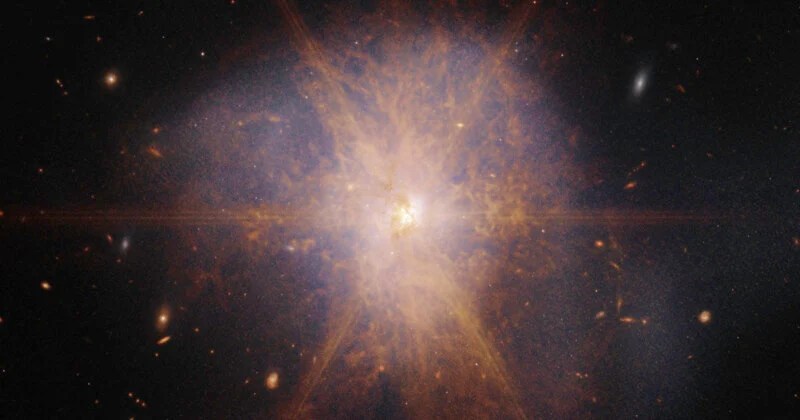
Image (Credit): Arp 220 as captured by NASA’s James Webb Space Telescope. (NASA, ESA, CSA, STScI, Alyssa Pagan)

Here are some recent stories of interest.

PetaPixel:Webb Captures Star-Forming Galactic Merger Brighter Than 1 Trillion Suns’”

NASA’s James Webb Space Telescope has captured a stunning “smash-up” of two spiral galaxies. Collectively called Arp 220, the collision of the pair of galaxies has facilitated massive star formation. Arp 220 is located within the constellation Serpens, about 250 million light-years from Earth. Arp 220 gets its namesake because it is the 220th object in Hallton Art’s Atlas of Peculiar Galaxies. Arp 220 is “peculiar” because it’s an ultra-luminous infrared galaxy (ULIRG), and the nearest ULIRG to Earth.

Phys.org:NASA’s TESS Celebrates Fifth Year Scanning the Sky for New Worlds’”

Now in its fifth year in space, NASA’s TESS (Transiting Exoplanet Survey Satellite) remains a rousing success. TESS’s cameras have mapped more than 93% of the entire sky, discovered 329 new worlds and thousands more candidates, and provided new insights into a wide array of cosmic phenomena, from stellar pulsations and exploding stars to supermassive black holes.

NASA:NASA’s Ingenuity Mars Helicopter Completes 50th Flight’”

NASA’s Ingenuity Mars Helicopter has completed its 50th flight on Mars. The first aircraft on another world reached the half-century mark on April 13, traveling over 1,057.09 feet (322.2 meters) in 145.7 seconds. The helicopter also achieved a new altitude record of 59 feet (18 meters) before alighting near the half-mile-wide (800-meter-wide) “Belva Crater.”