A Day in Astronomy: The Anniversary of JWST

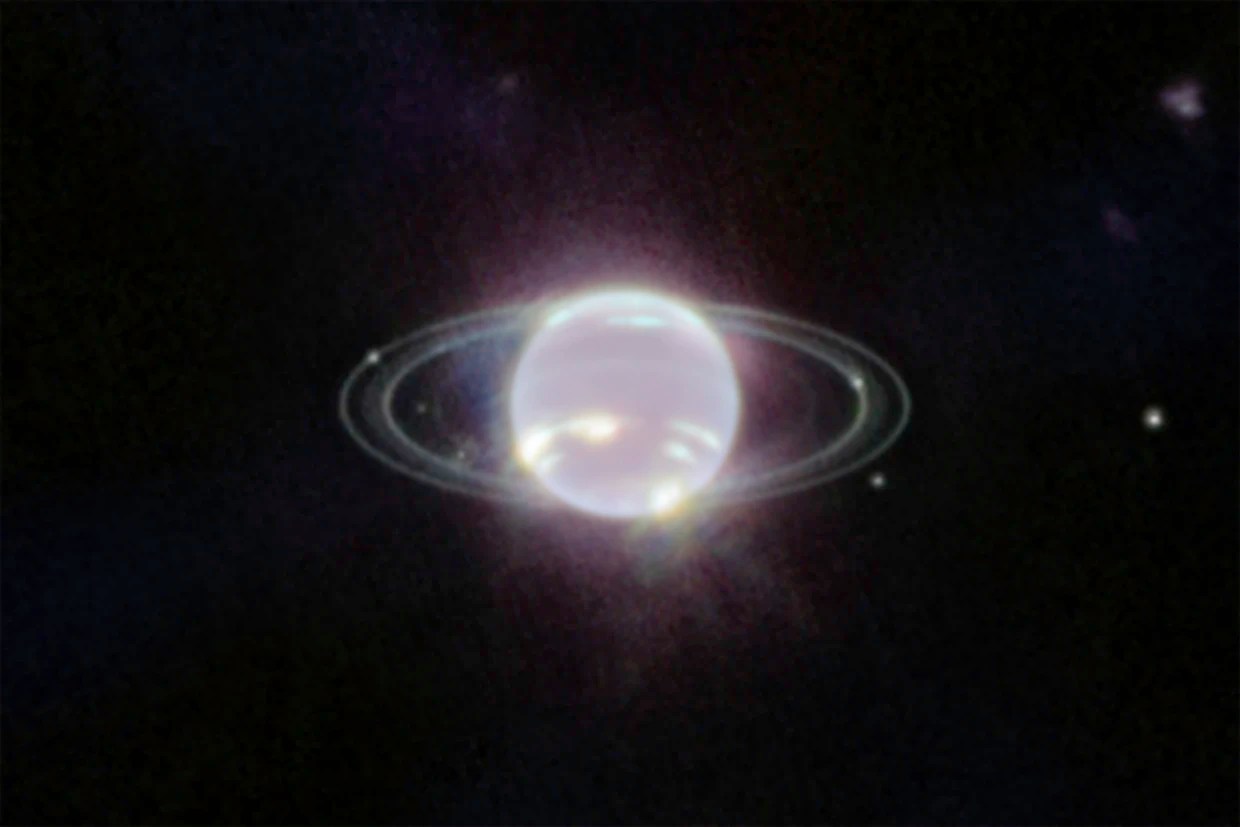
Tomorrow, July 12th, is the first anniversary of the James Webb Space Telescope (JWST). As a result, NASA has a few events planned that you may want to attend.

Here is the schedule from NASA:

  • 6 a.m.: Release of a new Webb image online
  • 6 a.m.: Live interview opportunities begin
    • Webb mission experts will be available to conduct live, remote interviews with broadcast media, in both English and Spanish. Details about scheduling these interviews are available online. Webb experts also are available for interviews outside of this window upon request.
  • 4 p.m.: NASA Science Live online
    • Two Webb experts will be featured on a NASA Science Live episode, discussing how Webb has made an impact in its first year on exploring the distant universe, characterizing exoplanet atmospheres, and understanding the solar system. The show will air live on the NASA Science Live website, as well as YouTubeFacebook, and Twitter. Viewers of this episode can submit questions on social media using the hashtag #UnfoldtheUniverse or by leaving a comment in the chat section of the Facebook or YouTube stream.

Space Quote: Did Harvard Professor Avi Loeb Find Evidence of Intelligent Alien Life?

Image (Credit): Characters from SyFy’s television series Battlestar Galactica. (SyFy)

“Our findings open a new frontier in astronomy of studying what lies outside the solar system through microscopes rather than telescopes.”

-Statement by Harvard Professor Avi Loeb to USAToday regarding his recent recovery of what is believed to be fragments of an asteroid from outside our solar system that crashed into the Earth back in 2014. More tests are being conducted on the pieces recovered from the Pacific Ocean to determine whether the material is natural or artificially made. If the latter, it may be the first evidence of intelligent life beyond Earth.

Profile: COSMIC

Image (Credit): Karl G. Jansky Very Large Array (VLA) in New Mexico. (Jeff Hellermann, NRAO/AUI/NSF)

COSMIC, also known as the Commensal Open-Source Multimode Interferometer Cluster, is part of the search for extraterrestrial intelligence (SETI) by attempting to find technosignatures using the National Science Foundation’s Karl G. Jansky Very Large Array (VLA) in New Mexico. This new project is a joint venture between the SETI Institute and the National Radio Astronomy Observatory (NRAO). The initial plan is to search for these technosignatures among about 40 million star systems.

Technosignature are basically indicators of technology not caused by natural phenomena. Examples include radio signals, pollutants, nighttime lighting, megastructures, or even the fallout from a nuclear war (not very optimistic, I know). This is different than the biosignatures that other astronomers are looking for among exoplanets by studying the composition of an exoplanet’s atmosphere.  

The NRAO has created a page on the COSMIC project that provides plenty of details.

It is good to see federal funding going into the SETI program again after Congress walked away from the program in 1993. With all the new evidence coming to us regarding the multitude of exoplanets, it only makes sense to have a multi-pronged approach to find alien life, particularly intelligent life.

Let’s hope COSMIC is the start of a new and stronger SETI partnership.

Space Stories: Ingenuity Mars Helicopter is Back, Reclaiming More Water on the ISS, and Directly Imaging an Exoplanet

Image (Credit): NASA’s Ingenuity Mars Helicopter. (NASA/JPL-Caltech/ASU/MSSS)

Here are some recent stories of interest.

NASA: “NASA’s Ingenuity Mars Helicopter Phones Home

The 52nd flight of NASA’s Ingenuity Mars Helicopter is now in the official mission logbook as a success. The flight took place back on April 26, but mission controllers at NASA’s Jet Propulsion Laboratory in Southern California lost contact with the helicopter as it descended toward the surface for landing. The Ingenuity team expected the communications dropout because a hill stood between the helicopter’s landing location and the Perseverance rover’s position, blocking communication between the two. 

Phys.org: “NASA Achieves Water Recovery Milestone on International Space Station

Astronauts on interplanetary missions will be a bit less thirsty after a new NASA system succeeded at reclaiming 98% of waste water aboard the International Space Station (ISS) by converting things like urine into a drinkable state. Future crewed deep space missions that will last months or even years will be very different from any that have come before. Until now, astronauts have either carried their own supplies along or relied on regular visits from cargo ships. As to waste products, these were simply disposed of in a variety of ways. Unfortunately, deep space missions don’t have that luxury.

SCI.News: “Astronomers Directly Image Jupiter-Like Exoplanet around Nearby Young Star

AF Leporis is a bright F8V star located about 87.5 light-years away from Earth in the constellation of Lepus. Also known as AF Lep, HD 35850, HIP 25486 and HR 1817, the star has an age of 24 million years and a mass of 1.2 solar masses. The star hosts a young exoplanet, AF Leporis b (AF Lep b), which is located about 8 times the Earth-Sun distance and is among the first ever discovered using a technique called astrometry. This method measures the subtle movements of a host star over many years to help astronomers determine whether hard-to-see orbiting companions, including planets, are gravitationally tugging at it.

Space Stories: Mapping with Pulsars, Rocky Exoplanets, and Words from the Pope

Image (Credit): The Vela pulsar, a neutron star that was formed when a massive star collapsed. (X-ray: NASA/CXC/Univ of Toronto/M.Durant et al; Optical: DSS/Davide De Martin)

Here are some recent stories of interest.

Universe Today: “Pulsars Could Help Map the Black Hole at the Center of the Milky Way

Last year, the Event Horizon Telescope (EHT)—an international consortium of astronomers and observatories—announced they had taken the first images of Sag A*, which came just two years after the release of the first-ever images of an SMBH (M87). In 2014, the European members of the EHT launched another initiative known as BlackHoleCam to gain a better understanding of SMBHs using a combination of radio imaging, pulsar observations, astrometry, and GR. In a recent paper, the BHC initiative described how they tested GR by observing pulsars orbiting Sgr A*.

Max Planck Institute for Astronomy: “Searching for an Atmosphere on the Rocky Exoplanet TRAPPIST-1 c

Using the James Webb Space Telescope, an MPIA-led group of astronomers searched for an atmosphere on rocky exoplanet TRAPPIST-1 c. Although the planet is nearly identical in size and temperature to Venus, its atmosphere has turned out to be very different. By analysing the heat emitted from the planet, they conclude it may only have a tenuous atmosphere with minimal carbon dioxide. However, this measurement is also consistent with a barren rocky planet without any significant atmosphere. This work contributes to our understanding of how the atmospheres of rocky planets orbiting low-mass stars can withstand their strong stellar winds and intense UV radiation.

Catholic News Service: “Pope Francis to Young Astronomers: Keep Love and Wonder Alive

Pope Francis sent a letter to young astronomy scholars Tuesday encouraging them to maintain their “sense of wonder” and surprise throughout their research. While praising the “great discoveries” of astronomy, he urged the researchers never to lose sight of other important realities such as love and friendship.