Space Stories: Questionable Move of Space Shuttle Discovery, the Problem with Red Dwarf Exoplanets, and a Rare Sight from Mars

Image (Credit): Space shuttle Discovery landing at Edwards Air Force Base in California. (NASA)

Here are some recent space-related stories of interest.

Chron: Historic Space Shuttle Could Be Compromised for Trip to Texas

Within the next 18 months, the space shuttle Discovery may be disassembled in Washington D.C., transported more than 1,000 miles to Houston and reassembled. But not if grassroots group Keep The Shuttle has anything to say about it. The plan to move a shuttle, notably an unnamed shuttle, was part of President Donald Trump’s “Big Beautiful Bill” passed this summer. The Smithsonian and others have dug in against the move, saying the research institute actually owns the Discovery in a trust for the American people, nothing that it’s unclear if Congress even has the authority to order the Smithsonian transfer an artifact.

Universe Today New Research Suggests Red Dwarf Systems are Unlikely to Have Advanced Civilizations

Thanks to the huge spate of exoplanet discoveries, multiple rocky planets have been found orbiting within the habitable zones (HZs) of red dwarf stars. For decades, there has been an ongoing debate as to whether these systems could be our best bet for finding evidence of life beyond Earth. In a recent study, Professor David Kipping addresses two key facts that could mean humanity is an outlier. Based on the age of the Universe and the relatively rare nature of our Sun, he concludes that astrobiologists examining red dwarf planets may be looking in the wrong place.

CBS News: “Interstellar Comet Passing by Mars Seen in Rare Images

A rare interstellar comet — only the third ever confirmed to enter our solar system — was photographed last week, closely approaching Mars, the European Space Agency said Tuesday. The images taken on Friday by two Mars orbiters show a bright, fuzzy white dot of the comet, also known as 3I/ATLAS, appearing to move against a backdrop of distant stars as it was about 18,641,135 miles away from Mars. The comet poses no threat to Earth, NASA has previously said.

Pic of the Week: The Butterfly Star

Image (Credit): The protostar IRAS 04302. (ESA/Webb, NASA & CSA, M. Villenave et al.)

This week’s image comes from the James Webb Space Telescope (JWST). It shows the beginning of exoplanets about 525 light-years away. Labeled the ever appealing name of IRAS 04302+2247, or better yet the Butterfly Star, the young star with its protoplanetary disc provides astronomers with plenty of information about the development of a protostar and its solar system.

Here is more from the European Space Agency (ESA):

In stellar nurseries across the galaxy, baby stars are forming in giant clouds of cold gas. As young stars grow, the gas surrounding them collects in narrow, dusty protoplanetary discs. This sets the scene for the formation of planets, and observations of distant protoplanetary discs can help researchers understand what took place roughly 4.5 billion years ago in our own Solar System, when the Sun, Earth, and the other planets formed.

IRAS 04302+2247, or IRAS 04302 for short, is a beautiful example of a protostar – a young star that is still gathering mass from its environment – surrounded by a protoplanetary disc in which baby planets might be forming. Webb is able to measure the disc at 65 billion km across – several times the diameter of our Solar System. From Webb’s vantage point, IRAS 04302’s disc is oriented edge-on, so we see it as a narrow, dark line of dusty gas that blocks the light from the budding protostar at its centre. This dusty gas is fuel for planet formation, providing an environment within which young planets can bulk up and pack on mass.

When seen face-on, protoplanetary discs can have a variety of structures like rings, gaps and spirals. These structures can be signs of baby planets that are burrowing through the dusty disc, or they can point to phenomena unrelated to planets, like gravitational instabilities or regions where dust grains are trapped. The edge-on view of IRAS 04302’s disc shows instead the vertical structure, including how thick the dusty disk is. Dust grains migrate to the midplane of the disc, settle there and form a thin, dense layer that is conducive to planet formation; the thickness of the disc is a measure of how efficient this process has been.

The dense streak of dusty gas that runs vertically across this image cocoons IRAS 04302, blotting out its bright light such that Webb can more easily image the delicate structures around it. As a result, we’re treated to the sight of two gauzy nebulas on either side of the disc. These are reflection nebulas, illuminated by light from the central protostar reflecting off of the nebular material. Given the appearance of the two reflection nebulas, IRAS 04302 has been nicknamed the ‘Butterfly Star’.

Space Stories: Dragon Docks with ISS, a Braille Astronomy Book, and an Exoplanet with No Atmosphere

Image (Credit): The Dragon cargo capsule approaching the ISS. (NASA)

Here are some recent space-related stories of interest.

NASA: SpaceX Dragon Docks to Station Delivering New Science, Supplies

At 7:05 a.m. EDT, the SpaceX Dragon spacecraft docked to the forward port of the International Space Station’s Harmony module.  The spacecraft carried over 5,000 pounds of scientific investigations and cargo to the orbiting laboratory on SpaceX’s 33rd commercial resupply services mission for NASA. The mission launched at 2:45 a.m. on Aug. 24 atop a SpaceX Falcon 9 rocket from Space Launch Complex 40 at Cape Canaveral Space Force Station in Florida. 

Cincinnati Enquirer: New Braille Book from Cincinnati Astronomer Lets You See Constellations Without Your Eyes

Longtime readers will recognize the name Dean Regas, astronomy contributor to The Enquirer and former cohost of the PBS series “Star Gazers,” but they may not know that Regas is also the author of seven books about astronomy. His latest foray into the world of writing, “All About Orion,” is a children’s book focused on its namesake, Orion, with a twist: the book features braille writing and textile constellations as well as large print for blind and visually impaired children.

Universe Today: “Another Earth-like Exoplanet Crossed Off the List: JWST Shows that GJ 3929b Has No Atmosphere

The JWST’s latest exoplanet atmosphere target is GJ 3929 b. Astronomers discovered it in TESS data in 2022. “Our analysis confirms the planetary nature of the transiting planet GJ 3929 b,” the authors of the 2022 paper wrote. “Its mass and radius (~ 0.43 Earth masses and ~1.15 Earth radii) put it into the regime of small Earth-sized planets.” Earth-like planets attract attention for obvious reasons. Now the JWST’s results are in, and the once-promising planet appears to be barren.

Space Stories: Gas Giant Exoplanet Found Orbiting Alpha Centauri A, New Jesuit Heads Vatican Observatory, and Crew-10 Mission Astronauts Return from ISS

Image (Credit): Alpha Centauri. (NASA)

Here are some recent space-related stories of interest.

Astronomy.com: Webb Telescope Discovers Potential New World in Neighboring Star System

A team of astronomers has found evidence of a candidate gas giant planet orbiting Alpha Centauri A, a Sun-like star in the closest stellar system to our own. Initial observations hinting at the planet’s existence were made in August 2024 using data from the James Webb Space Telescope (JWST). The Alpha Centauri system is located just 4 light-years from Earth. The findings, detailed in two papers accepted for publication in The Astrophysical Journal Letters, could represent a major milestone. As Charles Beichman of NASA’s Jet Propulsion Laboratory noted in a JWST news release, “With this system being so close to us, any exoplanets found would offer our best opportunity to collect data on planetary systems other than our own.”

News Nation: Pope Leo Appoints New Head Astronomer to Run the Vatican Observatory

Pope Leo XIV has appointed a new head astronomer to run the Vatican Observatory, one of the oldest scientific observatories in the world. Rev. Richard D’Souza, 47, will succeed Guy Consolmagno, an American physicist who was known as the “pope’s astronomer” for ten years. Both men are members of the Jesuit Order.

ISS National Laboratory: NASA’s SpaceX Crew-10 Returns Safely After Completing Dozens of ISS National Lab-Sponsored Investigations

After nearly six months onboard the International Space Station (ISS), the four astronauts of NASA’s SpaceX Crew-10 mission have safely returned to Earth. This weekend’s splashdown off the coast of California concludes a long-duration science expedition that supported dozens of investigations sponsored by the ISS National Laboratory. NASA astronauts Anne McClain and Nichole Ayers, Japan Aerospace Exploration Agency (JAXA) astronaut Takuya Onishi, and Roscosmos cosmonaut Kirill Peskov played a vital role in advancing science in space, contributing to biomedical research, physical and materials sciences, technology demonstrations, and student-led experiments. Their work helped push the boundaries of discovery in low Earth orbit (LEO) The orbit around the Earth that extends up to an altitude of 2,000 km (1,200 miles) from Earth’s surface. The ISS’s orbit is in LEO, at an altitude of approximately 250 miles. to benefit life on Earth and support a sustainable and robust space economy.

Space Stories: Watching a Newborn Planet, Investigating a Cosmic Fossil, and TRACERS to Study Magnetic Fields

Credit: Image by Yol Gezer from Pixabay.

Here are some recent space-related stories of interest.

European Southern Observatory: Astronomers Witness Newborn Planet Sculpting the Dust Around It

Astronomers may have caught a still-forming planet in action, carving out an intricate pattern in the gas and dust that surrounds its young host star. Using ESO’s Very Large Telescope (VLT), they observed a planetary disc with prominent spiral arms, finding clear signs of a planet nestled in its inner regions. This is the first time astronomers have detected a planet candidate embedded inside a disc spiral. “We will never witness the formation of Earth, but here, around a young star 440 light-years away, we may be watching a planet come into existence in real time,” says Francesco Maio, a doctoral researcher at the University of Florence, Italy, and lead author of this study, published today in Astronomy & Astrophysics.

Space.com: Astronomers Discover a Cosmic ‘Fossil’ at the Edge of Our Solar System. Is this Bad News for ‘Planet 9’?“

Astronomers have discovered a massive new solar system body located beyond the orbit of Pluto. The weird elongated orbit of the object suggests that if “Planet Nine” exists, it is much further from the sun than thought, or it has been ejected from our planetary system altogether. The strange orbit of the object, designated 2023 KQ14 and nicknamed “Ammonite,” classifies it as a “sednoid.” Sednoids are bodies beyond the orbit of the ice giant Neptune, known as trans-Neptunian objects (TNOs), characterized by a highly eccentric (non-circular) orbit and a distant closest approach to the sun or “perihelion.”

Southwest Research Institute: TRACERS Mission Prepares for Launch

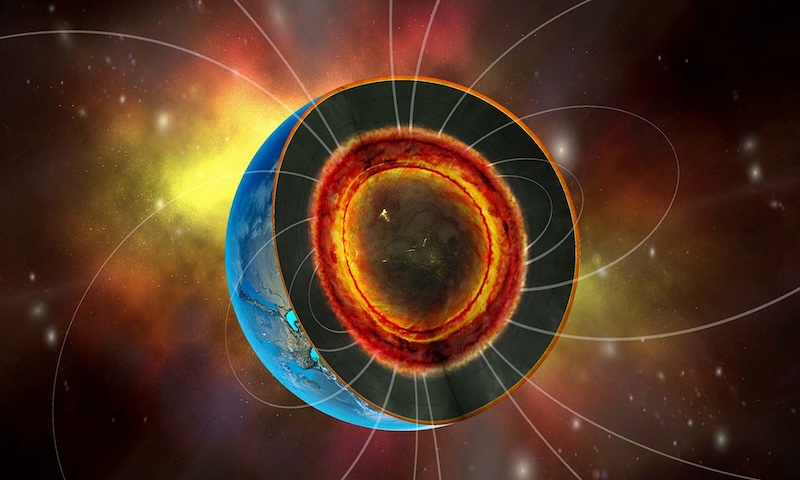
NASA’s Tandem Reconnection and Cusp Electrodynamics Reconnaissance Satellites (TRACERS) mission, a collaborative effort led by the University of Iowa (UI) with substantial contributions from Southwest Research Institute (SwRI), has entered its final integration phase. NASA is set to launch TRACERS’ two satellites into low Earth orbit on July 22, 2025, from Vandenberg Space Force Base in California. The TRACERS mission will explore the dynamic interactions between the Sun’s and Earth’s magnetic fields.