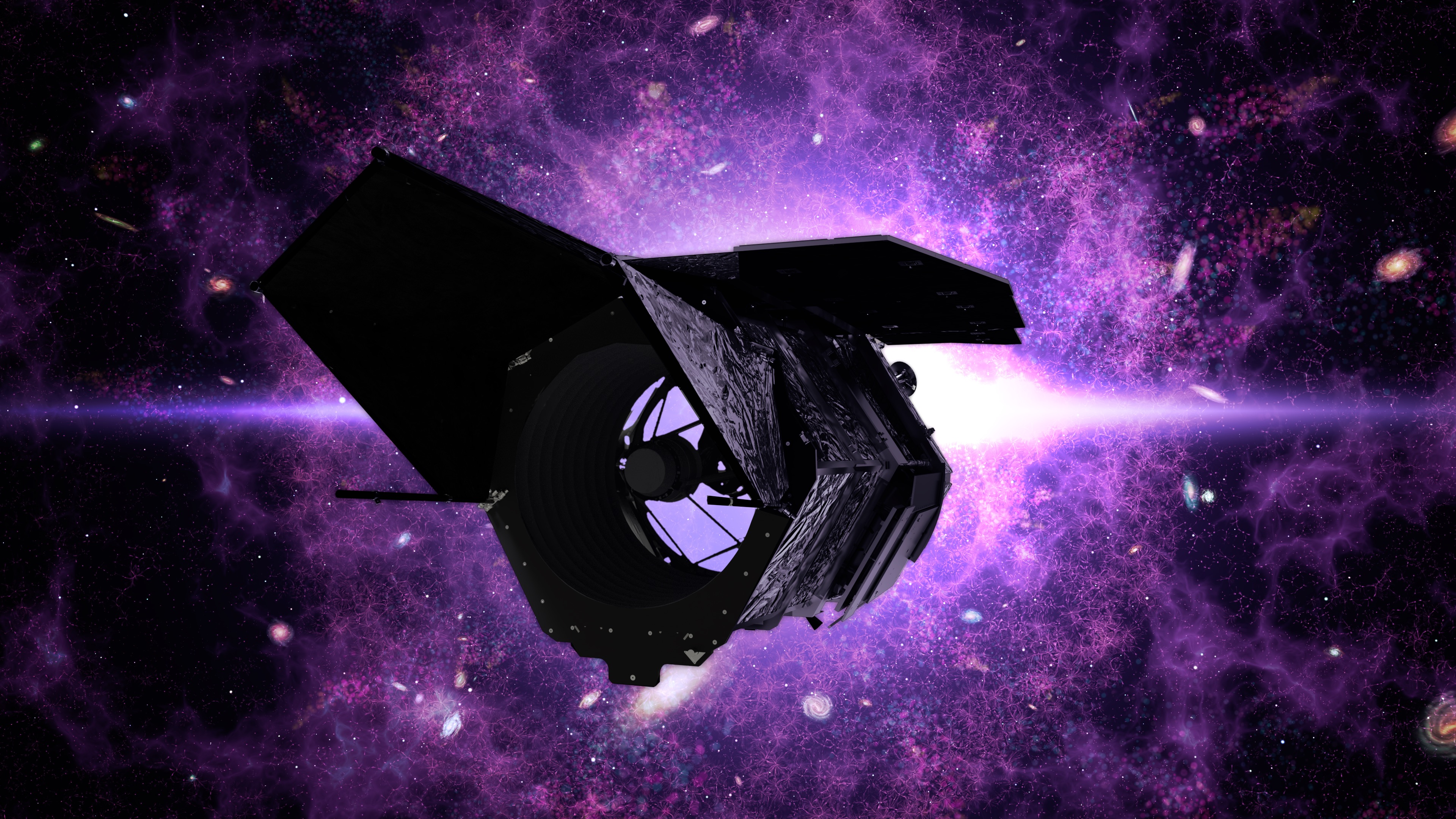
Image (Credit): Artist’s rending of the Nancy Grace Roman Space Telescope. (NASA)
If you want to be part of a NASA mission, you have until July 12th to get your name to NASA so it can be added to the Nancy Grace Roman Space Telescope.
All of the submitted names will be uploaded to an secure digital card that will be attached to the space telescope. These names (and maybe yours) will then be stationed about one million miles away from Earth. As of this moment, NASA already has 145,949 names.
It is not the same as having an exoplanet named after you, but your name will be attached to the observatory that will be finding and analyzing exoplanets and more.
The current schedule calls for the Nancy Grace Roman Space Telescope to be launched on August 30th.
Go to this link to provide your name and learn more about the space telescope’s upcoming mission.
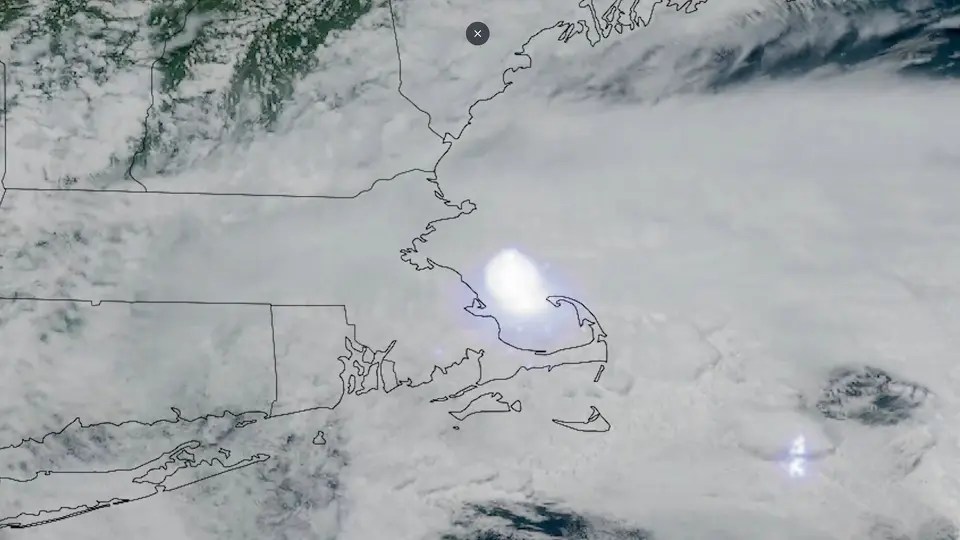
Image (Credit): A exploding meteor off the coast of Massachusetts as captured by the National Oceanic and Atmospheric Administration’s Geostationary Lightning Mapper on May 30, 2026. (National Oceanic and Atmospheric Administration)
A meteor that created a sonic boom heard by thousands in Massachusetts and parts of the Northeast Saturday afternoon was larger than previously believed, NASA said Monday. Scientists now say the meteor was 5 feet in diameter, up from the initial thought of 3 feet, NASA said. “The meteor was about 5 feet (1.6 meters) in diameter with a mass of 5.6 metric tons and entered Earth’s atmosphere at roughly 42,000 mph,” NASA said Monday. Scientists believe it traveled through the atmosphere from northwest to southeast for 26 miles before breaking up at an altitude of 31 miles and producing a meteorite fall into Cape Cod Bay.
Astronomers have found some of the strongest evidence yet that stars can swallow their own planets. A new study, published in Monthly Notices of the Astronomical Society, supports the long-held belief that young stars are capable of ‘eating’ nearby worlds as planetary systems form. Researchers from Keele University and the University of Exeter studied thousands of stars and found evidence that six different red dwarfs – the smallest, coolest, and most common type of star in the universe – had engulfed Earth-like rocky planets.
Our solar system has two ice giants, Uranus and Neptune, but there may have been a third. According to a new study published in the journal Icarus, this extra world might have triggered a violent planetary shuffling billions of years ago that could have disrupted some of Jupiter’s and Uranus’s moons and possibly led to the formation of others.
The Smile spacecraft lifted off on a Vega-C rocket from Europe’s Spaceport in French Guiana at 04:52 BST / 05:52 CEST (00:52 local time) on 19 May 2026. The launch marks the beginning of an ambitious mission to better understand solar storms, geomagnetic storms, and the science of space weather…Smile is a collaboration between the European Space Agency (ESA) and the Chinese Academy of Sciences (CAS). It will reveal how Earth responds to the streams of particles and bursts of radiation from the Sun, using an X-ray camera to make the world’s first X-ray observations of Earth’s magnetic shield, and an ultraviolet camera to watch the resulting northern lights non-stop for 45 hours at a time.
Nasa announced on Tuesday ambitious plans for three uncrewed lunar missions this year to kickstart construction of a $20bn moon base, and said it had chosen the Amazon founder Jeff Bezos’s Blue Origin, ahead of Elon Musk’s SpaceX, to conduct the first...[NASA’s Administrator] said the three missions planned for 2026 would be followed by “more than a dozen” more in the coming years to test systems and equipment. He said the highly successful Artemis II mission last month that sent four astronauts around the moon for the first time since 1972 had been both a catalyst and incentive to advance the moon base plan.
Every morning, clouds roll in, and by evening, they have cleared off. This sounds like a weather forecast for a coastal city here on Earth — but it’s for WASP-94A b, a well-studied gas giant orbiting a star located nearly 700 light-years away. A new study published in the journal Science documents the first detection of repeating cloud cycles on a hot Jupiter exoplanet. The first author of the study is Sagnick Mukherjee, a 51 Pegasi b postdoctoral fellow at Arizona State University’s School of Earth and Space Exploration. Mukherjee is part of a research team that analyzed data from the James Webb Space Telescope targeting WASP-94 A b, a gas giant in the constellation Microscopium. The team discovered that the planet’s morning side is blanketed in clouds of magnesium silicate, the same mineral found in common rocks, while its evening side is under clear skies.
We present the deepest systematic search for planets around mid-to-late M dwarfs to date. We have surveyed 8134 mid-to-late M dwarfs observed by the Transiting Exoplanet Survey Satellite with a custom-built pipeline and recover 77 vetted transiting planet candidates. We characterize the sensitivity of our survey via injection–recovery and measure the occurrence rate of planets as a function of orbital period, instellation, and planet radius. We measure a cumulative occurrence rate of 1.10 ± 0.16 planets per star with radii >1 R⊕ orbiting within 30 days. This value is consistent with the cumulative occurrence rate around early M dwarfs, making M dwarfs collectively the most prolific hosts of small close-in planets. Unlike the bimodal radius valley exhibited by close-in planet populations around FGK and early M dwarfs, we recover a unimodal planet radius distribution peaking at 1.25 ± 0.05 R⊕. We additionally find 0.954 ± 0.147 super-Earths and 0.148 ± 0.045 sub-Neptunes per star, with super-Earths outnumbering sub-Neptunes 5.5:1, firmly demonstrating that the radius valley disappears around the lowest-mass stars. The dearth of sub-Neptunes around mid-to-late M dwarfs is consistent with predictions from water-rich pebble accretion models that predict a fading radius valley with decreasing stellar mass. Our results support the emerging idea that the sub-Neptune population around M dwarfs is composed of water-rich worlds. We find no hot Jupiters in our survey and set an upper limit of 0.012 hot Jupiters per mid-to-late M dwarf within 10 days.
Citation: Erik Diego Gillis et al. TESS planet occurrence rates reveal the disappearance of the radius valley around mid-to-late M dwarfs. AJ 171 317 (2026).
If you need to stretch your mind, I recommend you check out some of the articles and videos available on the Aeon website. As the website states about its purpose:
We ask the big, existentially significant questions and find the freshest, most original answers, provided by leading thinkers on philosophy, science, psychology, society and culture.
One recently posted video with US astrobiologist Lynn Rothschild is a fascinating discussion about the difficulties in humans surviving on another planet or moon, and some of the problems and potential solutions that need to be considered. The video ends with a Q&A where Dr. Rothschild goes into a variety of related topics.
The talk itself comes from The Long Now Foundation, which has this statement about Dr. Rothschild’s talk titled “Nature’s Hardware Store”:
In her Long Now Talk, Dr. Rothschild will open the doors to “Nature’s hardware store” — a vast, largely untapped reservoir of biological strategies available to scientists, engineers, and innovators. Dr. Rothschild’s own work in recent years has included 3D-printing trees, designing fungal-based housing fit for the moon, and building synthetic cells de novo in the lab. In doing so, she has connected theoretical insights about the very nature of life on this planet with practical applications and future directions for innovation on the hardest problems facing our civilization.
The foundation has many other other great talks, including science fiction writer Kim Stanley Robinson and public policy expert Stephen Heintz talking about geopolitics here on Earth.
But getting back to Aeon, some other videos for you to explore include:
With the news seemingly on a doom loop these days, it is worth contemplating some new ideas, if only to give your mind a rest. For that reason, you need Aeon and The Long Now Foundation in your mental medicine cabinet.