Space Stories: Volcanic Exoplanets, Medieval Star Maps, and Near-Earth Asteroids

Image (Credit): The lava lake that sits atop Mount Nyiragongo in the Democratic Republic of Congo (Stocktrek Images / Richard Roscoe via Getty Images)

Here are some recent stories of interest.

Universe.com: “Scientists Discover a New Way Exoplanets Could Make Oxygen; Unfortunately, it Doesn’t Require Life

The researchers have found an abiotic source of oxygen that stems from sulphur dioxide. Sulphur is not rare in celestial bodies, and since volcanoes produce sulphur and pump it into the atmosphere, terrestrial volcanic exoplanets may have oxygen in their atmospheres. And life needn’t be involved.

Nature.com: “First Known Map of Night Sky Found Hidden in Medieval Parchment

A medieval parchment from a monastery in Egypt has yielded a surprising treasure. Hidden beneath Christian texts, scholars have discovered what seems to be part of the long-lost star catalogue of the astronomer Hipparchus — believed to be the earliest known attempt to map the entire sky.

Phys.org: “30,000 Near-Earth Asteroids Discovered, and Numbers are Rising

We have now discovered 30,039 near-Earth asteroids in the solar system—rocky bodies orbiting the sun on a path that brings them close to Earth’s orbit. The majority of these were discovered in the last decade, showing how our ability to detect potentially risky asteroids is rapidly improving.

Have You Heard of Super-Mercuries?

Image (Credit): Surface of Mercury captured by NASA’s MESSENGER spacecraft.(NASA/Johns Hopkins University Applied Physics Laboratory/Carnegie Institution of Washington)

I often here of super-Earths among the spotted expolanets, but super-Mercuries? They are less common, with only eight spotted to date, including two recently found around exoplanet using the Echelle SPectrograph for Rocky Exoplanet and Stable Spectroscopic Observations (ESPRESSO) spectrograph on the European Southern Observatory’s Very Large Telescope in Chile. The two super-Mercuries were spotted in the star system HD 23472 along with two super-Earths.

Researcher researcher Susana Barros with the Astrofísica e Ciências do Espaço’s, who led the team that found the new super-Mercuries, stated:

For the first time we have discovered a system with two super-mercuries. This allows us to obtain clues about how these planets were formed, which could help us exclude some possibilities. For example, if an  impact large enough to create a Super-Mercury is already very unlikely, two giant impacts in the same system seems very improbable. We still don’t know how these planets are formed but it appears to be connected to the composition of the parent star. This new system can help us find out.

Much of the exoplanet talk to date has been about super-Earths and mini-Neptunes, so it is nice to see a super-Mercury thrown into the mix. With the exoplanet search is still in its early days, expect more local planet terminology to be added to the discussion.

For more on the super-Mercury story, go here.

The JWST’s First Image of an Exoplanet

Image (Credit): Exoplanet HIP 65426 b in different bands of infrared light, as seen from the JWST: purple shows the Near-Infrared Camera (NIRCam) instrument’s view at 3.00 micrometers, blue shows the NIRCam instrument’s view at 4.44 micrometers, yellow shows the Mid-Infrared Instrument (MIRI) instrument’s view at 11.4 micrometers, and red shows the MIRI instrument’s view at 15.5 micrometers. These images look different because of the ways the different Webb instruments capture light. A set of masks within each instrument, called a coronagraph, blocks out the host star’s light so that the planet can be seen. The small white star in each image marks the location of the host star HIP 65426, which has been subtracted using the coronagraphs and image processing. The bar shapes in the NIRCam images are artifacts of the telescope’s optics, not objects in the scene. (NASA/ESA/CSA, A Carter (UCSC), the ERS 1386 team, and A. Pagan (STScI))

It was only a matter of time, but even so it was pretty quick. The James Webb Space Telescope (JWST) has taken a direct image of an exoplanet. HIP 65426 b, a gas giant that lies 355 light-years away, is from 15 to 20 million years old and about 6 to 12 times the mass of Jupiter. This gas giant is also about 100 times farther from its host star than Earth is from the Sun, allowing the JWST to see the exoplanet’s light separate from its sun.

This is not the first direct image of an exoplanet. The Hubble Space Telescope has also captured images of exoplanets. For instance, in 2008 an astronomer using Hubble images reported on Fomalhaut b, a Jupiter-mass exoplanet that is about 25 light-years away and approximately 200 million years old. It takes close to 872 years for the exoplanet to orbit its sun. Fomalhaut b will most likely be another target for JWST in the near future.

Image (Credit): Hubble Space Telescope optical image from 2006 showing the belt of dust and debris (bright oval) surrounding the star Fomalhaut and the planet (inset) that orbits the star every 872 years and sculpts the inner edge of the belt. A coronagraph (center) on the Advanced Camera for Surveys blocks out the light of the star, which is 100 million times brighter than the planet. (Paul Kalas/UC Berkeley, NASA, ESA)

Exoplanet WASP-39b Found to Have Carbon Dioxide in its Atmosphere

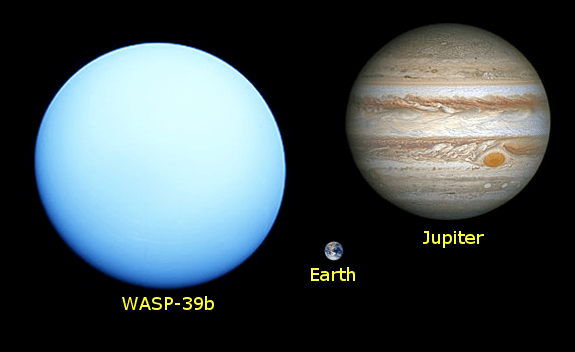
Image (Credit): Comparison of exoplanet WASP-39b to Earth and Jupiter. (wasp-planets.net)

Yesterday, the University of Maryland reported that the James Webb Space Telescope (JWST) has detected carbon dioxide in the atmosphere of exoplanet WASP-39b, a gas giant about 700 light-years away. This is the first time carbon dioxide has been detected on a planet outside of our solar system.

Eliza Kempton, an associate professor of astronomy at the University of Maryland, stated:

The reason we hadn’t been able to definitively identify CO2 in the atmosphere of WASP-39 b previously was that we never had a telescope that could produce spectra across the right wavelength range…This discovery shows us that Webb is delivering on its promise of being a transformational facility for astronomical observations.

Natalie Batalha of the University of California at Santa Cruz, who leads the team, added:

Detecting such a clear signal of carbon dioxide on WASP-39 b bodes well for the detection of atmospheres on smaller, terrestrial-sized planets.

Again, the JWST is showing it is worth its weight in gold (see note below) as it peers through the universe and quickly observes things we only speculated about earlier.

Note: In fact, the JWST weights 14,300 lbs here on Earth, or 228,800 ounces. Today, gold costs $1,763.00 per ounce. So if the JWST was made of solid gold, it would cost about $403 million. Given that the JWST actually costed $10 billion to build and launch, in weight it is 25 times more valuable than gold.

Space Adventures with Exotopia

Credit: SETI Institute.

The Search for Extraterrestrial Intelligence (SETI) Institute has devised a fun way to ponder extraterrestrial life elsewhere in the galaxy. The adventure, Exotopia, allows you to follow a fictional exoplanet voyage for 30 days utilizing real SETI scientific data. The specially-crafted narrative includes unique digital art along the way illustrating the adventure. You can learn more about this project via this video and the Exotopia website.

It’s a fun way for the Institute to involve and educate the public.  The first voyage in June explored the TRAPPIST-1 exoplanets. The next Exotopia voyage launches on September 22, 2022.

Image (Credit): Exotopia ticket for the June 2022 TRAPPIST-1 voyage. (SETI Institute)