Exoplanet WASP-39b Found to Have Carbon Dioxide in its Atmosphere

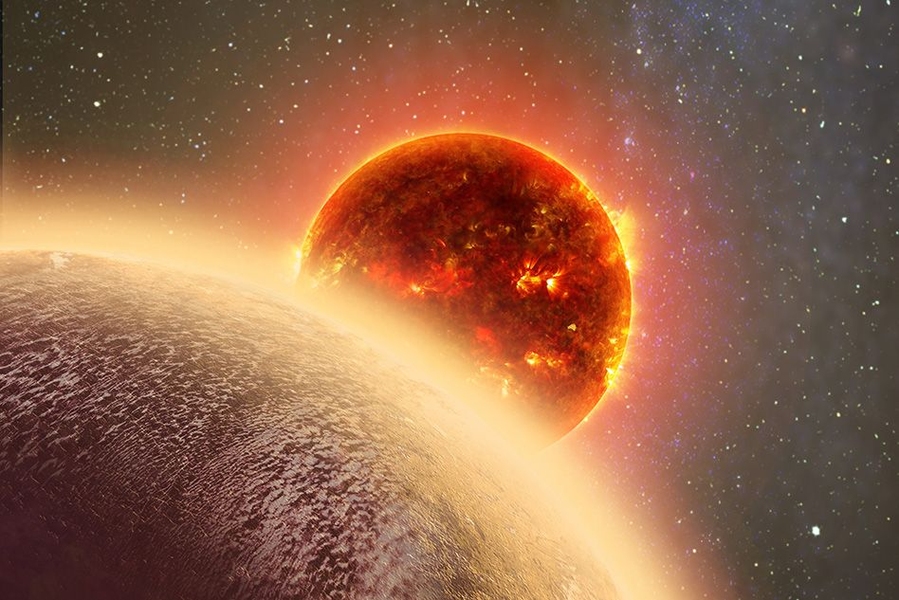
Image (Credit): Comparison of exoplanet WASP-39b to Earth and Jupiter. (wasp-planets.net)

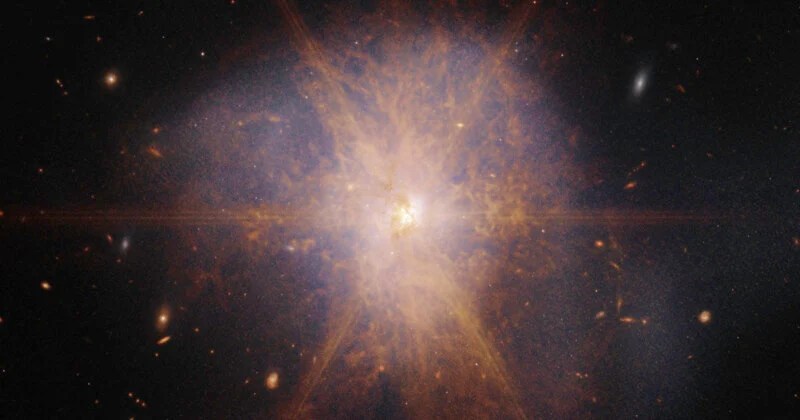
Yesterday, the University of Maryland reported that the James Webb Space Telescope (JWST) has detected carbon dioxide in the atmosphere of exoplanet WASP-39b, a gas giant about 700 light-years away. This is the first time carbon dioxide has been detected on a planet outside of our solar system.

Eliza Kempton, an associate professor of astronomy at the University of Maryland, stated:

The reason we hadn’t been able to definitively identify CO2 in the atmosphere of WASP-39 b previously was that we never had a telescope that could produce spectra across the right wavelength range…This discovery shows us that Webb is delivering on its promise of being a transformational facility for astronomical observations.

Natalie Batalha of the University of California at Santa Cruz, who leads the team, added:

Detecting such a clear signal of carbon dioxide on WASP-39 b bodes well for the detection of atmospheres on smaller, terrestrial-sized planets.

Again, the JWST is showing it is worth its weight in gold (see note below) as it peers through the universe and quickly observes things we only speculated about earlier.

Note: In fact, the JWST weights 14,300 lbs here on Earth, or 228,800 ounces. Today, gold costs $1,763.00 per ounce. So if the JWST was made of solid gold, it would cost about $403 million. Given that the JWST actually costed $10 billion to build and launch, in weight it is 25 times more valuable than gold.

Space Adventures with Exotopia

Credit: SETI Institute.

The Search for Extraterrestrial Intelligence (SETI) Institute has devised a fun way to ponder extraterrestrial life elsewhere in the galaxy. The adventure, Exotopia, allows you to follow a fictional exoplanet voyage for 30 days utilizing real SETI scientific data. The specially-crafted narrative includes unique digital art along the way illustrating the adventure. You can learn more about this project via this video and the Exotopia website.

It’s a fun way for the Institute to involve and educate the public.  The first voyage in June explored the TRAPPIST-1 exoplanets. The next Exotopia voyage launches on September 22, 2022.

Image (Credit): Exotopia ticket for the June 2022 TRAPPIST-1 voyage. (SETI Institute)

A Young Exoplanet Spotted

Image (Credit): ALMA telescope image of AS 209 (ALMA (ESO/NAOJ/NRAO), A. Sierra (U. Chile))

Last week’s news that a young exoplanet has been spotted has generated quite a bit of interest. The discovery was reported in the journal The Astrophysical Journal Letters. Of course, if you read the abstract of the study itself, you may be confused with all the scientific jargon:

We report the discovery of a circumplanetary disk (CPD) candidate embedded in the circumstellar disk of the T Tauri star AS 209 at a radial distance of about 200 au (on-sky separation of 1.4 from the star at a position angle of 161°), isolated via 13CO J = 2−1 emission. This is the first instance of CPD detection via gaseous emission capable of tracing the overall CPD mass. The CPD is spatially unresolved with a 117 × 82 mas beam and manifests as a point source in 13CO, indicating that its diameter is ≲14 au… 

We could not fund the space program if this is what we shared with taxpayers. Fortunately, the accompanying press release was better:

Scientists using the Atacama Large Millimeter/submillimeter Array (ALMA)— in which the National Radio Astronomy Observatory (NRAO) is a partner— to study planet formation have made the first-ever detection of gas in a circumplanetary disk. What’s more, the detection also suggests the presence of a very young exoplanet. The results of the research are published in The Astrophysical Journal LettersWhile studying AS 209— a young star located roughly 395 light-years from Earth in the constellation Ophiuchus— scientists observed a blob of emitted light in the middle of an otherwise empty gap in the gas surrounding the star. That led to the detection of the circumplanetary disk surrounding a potential Jupiter-mass planet. Scientists are watching the system closely, both because of the planet’s distance from its star and the star’s age. The exoplanet is located more than 200 astronomical units, or 18.59 billion miles, away from the host star, challenging currently accepted theories of planet formation. And if the host star’s estimated age of just 1.6 million years holds true, this exoplanet could be one of the youngest ever detected. Further study is needed, and scientists hope that upcoming observations with the James Webb Space Telescope will confirm the planet’s presence.

My first point is that communication matters, and we need both the scientists and the communicators if the public is to learn anything about what is being funded.

My second point relates to information found later in the press release about the new planet being 200 astronomical units from its sun. Pluto is only 39 astronomical units away from our Sun, so this is quite a difference. Which makes me wonder about our solar system and its various components. Even the hazy image above is more than we have of our own solar system as we guess about a ninth planet out there somewhere and hypothesize about the Oort Cloud. Should a civilization many light years away focus its best telescopes on our solar system , what could they tell us?

We seem to be explorers looking out over the sea at far-away islands not even understanding the components of the island we stand on. We certainly learn more every day as we pick and probe at the objects around us, yet it is clear that our knowledge of our own home has plenty of gaps. Maybe the solar system images from afar should be seen as weak reflections from our own solar system.

Given that the James Webb Space Telescope has yet to turn its attention to AS 209, we can expect even more surprises related to this distant solar system, and maybe our own.

Space Quote: Studying Exoplanets

Image (Credit): Artist’s rendering of 25 hot Jupiters captured by the NASA/ESA Hubble Space Telescope that have been analysed by an international team of astronomers, enabling them to answer five open questions important to our understanding of exoplanet atmospheres. (ESA/Hubble, N. Bartmann)

“We are interested in understanding the diversity and atmospheric compositions of planets between the size of Earth and Neptune…“‘Super-Earths’ and ‘mini-Neptunes’ are the most common types of planets in our galaxy. But we only have a few examples of atmospheric measurements from these types of planets.”

-Statement by Johanna Teske, a staff scientist at the Carnegie Institution of Washington who is co-leading a Webb observation team with Natasha Batalha at NASA’s Ames Research Center in Northern California. She was discussing the James Webb Space Telescope’s role to better understand exoplanets. Her comments and more are included in a NASA news article, “Exoplanets: What NASA Will See with the Webb Telescope.”

ISS Research Projects

Image (Credit): International Space Station. (NASA)

Have you ever wondered about all of the scientific projects, past and present, on the International Space Station (ISS)? Quite a bit has happened onboard the station since it was first occupied back in November 2000.

Fortunately, NASA maintains an inventory of all of these projects. The Space Station Research Explorer provides information on all of the experiments, separated into six categories:

  • Biology and Biotechnology;
  • Earth and Space Science;
  • Educational Activities;
  • Human Research;
  • Physical science; and
  • Technology.

For instance, back in 2017 the station supported an experiment under “Earth and Space Science” titled ASTERIA:

The Arcsecond Space Telescope Enabling Research in Astrophysics (ASTERIA) is a six-unit (6U) CubeSat deployed from the International Space Station (ISS) that tests new technologies for astronomical observation, such as the detection of planets outside our solar system (a.k.a., exoplanets). Observing exoplanets requires repeated observation of stars over a long period of time from a dark environment, so that the small shadow of an orbiting planet can be detected passing through the star’s light. ASTERIA uses advanced pointing control technology, new thermal stabilization features, and the scalable CubeSat-platform to perform these complex measurements.

Some projects still lack information. These incomplete projects tend to be sponsored by ROSCOSMOS, though the Russian space agency has plenty of complete projects as well.

Poke around and see what you can find.