Space Stories: Stargazing Apps, Ringless Jupiter, and Detecting Exoplanets

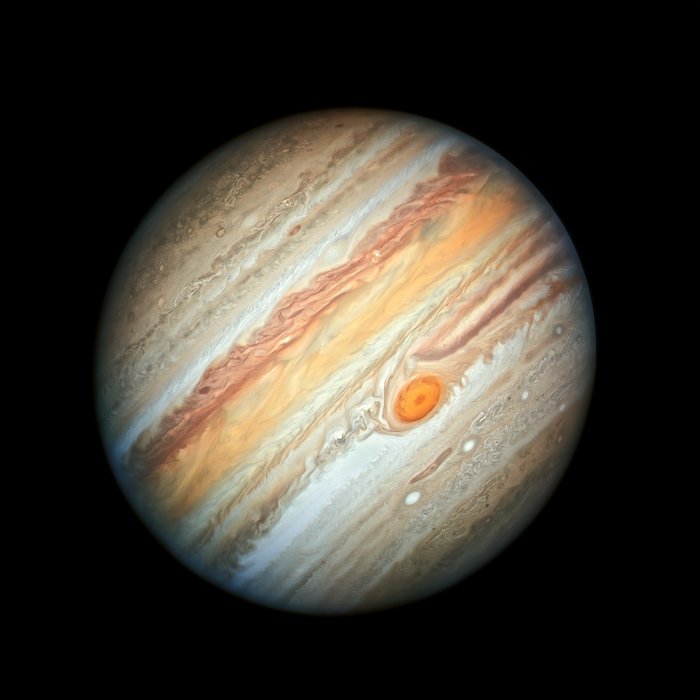
Image (Credit): This enhanced color view of Jupiter’s south pole was created by citizen scientist Gabriel Fiset using data from the JunoCam instrument on NASA’s Juno spacecraft. (NASA/JPL-Caltech/SwRI/MSSS/Gabriel Fiset)

Here are some recent stories of interest.

Mashable.com:The Best Astronomy Apps for Stargazing This Summer

Thanks to these astronomy apps, you can use your phone to see which stars and constellations are above you in real time, day or night. Whether you’re planning on stargazing, are curious about which constellations are in your location, or simply want to flex on your family and friends around the campfire, the following apps can show you what you’re seeing in the sky.

Technology.org:Why Jupiter Doesn’t Have Rings Like Saturn

To understand the reason Jupiter currently looks the way it does, Kane and his graduate student Zhexing Li ran a dynamic computer simulation accounting for the orbits of Jupiter’s four main moons, as well as the orbit of the planet itself, and information about the time it takes for rings to form. Their results are detailed here, soon to be published in the Planetary Science journal.

ScienceDaily.com:A New Method to Detect Exoplanets

In recent years, a large number of exoplanets have been found around single ‘normal’ stars. New research shows that there may be exceptions to this trend. Researchers suggest a new way of detecting dim bodies, including planets, orbiting exotic binary stars known as Cataclysmic Variables (CVs).

In Case You Missed It: Hubble Finds Water on an Exoplanet

Image (Credit): Recent JWST analysis of exoplanet WASP-96 b. (NASA, ESA, CSA, and STScI)

The recent James Webb Space Telescope (JWST) images included hot gas giant exoplanet WASP-96 b, with NASA noting that the space telescope “…has captured the distinct signature of water, along with evidence for clouds and haze, in the atmosphere surrounding a hot, puffy gas giant planet orbiting a distant Sun-like star.”

The same NASA article also noted that the Hubble Space Telescope had found the first evidence of water on a exoplanet back in 2013. So I thought I would dig out that earlier from the European Space Agency, titled “Hubble Finds Water Vapour on Habitable-Zone Exoplanet for the First Time“:

With data from the NASA/ESA Hubble Space Telescope, water vapour has been detected in the atmosphere of a super-Earth within the habitable zone by University College London (UCL) researchers in a world first. K2-18b, which is eight times the mass of Earth, is now the only planet orbiting a star outside the Solar System, or exoplanet, known to have both water and temperatures that could support life.

The parent star, K2-18, is 110 light years from Earth in the constellation of Leo. Maybe we can convince the ESA and others to take another look with the JWST, assuming it is not already on the list of many upcoming projects.

JWST: An Impressive List of Priorities

Image (Credit): Stephan’s Quintet, representing a grouping of five galaxies, as captured by the JWST. (NASA, ESA, CSA, and STScI)

I think we are all eager for more amazing photos from the James Webb Space Telescope, but we need to remember that the space telescope has a long list of priorities and these were not simply random images. An international committee with representatives from NASA, the European Space Agency (ESA), the Canadian Space Agency (CSA), and the Space Telescope Science Institute (STScI) decided on the future work of the space telescope.

The committee has shared these five missions represented by the images already released to the public, indicating the JWST has been pretty busy already:

  • Carina Nebula: The Carina Nebula is one of the largest and brightest nebulae in the sky, located approximately 7,600 light-years away in the southern constellation Carina. Nebulae are stellar nurseries where stars form. The Carina Nebula is home to many massive stars several times larger than the Sun.
  • WASP-96b (spectrum): WASP-96b is a giant planet outside our solar system, composed mainly of gas. The planet, located nearly 1,150 light-years from Earth, orbits its star every 3.4 days. It has about half the mass of Jupiter, and its discovery was announced in 2014.
  • Southern Ring Nebula: The Southern Ring, or “Eight-Burst” nebula, is a planetary nebula – an expanding cloud of gas surrounding a dying star. It is nearly half a light-year in diameter and is located approximately 2,000 light-years away from Earth.
  • Stephan’s Quintet: About 290 million light-years away, Stephan’s Quintet is located in the constellation Pegasus. It is notable for being the first compact galaxy group ever discovered in 1787. Four of the five galaxies within the quintet are locked in a cosmic dance of repeated close encounters.
  • SMACS 0723: Massive foreground galaxy clusters magnify and distort the light of objects behind them, permitting a deep field view into both the extremely distant and intrinsically faint galaxy populations.

So what else is planned? NASA believes the JWST can stay in operation for the next 5 to 10 years, so it has a fair amount of time to allocate to scientists. This link takes you to the 266 approved projects for the telescope’s first year, representing approximately 6,000 hours of JWST prime time and up to 1,231 hours of parallel time. For instance, during the first year you have “Exoplanets and Disks” projects such as:

  • Icy Kuiper Belts in Exoplanetary Systems;
  • Unlocking the Mysteries of the Archetype Sub-Neptune GJ1214b with a Full-Orbit Phase Curve;
  • A Search for the Giant Planets that Drive White Dwarf Accretion;
  • Tell Me How I’m Supposed To Breathe With No Air: Measuring the Prevalence and Diversity of M-Dwarf Planet Atmospheres; and
  • Diamonds are Forever: Probing the Carbon Budget and Formation History of the Ultra-Puffy Hot Jupiter WASP-127b.

That is just a sample, but you can see from some of that titles that the scientists are having fun. Expect hundreds of new discoveries this year resulting from these observations.

Nearby Planetary System Discovery: Two Earth-sized Planets

Image (Credit): Artist’s image of two new planets orbiting HD 260655. (NASA)

MIT News reports a star about 33 light years away contains two Earth-like planets, one that is 1.2 times the size of the Earth and the second that is about 1.5 times the size.

The discovery of these exoplanets orbiting the M-dwarf star, named HD 260655, came about when scientists combined data from NASA’s Transiting Exoplanet Survey Satellite (TESS) with data from the High Resolution Echelle Spectrometer (HIRES) in Hawaii and CARMENES at the Calar Alto Observatory in Spain. 

While both planets are too close to their sun, and thereby too hot to have liquid water on their surface, they are still objects for further study. The article quotes Michelle Kunimoto, a postdoc in MIT’s Kavli Institute for Astrophysics and Space Research and one of the discovery’s lead scientists:

Both planets in this system are each considered among the best targets for atmospheric study because of the brightness of their star…Is there a volatile-rich atmosphere around these planets? And are there signs of water or carbon-based species? These planets are fantastic test beds for those explorations.

Podcast: More on the James Webb Space Telescope

Image (Credit): Alan Alda’s podcast Clear & Vivid (Amazon)

I wanted to highlight another astronomy interview from Alan Alda’s Clear+Vivid podcast, in this case involving a mother and daughter team. Astronomers Natalie and Natasha Batalha discuss “Looking for Life on Alien Worlds” using the new James Webb Space Telescope. The two guests discuss upcoming efforts to better understand the 5,000+ planets that have already been discovered. One of their favorites among the exoplanet systems is the TRAPPIST-1 system, noting the parent red star is about the size of Jupiter. This small star has seven exoplanets, with the “Goldilocks zone” being much closer in than is the case in our system.

NASA describes one of the exoplanets in the “Goldilocks zone,” TRAPPIST-1d, in this way:

TRAPPIST-1d is one of seven Earth-sized planets in the TRAPPIST-1 system. About 40 light-years from Earth, TRAPPIST-1 is unusual both for its number of small rocky planets and the number in the habitable zone. Several of the artist’s illustrationsportray possible water or ice in the system– the proximity of the planets to their red dwarf star may indicate that any of them could have water on their surface. This artist’s concept shows TRAPPIST-1d with a narrow band of water near the terminator, the divide between a hot, dry day and an ice-covered night side.

You can read more about the TRAPPIST-1 system here.

Image (Credit): Artist’s image of exoplanet TRAPPIST-1d. (NASA)