JWST: An Impressive List of Priorities

Image (Credit): Stephan’s Quintet, representing a grouping of five galaxies, as captured by the JWST. (NASA, ESA, CSA, and STScI)

I think we are all eager for more amazing photos from the James Webb Space Telescope, but we need to remember that the space telescope has a long list of priorities and these were not simply random images. An international committee with representatives from NASA, the European Space Agency (ESA), the Canadian Space Agency (CSA), and the Space Telescope Science Institute (STScI) decided on the future work of the space telescope.

The committee has shared these five missions represented by the images already released to the public, indicating the JWST has been pretty busy already:

  • Carina Nebula: The Carina Nebula is one of the largest and brightest nebulae in the sky, located approximately 7,600 light-years away in the southern constellation Carina. Nebulae are stellar nurseries where stars form. The Carina Nebula is home to many massive stars several times larger than the Sun.
  • WASP-96b (spectrum): WASP-96b is a giant planet outside our solar system, composed mainly of gas. The planet, located nearly 1,150 light-years from Earth, orbits its star every 3.4 days. It has about half the mass of Jupiter, and its discovery was announced in 2014.
  • Southern Ring Nebula: The Southern Ring, or “Eight-Burst” nebula, is a planetary nebula – an expanding cloud of gas surrounding a dying star. It is nearly half a light-year in diameter and is located approximately 2,000 light-years away from Earth.
  • Stephan’s Quintet: About 290 million light-years away, Stephan’s Quintet is located in the constellation Pegasus. It is notable for being the first compact galaxy group ever discovered in 1787. Four of the five galaxies within the quintet are locked in a cosmic dance of repeated close encounters.
  • SMACS 0723: Massive foreground galaxy clusters magnify and distort the light of objects behind them, permitting a deep field view into both the extremely distant and intrinsically faint galaxy populations.

So what else is planned? NASA believes the JWST can stay in operation for the next 5 to 10 years, so it has a fair amount of time to allocate to scientists. This link takes you to the 266 approved projects for the telescope’s first year, representing approximately 6,000 hours of JWST prime time and up to 1,231 hours of parallel time. For instance, during the first year you have “Exoplanets and Disks” projects such as:

  • Icy Kuiper Belts in Exoplanetary Systems;
  • Unlocking the Mysteries of the Archetype Sub-Neptune GJ1214b with a Full-Orbit Phase Curve;
  • A Search for the Giant Planets that Drive White Dwarf Accretion;
  • Tell Me How I’m Supposed To Breathe With No Air: Measuring the Prevalence and Diversity of M-Dwarf Planet Atmospheres; and
  • Diamonds are Forever: Probing the Carbon Budget and Formation History of the Ultra-Puffy Hot Jupiter WASP-127b.

That is just a sample, but you can see from some of that titles that the scientists are having fun. Expect hundreds of new discoveries this year resulting from these observations.
Nearby Planetary System Discovery: Two Earth-sized Planets

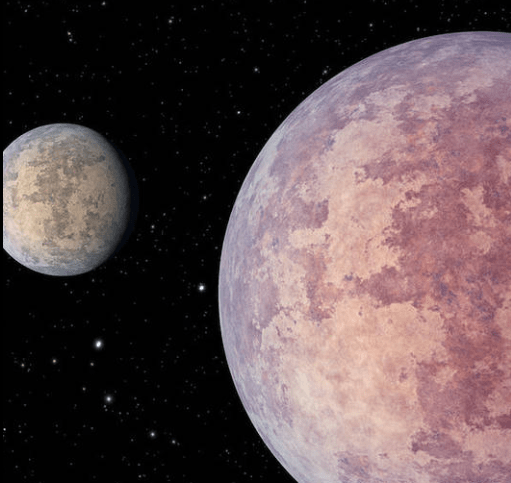
Image (Credit): Artist’s image of two new planets orbiting HD 260655. (NASA)

MIT News reports a star about 33 light years away contains two Earth-like planets, one that is 1.2 times the size of the Earth and the second that is about 1.5 times the size.

The discovery of these exoplanets orbiting the M-dwarf star, named HD 260655, came about when scientists combined data from NASA’s Transiting Exoplanet Survey Satellite (TESS) with data from the High Resolution Echelle Spectrometer (HIRES) in Hawaii and CARMENES at the Calar Alto Observatory in Spain. 

While both planets are too close to their sun, and thereby too hot to have liquid water on their surface, they are still objects for further study. The article quotes Michelle Kunimoto, a postdoc in MIT’s Kavli Institute for Astrophysics and Space Research and one of the discovery’s lead scientists:

Both planets in this system are each considered among the best targets for atmospheric study because of the brightness of their star…Is there a volatile-rich atmosphere around these planets? And are there signs of water or carbon-based species? These planets are fantastic test beds for those explorations.

Podcast: More on the James Webb Space Telescope

Image (Credit): Alan Alda’s podcast Clear & Vivid (Amazon)

I wanted to highlight another astronomy interview from Alan Alda’s Clear+Vivid podcast, in this case involving a mother and daughter team. Astronomers Natalie and Natasha Batalha discuss “Looking for Life on Alien Worlds” using the new James Webb Space Telescope. The two guests discuss upcoming efforts to better understand the 5,000+ planets that have already been discovered. One of their favorites among the exoplanet systems is the TRAPPIST-1 system, noting the parent red star is about the size of Jupiter. This small star has seven exoplanets, with the “Goldilocks zone” being much closer in than is the case in our system.

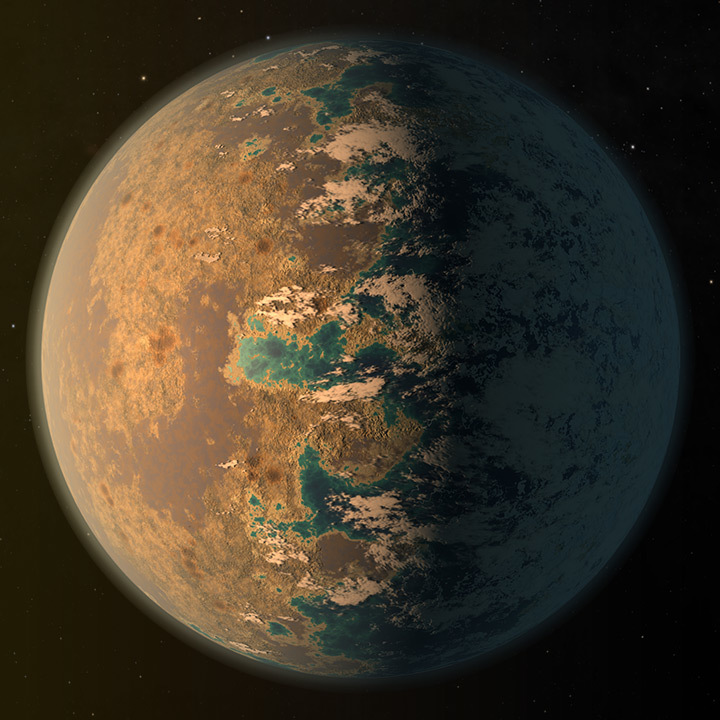
NASA describes one of the exoplanets in the “Goldilocks zone,” TRAPPIST-1d, in this way:

TRAPPIST-1d is one of seven Earth-sized planets in the TRAPPIST-1 system. About 40 light-years from Earth, TRAPPIST-1 is unusual both for its number of small rocky planets and the number in the habitable zone. Several of the artist’s illustrationsportray possible water or ice in the system– the proximity of the planets to their red dwarf star may indicate that any of them could have water on their surface. This artist’s concept shows TRAPPIST-1d with a narrow band of water near the terminator, the divide between a hot, dry day and an ice-covered night side.

You can read more about the TRAPPIST-1 system here.

Image (Credit): Artist’s image of exoplanet TRAPPIST-1d. (NASA)

Exoplanet or Star?

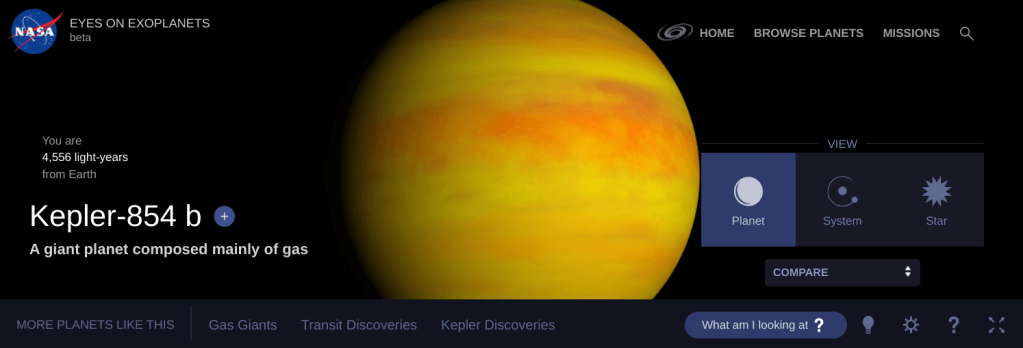
Image(Credit): Kepler-854b (NASA Exoplanet Exploration).

Phys.org had a good story on the reclassification of objects captured by the NASA’s Kepler Space Telescope once believed to be exoplanets. New evidence indicates three “exoplanets” – Kepler-854b, Kepler-840b, and Kepler-699b – are actually stars (hence, the NASA image above will need to be modified).

The article notes that the three objects are too large to be considered planets, being between two and four times the size of Jupiter. The results were part of a study from the Astronomical Journal. A fourth exoplanet, Kepler-747 b, might also be a star.

After updated information indicated Kepler-854b was about three times the size of Jupiter, one of the study authors said, “There’s no way the universe can make a planet of that size…It just doesn’t exist.”

While the team reviewed about 2,000 Kepler exoplanets to find these four questionable items, it is likely that more will be found in the future among other reported exoplanets. Fortunately, that still leaves us with plenty of real exoplanets to study.

Another Space Telescope is Coming: The Nancy Grace Roman Space Telescope

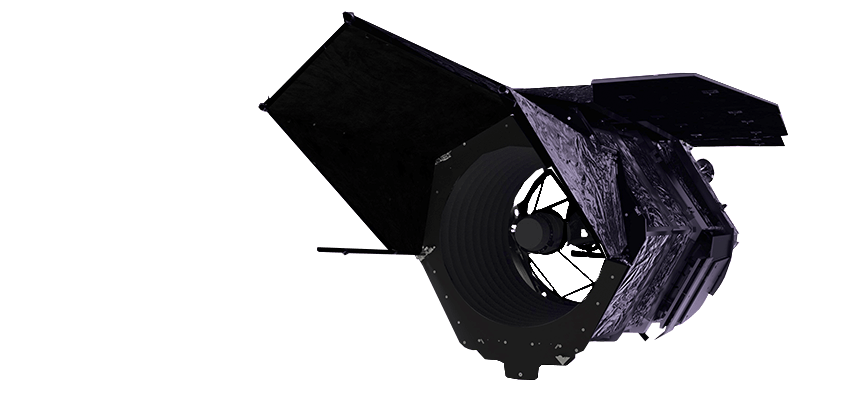
Source/Credit: Nancy Grace Roman Space Telescope from NASA.

With all the excitement about the James Webb Space Telescope coming online shortly, we do not want to forget about another space telescope in development. NASA’s Nancy Grace Roman Space Telescope, expected to be launched in 2027, will be even more productive than the Hubble Space Telescope. NASA noted the new space telescope will be:

Providing the same crisp infrared resolution as Hubble over a field of view 200 times larger, Roman will conduct sweeping cosmic surveys that would take hundreds of years using Hubble. Roman will map stars, galaxies, and dark matter to explore the formation and evolution of large cosmic structures, like clusters and superclusters of galaxies, and investigate dark energy, which is thought to accelerate the expansion of the universe.

The Nancy Grace Roman Space Telescope will also have a Coronagraph Instrument that will be able to detect more exoplanets, including smaller, rocky exoplanets similar to Earth. By using the parent star’s reflected light on a larger exoplanet, this instrument will also allow astronomers to analyze the colors of the exoplanet’s atmosphere and learn more about the content of that atmosphere (complementing other studies of large exoplanets, one of which was noted here earlier). If successful, this technology could be refined further to one day help to detect oxygen, methane, and other elements/compounds in the atmosphere of distant, Earth-sized exoplanets.

Astronomer Vanessa Bailey from NASA’s Jet Propulsion Laboratory stated:

To image Earth-like planets, we’ll need 10,000 times better performance than today’s instruments provide…The Coronagraph Instrument will perform several hundred times better than current instruments, so we will be able to see Jupiter-like planets that are more than 100 million times fainter than their host stars.

The telescope is named after Nancy Grace Roman, who was NASA’s first chief astronomer and also known as the “Mother of Hubble” for her efforts in making the Hubble Space Telescope a reality. You can read more about her here.