Source/Credit: Artist’s image of WASP-121b from Engine House VFX.
It was not so long ago that we were questioning the very existence of exoplanets, and now we are measuring their dark-sides. MIT News has a story about a recent paper discussing the findings of astronomers observing an exoplanet approximately 850 light years from Earth. About twice the size of Jupiter and tidally-locked with its host star, the exoplanet has a very strange water cycle. The article states:
While on Earth, water cycles by first evaporating, then condensing into clouds, then raining out, on WASP-121b, the water cycle is far more intense: On the day side, the atoms that make up water are ripped apart at temperatures over 3,000 kelvins. These atoms are blown around to the night side, where colder temperatures allow hydrogen and oxygen atoms to recombine into water molecules, which then blow back to the day side, where the cycle starts again.
The article and paper go into many more details, yet I am most impressed with this level of observation already possible using a spectroscopic camera aboard NASA’s Hubble Space Telescope. With the James Webb Space Telescope soon to go online, we can only hope for more fascinating insights into distant exoplanets.
Source/Credit: A NASA composite image of Uranus taken from Voyager 2 and the Hubble Space Telescope.
In an earlier posting, I highlighted some scientific papers calling for a return to Neptune rather than Uranus, in part because of Neptune’s moon Triton. But what is the argument for a mission to Uranus? Below I highlight one of the papers submitted to the Planetary Science and Astrobiology Decadal Survey 2023-2032 arguing the merits of a NASA mission to Uranus.
The large moons of Uranus are possible ocean worlds that exhibit a variety of surface features, hinting at endogenic geologic activity in the recent past. These moons are rich in water ice, as well as carbon-bearing and likely nitrogen-bearing constituents, which represent some of the key components for life as we know it. However, our understanding of Uranus and its moons is severely limited by the absence of data collected by an orbiting spacecraft…
An orbiter would vastly improve our understanding of these possible ocean worlds and allow us to assess the nature of water and organics in the Uranian system, thereby improving our knowledge of these moons’ astrobiological potential. A Flagship mission to Uranus can be carried out with existing chemical propulsion technology by making use of a Jupiter gravity assist in the 2030 – 2034 timeframe, leading to a flight time of only ~11 years, arriving in the early to mid 2040’s (outlined in the Ice Giants Pre-Decadal Survey Mission Study Report: https://www.lpi.usra.edu/icegiants/mission_study/Full-Report.pdf).
The five large moons discussed in the paper are Miranda, Ariel, Umbriel, Titania, and Oberon. Titania and Oberon where the first to be discovered back in 1787, followed by the later discoveries of Ariel, Umbriel, and Miranda (in that order). Unlike the moons of other planets, the moons of Uranus are named after magical spirits in English literature.
All of these ocean worlds have gained greater interest as we learn about the dynamics of life on of our own planet. As noted in an article in the MIT Technology Review:
It was once thought the solar system was probably a barren wasteland apart from Earth. Rocky neighbors were too dry and cold like Mars, or too hot and hellish like Venus. The other planets were gas giants, and life on those worlds or their satellite moons was basically inconceivable. Earth seemed to be a miracle of a miracle.
But life isn’t that simple. We now know that life on Earth is able to thrive in even the harshest, most brutal environments, in super cold and super dry conditions, depths of unimaginable pressures, and without the need to use sunlight as a source of energy. At the same time, our cursory understanding of these obscure worlds has expanded tremendously.
We have plenty of worlds to explore in our own solar system as other scientists continue their search for exoplanets and exomoons. The only question now is which local worlds will we visit in our next round of space missions.
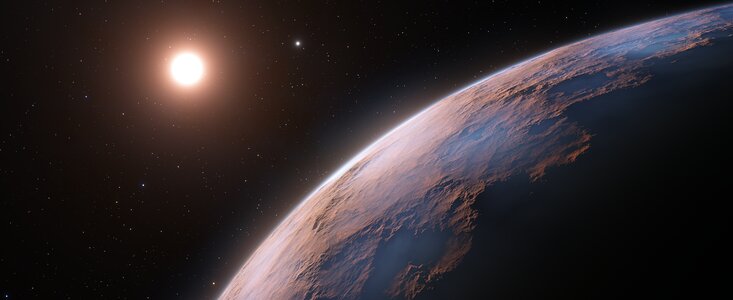
Source/Credit: Artist rendering of a candidate exoplanet orbiting Proxima Centauri from the ESO.
Earlier this month, astronomers utilizing the European Space Observatory’s (ESO) Very Large Telescope identified what appears to be a third exoplanet orbiting Proxima Centauri, the closest star to our solar system at about 4.2 light years away. The ESO press release shared the following details:
The newly discovered planet, named Proxima d, orbits Proxima Centauri at a distance of about four million kilometres, less than a tenth of Mercury’s distance from the Sun. It orbits between the star and the habitable zone — the area around a star where liquid water can exist at the surface of a planet — and takes just five days to complete one orbit around Proxima Centauri.
The star is already known to host two other planets: Proxima b, a planet with a mass comparable to that of Earth that orbits the star every 11 days and is within the habitable zone, and candidate Proxima c, which is on a longer five-year orbit around the star.
…At just a quarter of the mass of Earth, Proxima d is the lightest exoplanet ever measured using the radial velocity technique, surpassing a planet recently discovered in the L 98-59 planetary system. The technique works by picking up tiny wobbles in the motion of a star created by an orbiting planet’s gravitational pull. The effect of Proxima d’s gravity is so small that it only causes Proxima Centauri to move back and forth at around 40 centimetres per second (1.44 kilometres per hour).
It’s great to learn a little more about our nearest neighbor.
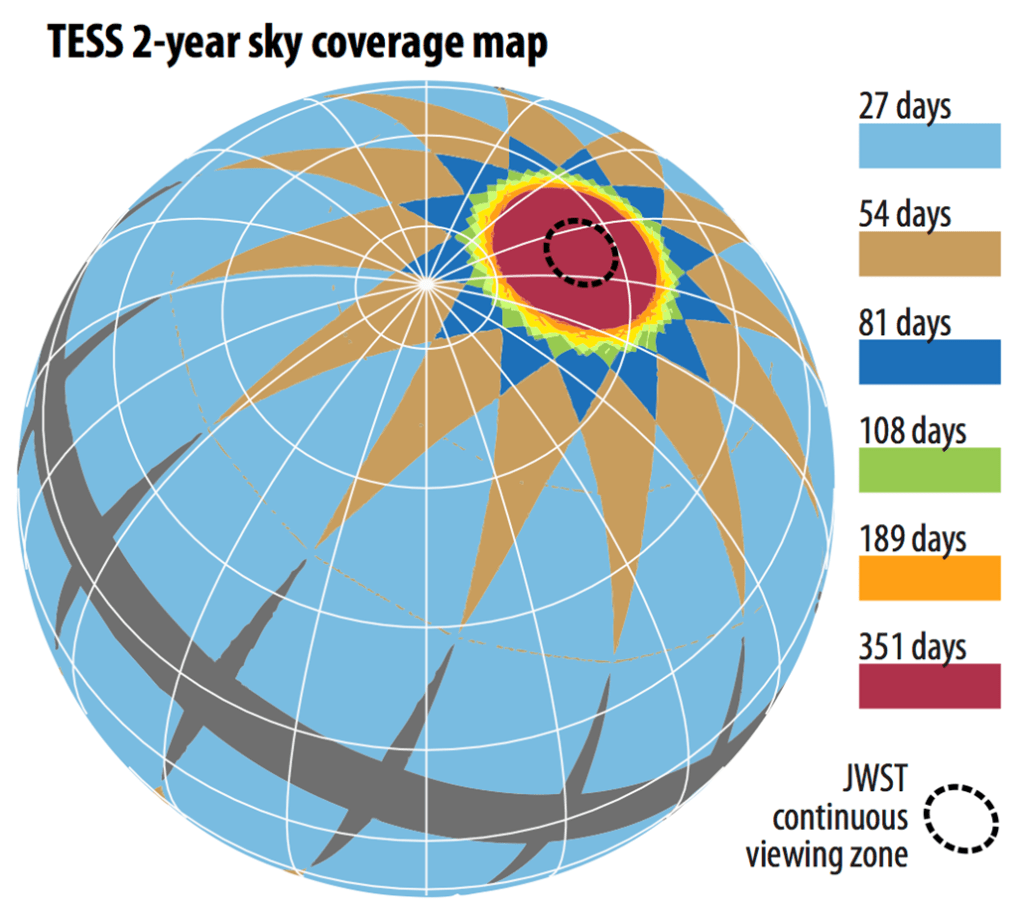
The volume of possible new worlds continues to expand with the work of the MIT-led NASA mission to observe the heavens for potential exoplanet candidates. Since 2018, the Transiting Exoplanet Survey Satellite (TESS) program has been monitoring stars for temporary drops in brightness caused by planetary transits (the mapping of the initial two years of viewing is provided above). With the addition of new candidates from July 2020 to June 2021, the count of potential exoplanets now exceeds 5,000. Potential candidates will be studied to learn more about their characteristics. TESS’s mission goal has been to discover 50 planets of size less than 4 Earth radii with measured masses.
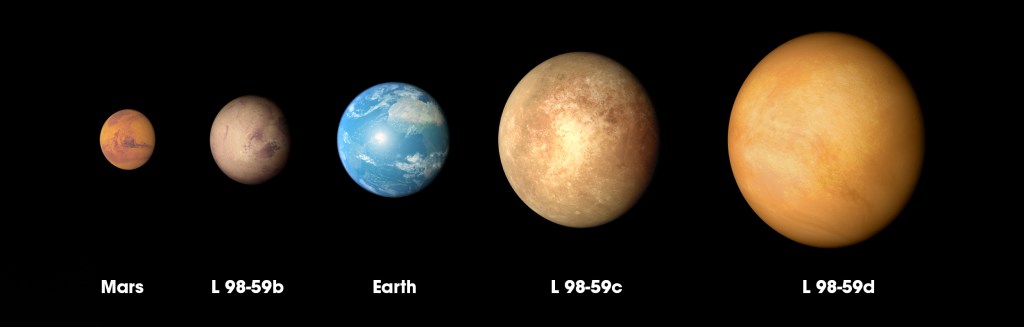
You can read more about some of TESS’s earlier exoplanet discoveries (shown below and here). For instance, L 98-59b is about 80 percent Earth’s size and orbits L 98-59, an M dwarf about one-third the mass of the Sun. L98-59 is about 35 light-years away.
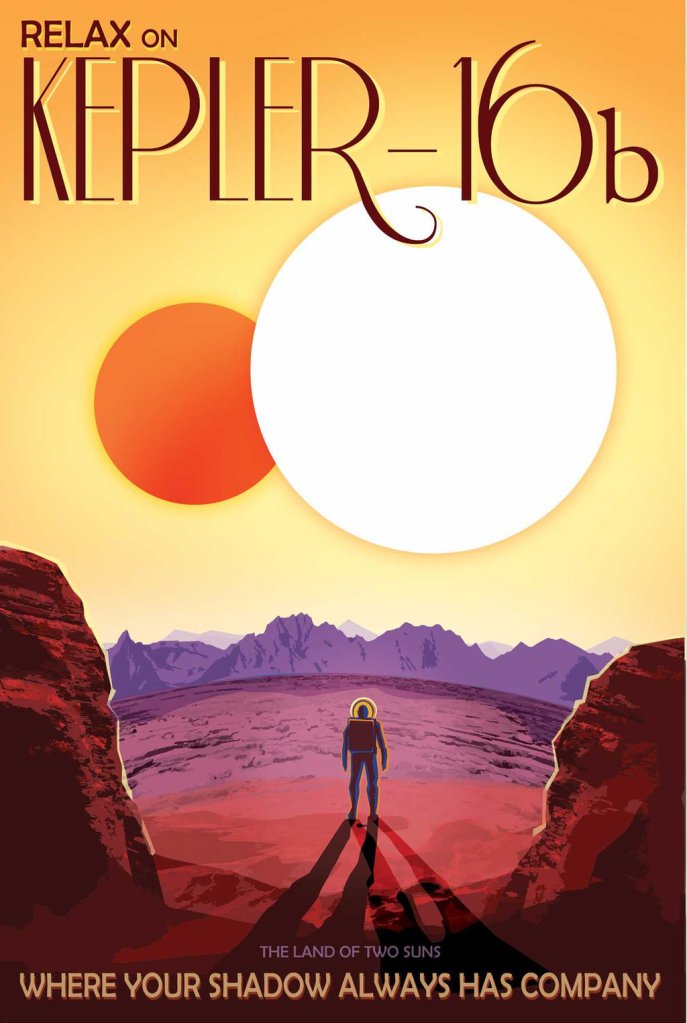
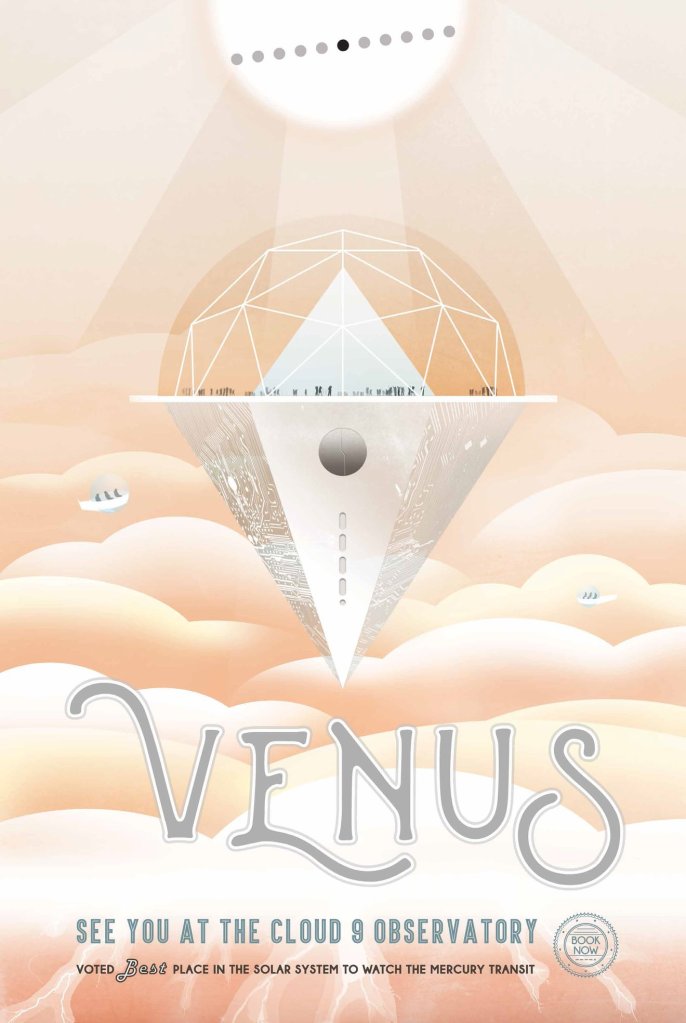
If you are getting tired of staying home these days, NASA has some fun destinations in mind for you. Late last year, NASA’s Jet Propulsion Laboratory (JPL) put together “Visions of the Future” to show you where the space agency hopes to go someday. You may not want to pack just yet, but whether it is this solar system or some other solar system, NASA wants to help.
The poster above for Kepler-16b comes with this enticing description:
Like Luke Skywalker’s planet “Tatooine” in Star Wars, Kepler-16b orbits a pair of stars. Depicted here as a terrestrial planet, Kepler-16b might also be a gas giant like Saturn. Prospects for life on this unusual world aren’t good, as it has a temperature similar to that of dry ice. But the discovery indicates that the movie’s iconic double-sunset is anything but science fiction.
You might also enjoy this NASA video showing some space activities in these prime locations.
I dropped in a few more posters below, but be sure to check out all of them. A big thanks also to the folks at JPL for these fun images. The 14 posters were created by nine artists, designers, and illustrators.
Of course, these free photos are already being sold on Etsy.com and elsewhere as posters and t-shirts.



 Our Awesome Universe