Space Stories: NASA’s Probe Explorers, Finding Exoplanet Atmospheres, and an Australian Space Antenna

Here are some recent stories of interest.

Universe TodayNASA Announces a New Class of Space Missions: Probe Explorers

NASA has sent a whole host of spacecraft across the Solar System and even beyond. They range from crewed ships to orbit and to the Moon to robotic explorers. Among them are a range of mission classes from Flagships to Discovery Class programs. Now a new category has been announced: Probe Explorers. This new category will fill the gap between Flagship and smaller missions. Among them are two proposed missions; the Advanced X-ray Imaging Satellite and the Probe Far-Infrared Mission for Astrophysics.

uChicago News: “UChicago Researchers Use New Method of Finding Atmospheres in Distant Planets

It is a major goal of astronomical research to find planets other than Earth that might be suitable for sustaining life. There are a number of factors which many scientists agree are essential to a planet being habitable, but an important one is whether or not a planet has an atmosphere. Scientists have found other rocky, Earth-like exoplanets, but none that we can definitively say have atmospheres. Finding these planets will reveal insights into how such atmospheres are formed and retained, so that we can better predict which planets could be habitable. A study conducted by University of Chicago PhD student Qiao Xue with Prof. Jacob Bean’s group has demonstrated a new way to determine if faraway exoplanets have an atmosphere—and showed that it was simpler and more efficient than previous methods. The new technique, when applied to more planets, has the potential to help us learn more about patterns in atmosphere formation.

European Space Agency: “ESA Crowns New Deep Space Antenna in Australia

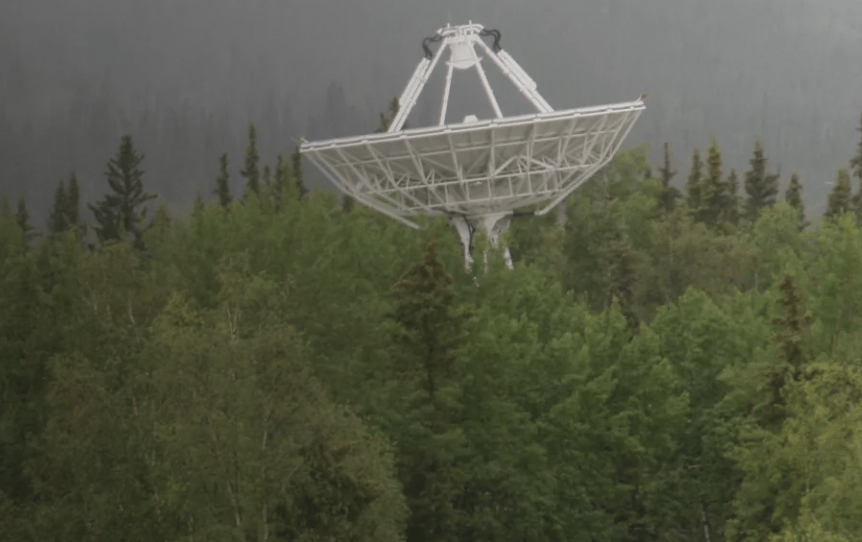
A giant wakes as the Sun sets in Western Australia. The workers can finally rest easy after more than a day spent using an enormous crane to lift the colossal 122-tonne, 35-metre diameter reflector dish and crown ESA’s newest deep space communication antenna. With the dish and its quadrupole now installed, ESA is on track to inaugurate its fourth deep-space antenna, and second at the New Norcia site in Australia, by the end of 2025. Referred to as NNO3, the New Norcia 3 antenna will allow spacecraft to send and receive more valuable data collected from onboard scientific instruments and vital flight instructions for mission operations.

Study Finding: Gravitational Instability in a Planet-forming Disk

Credit: Peter Schmidt from Pixabay

Nature abstract of the study findings:

The canonical theory for planet formation in circumstellar disks proposes that planets are grown from initially much smaller seeds. The long-considered alternative theory proposes that giant protoplanets can be formed directly from collapsing fragments of vast spiral arms induced by gravitational instability—if the disk is gravitationally unstable. For this to be possible, the disk must be massive compared with the central star: a disk-to-star mass ratio of 1:10 is widely held as the rough threshold for triggering gravitational instability, inciting substantial non-Keplerian dynamics and generating prominent spiral arms. Although estimating disk masses has historically been challenging, the motion of the gas can reveal the presence of gravitational instability through its effect on the disk-velocity structure. Here we present kinematic evidence of gravitational instability in the disk around AB Aurigae, using deep observations of 13CO and C18O line emission with the Atacama Large Millimeter/submillimeter Array (ALMA). The observed kinematic signals strongly resemble predictions from simulations and analytic modelling. From quantitative comparisons, we infer a disk mass of up to a third of the stellar mass enclosed within 1″ to 5″ on the sky.

Citation: Speedie, J., Dong, R., Hall, C. et al. Gravitational instability in a planet-forming disk. Nature 633, 58–62 (2024).
https://doi.org/10.1038/s41586-024-07877-0

Study-related stories:

MIT News

Space Daily

Universe Today

Space Stories: More Quality Control Issues at Boeing, Blue Origin’s Planned Lunar Landing, and Citizen Scientists Assisting with Exoplanet Research

Image (Credit): Artist’s rendering of the SLS in flight. (NASA)

Here are some recent stories of interest.

NBC NewsNASA Inspector General Gives Damning Assessment of Boeing’s Quality Control in New Report

The report, released Thursday by NASA’s Office of Inspector General, calls into question Boeing’s standards and quality control for its part in NASA’s efforts to return astronauts to the moon. In NASA’s development of its next-generation megarocket, known as the Space Launch System, it gave Boeing the contract to build the rocket system’s powerful upper stage. But according to the report, Boeing’s quality control systems fall short of NASA’s requirements, and some known deficiencies have gone unaddressed. What’s more, the workers on the project are not, as a whole, sufficiently experienced or well trained, according to the inspector general.

Space NewsNASA Payload to Fly on First Blue Origin Lunar Lander Mission

A NASA payload will hitch a ride to the moon on Blue Origin’s first lunar lander mission, scheduled to launch as soon as next March. In an Aug. 6 procurement filing, NASA revealed it selected Blue Origin to fly a camera system to study how engine plumes interact with regolith at south polar regions of the moon, collecting data to support future crewed landing missions. The payload, called Stereo Cameras for Lunar Plume Surface Studies (SCALPSS), will fly through NASA’s Commercial Lunar Payload Services (CLPS) program.

NASAHow NASA Citizen Science Fuels Future Exoplanet Research

NASA’s upcoming flagship astrophysics missions, the Nancy Grace Roman Space Telescope and the Habitable Worlds Observatory, will study planets outside our solar system, known as exoplanets. Over 5,000 exoplanets have been confirmed to date — and given that scientists estimate at least one exoplanet exists for every star in the sky, the hunt has just begun. Exoplanet discoveries from Roman and the Habitable Worlds Observatory may not be made only by professional researchers, but also by interested members of the public, known as citizen scientists.

Space Stories: A Polish Astronaut Heads to ISS, Two Astronauts Are Missing from Church, and Deadly Red Dwarves

Image (Credit): Sławosz Uznański in ESA’s Neutral Buoyancy Facility. (ESA)

Here are some recent stories of interest.

European Space Agency (ESA)Sławosz Uznański from Poland Will fly to International Space Station on Rourth Axiom Space Mission

Axiom Space announced that it is partnering with India, Hungary, and with Poland through ESA to send three national astronauts to the International Space Station on Axiom Mission 4 (Ax-4). ESA project astronaut Sławosz Uznański has been assigned as mission specialist under the command of Axiom Space’s Chief Astronaut Peggy Whitson...The other two Ax-4 crew members are pilot Shubhanshu Shukla from India, and mission specialist Tibor Kapu from Hungary.

Associated PressOne Church, Two Astronauts. How a Texas Congregation is Supporting its Members on the Space Station

there’s no way on Earth for NASA astronauts Barry “Butch” Wilmore and Tracy Dyson to show up at Providence Baptist Church. They’re in space, orbiting the planet. More specifically, these two members are working on the International Space Station together...Dyson’s six-month mission isn’t scheduled to end until September, but Wilmore and his fellow NASA test pilot, Suni Williams, should have been back weeks ago. They are staying longer than expected following thruster failures and helium leaks on Boeing’s inaugural crew flight for its Starliner capsule. Wilmore and Williams have said they are confident the capsule will return them home safely; engineers are still poring over Starliner test data.

University of CambridgeAstronomers Uncover Risks to Planets that Could Host Life

Astronomers have discovered that red dwarf stars can produce stellar flares that carry far-ultraviolet (far-UV) radiation levels much higher than previously believed. The discovery suggests that the intense UV radiation from these flares could significantly impact whether planets around red dwarf stars can be habitable…According to researchers, UV radiation from stellar flares can either erode planetary atmospheres, threatening their potential to support life, or contribute to the formation of RNA building blocks, which are essential for the creation of life.

Pic of the Week: View of a Nearby Exoplanet

Image (Credit): JWST’s view of exoplanet Epsilon Indi Ab. (NASA, ESA, CSA, STScI, E. Matthews (Max Planck Institute for Astronomy))

This week’s image looks dark and simple, and yet it is an amazing sight provided by NASA’s James Webb Space Telescope (JWST). It shows a directly imaged exoplanets that resides about 12 light-years from us. It is called Epsilon Indi Ab and is several times the mass of Jupiter.

Here is an explanation from NASA about what you are seeing in the image:

This image of the gas-giant exoplanet Epsilon Indi Ab was taken with the on NASA’s James Webb Space Telescope’s MIRI (Mid-Infrared Instrument). A star symbol marks the location of the host star Epsilon Indi A, whose light has been blocked by the coronagraph, resulting in the dark circle marked with a dashed white line. Epsilon Indi Ab is one of the coldest exoplanets ever directly imaged. Light at 10.6 microns was assigned the color blue, while light at 15.5 microns was assigned the color orange. MIRI did not resolve the planet, which is a point source.