Study Findings: Satellite Megaconstellations will Threaten Space-based Astronomy

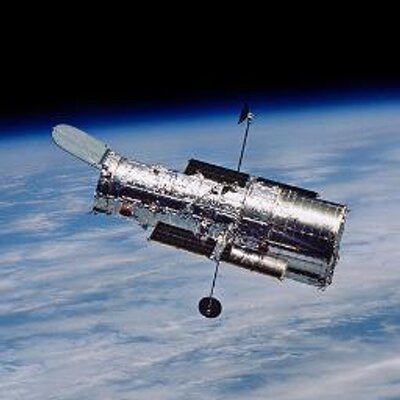
Image (Credit): The Hubble Space Telescope. (NASA)

Nature abstract of the study findings:

Rapidly growing satellite constellations have raised strong concerns among the scientific community. Reflections from satellites can be visible to the unaided eye and extremely bright for professional telescopes. These trails already affect astronomical images across the complete electromagnetic spectrum, with a noticeable cost for operations and mitigation efforts. Contrary to popular perception, satellite trails affect not only ground-based observatories but also space observatories such as the Hubble Space Telescope. However, the current number of satellites is only a fraction (less than 3%) of those to be launched in the next decade. Here we show a forecast of the satellite trail contamination levels for a series of international low-Earth-orbit telescopes on the basis of the proposed telecommunication industry constellations. Our results show that if these constellations are completed, one-third of the images of the Hubble Space Telescope will be contaminated, while the SPHEREx (Spectro-Photometer for the History of the Universe, Epoch of Reionization and Ices Explorer), ARRAKIHS (Analysis of Resolved Remnants of Accreted galaxies as a Key Instrument for Halo Surveys) and Xuntian space telescopes will have more than 96% of their exposures affected, with 5.6,  69 and 92 trails per exposure, respectively, with an average surface brightness of μ = 19 ± 2 mag arcsec−2. Our results demonstrate that light contamination is a growing threat for space telescope operations. We propose a series of actions to minimize the impact of satellite constellations, allowing researchers to predict, model and correct unwanted satellite light pollution from science observations.

Citation: Borlaff, A.S., Marcum, P.M. & Howell, S.B. Satellite megaconstellations will threaten space-based astronomy. Nature 648, 51–57 (2025).

https://doi.org/10.1038/s41586-025-09759-5

Study-related stories:

Scientific American – “Satellites Swarming Low-Earth Orbit Threaten Space Telescopes”

News Scientist – “Planned Satellite Launches Could Ruin Hubble Space Telescope Images”

Orbital Today – “Satellite Boom Set To Disrupt Space Telescopes As Researchers Warn Of ‘Growing Threat’”

Pic of the Week: The Indescribable NGC 2775

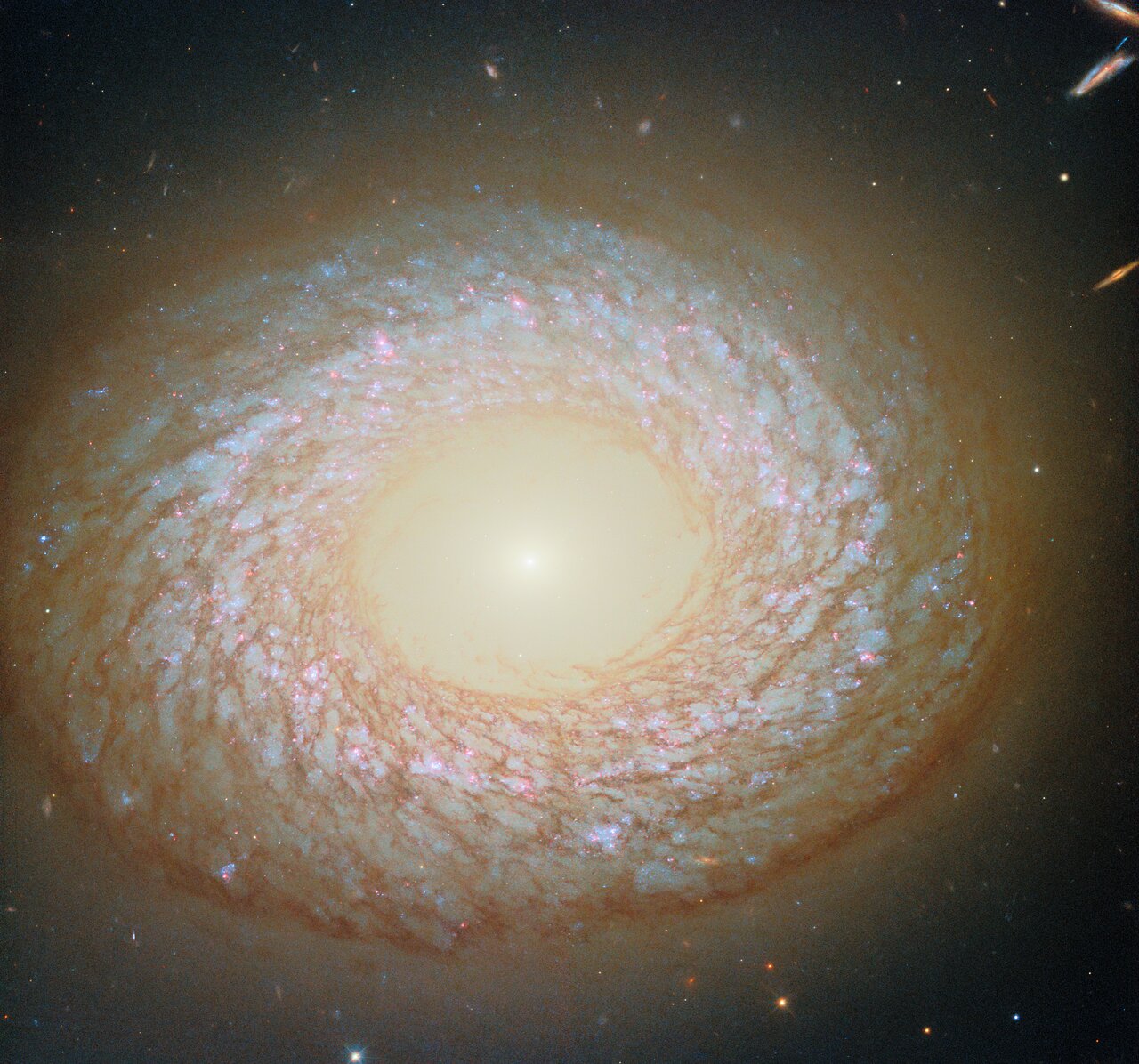
Image (Credit): NGC 2775, which is 67 million light-years away, as captured by the NASA/ESA Hubble Space Telescope. (ESA/Hubble & NASA, F. Belfiore, J. Lee and the PHANGS-HST Team)

This week’s image is from the NASA/European Space Agency (ESA) Hubble Space Telescope. It shows the odd galaxy NGC 2275 that is hard to describe. Is it an elliptical galaxy, a spiral galaxy, or something else?

The ESA weighs in on the issue below:

NGC 2775 sports a smooth, featureless centre that is devoid of gas, resembling an elliptical galaxy. It also has a dusty ring with patchy star clusters, like a spiral galaxy. Which is it, then: spiral or elliptical — or neither?

Because we can only view NGC 2775 from one angle, it’s difficult to say for sure. Some researchers have classified NGC 2775 as a spiral galaxy because of its feathery ring of stars and dust, while others have classified it as a lenticular galaxy. Lenticular galaxies have features common to both spiral and elliptical galaxies.

It’s not yet known exactly how lenticular galaxies come to be, and they might form in a variety of ways. Lenticular galaxies might be spiral galaxies that have merged with other galaxies, or that have mostly run out of star-forming gas and lost their prominent spiral arms. They also might have started out more similar to elliptical galaxies, then collected gas into a disk around them.

Some evidence suggests that NGC 2775 has merged with other galaxies in the past. Invisible in this Hubble image, NGC 2775 has a tail of hydrogen gas that stretches almost 100 000 light-years around the galaxy. This faint tail could be the remnant of one or more galaxies that wandered too close to NGC 2775 before being stretched apart and absorbed. If NGC 2775 merged with other galaxies in the past, it could explain the galaxy’s strange appearance today.

Pic of the Week: The Third Interstellar Visitor

Image (Credit): Interstellar comet 3I/Atlas captured by the Hubble Space Telescope. (NASA, ESA, D. Jewitt (UCLA), J. DePasquale (STScI))

This week’s image is from the NASA/European Space Agency’s (ESA) Hubble Space Telescope. It shows an image of interstellar comet 3I/Atlas from July 21, 2025. The comet was about 365 million kilometers from Earth. First identified by a telescope in Chile last month, this is the third such object to be observed by astronomers.

Here is a little more from the ESA about this unusual object:

Hubble also captured a dust plume ejected from the Sun-warmed side of the comet, and the hint of a dust tail streaming away from the nucleus. Hubble’s data yields a dust-loss rate consistent with comets that are first detected around 480 million kilometres from the Sun. This behaviour is much like the signature of previously seen Sun-bound comets originating within our Solar System. The big difference is that this interstellar visitor originated in some other Solar System elsewhere in our Milky Way galaxy. 3I/ATLAS is traveling through our Solar System at roughly 210,000 kilometres per hour, the highest velocity ever recorded for a Solar System visitor. This breathtaking sprint is evidence that the comet has been drifting through interstellar space for many billions of years. The gravitational slingshot effect from innumerable stars and nebulae the comet passed added momentum, ratcheting up its speed. The longer 3I/ATLAS was out in space, the higher its speed grew.

Pic of the Week: The Veil Nebula

Image (Credit): The Veil Nebula as captured by the Hubble Space Telescope. (ESA/Hubble & NASA, R. Sankrit)

This week’s image was captured by the NASA/European Space Agency (ESA) Hubble Space Telescope. The beautiful array of colors in the Veiled Nebula can be found about 2,400 light-years away.

Here is more about the image from NASA:

The remnant of a star roughly 20 times as massive as the Sun that exploded about 10,000 years ago, the Veil Nebula is situated about 2,400 light-years away in the constellation Cygnus. Hubble images of this photogenic nebula were first taken in 1994 and 1997, and again in 2015.

This view combines images taken in three different filters by Hubble’s Wide Field Camera 3, highlighting emission from hydrogen, sulfur, and oxygen atoms. The image shows just a small fraction of the Veil Nebula; if you could see the entire nebula without the aid of a telescope, it would be as wide as six full Moons placed side-by-side.

Although this image captures the Veil Nebula at a single point in time, it helps researchers understand how the supernova remnant evolves over decades. Combining this snapshot with Hubble observations from 1994 will reveal the motion of individual knots and filaments of gas over that span of time, enhancing our understanding of this stunning nebula.

Pic of the Week: Open Clusters NGC 460 and NGC 456

Image (Credit): Open clusters NGC 460 and NGC 456 within the Small Magellanic Cloud, a dwarf galaxy orbiting the Milky Way. (NASA, ESA, and C. Lindberg (The Johns Hopkins University); Processing: Gladys Kober (NASA/Catholic University of America))

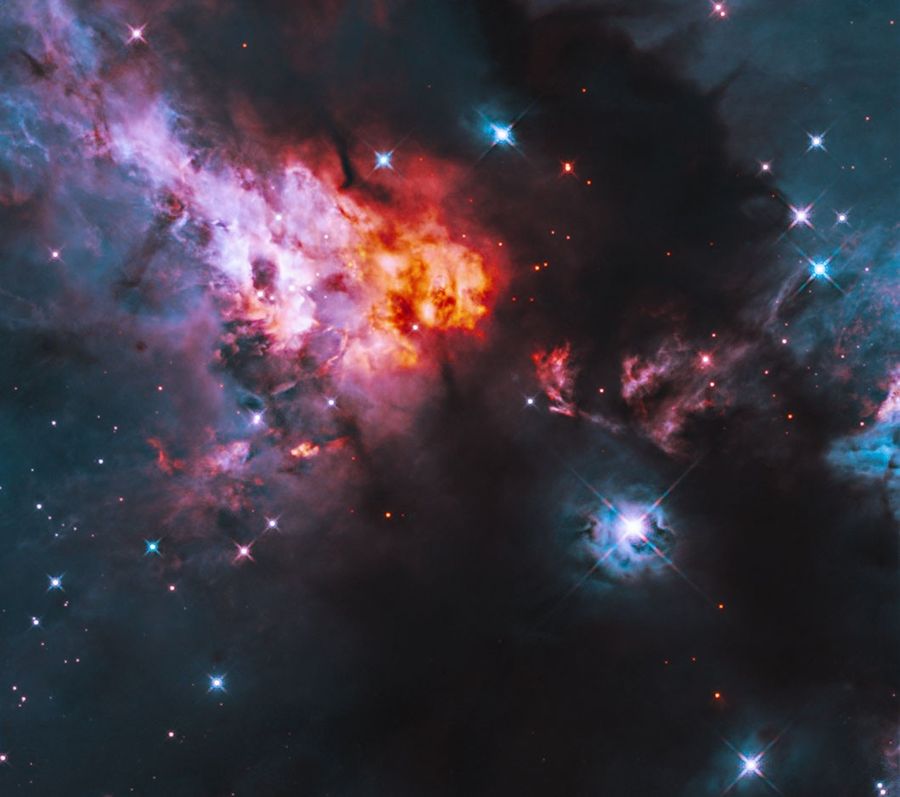
This week’s image combines images from the James Webb Space Telescope (JWST) and the Hubble Space Telescope to create a compressive view of open clusters NGC 460 and NGC 456, which are located within the Small Magellanic Cloud orbiting the Milky Way. If you go to the NASA website hosting this image, you can see the original JWST and Hubble images that were combined to create that you see above.

Here is a little more from NASA explaining what you are seeing:

A riotous expanse of gas, dust, and stars stake out the dazzling territory of a duo of star clusters in this combined image from NASA’s Hubble and Webb space telescopes.

Open clusters NGC 460 and NGC 456 reside in the Small Magellanic Cloud, a dwarf galaxy orbiting the Milky Way. Open clusters consist of anywhere from a few dozen to a few thousand young stars loosely bound together by gravity. These particular clusters are part of an extensive complex of star clusters and nebulae that are likely linked to one another. As clouds of gas collapse, stars are born. These young, hot stars expel intense stellar winds that shape the nebulae around them, carving out the clouds and triggering other collapses, which in turn give rise to more stars.

In these images, Hubble’s view captures the glowing, ionized gas as stellar radiation blows “bubbles” in the clouds of gas and dust (blue), while Webb’s infrared vision highlights the clumps and delicate filamentary structures of dust (red). In Hubble images, dust is often seen silhouetted against and blocking light, but in Webb’s view, the dust – warmed by starlight – shines with its own infrared glow. This mixture of gas and dust between the universe’s stars is known as the interstellar medium.