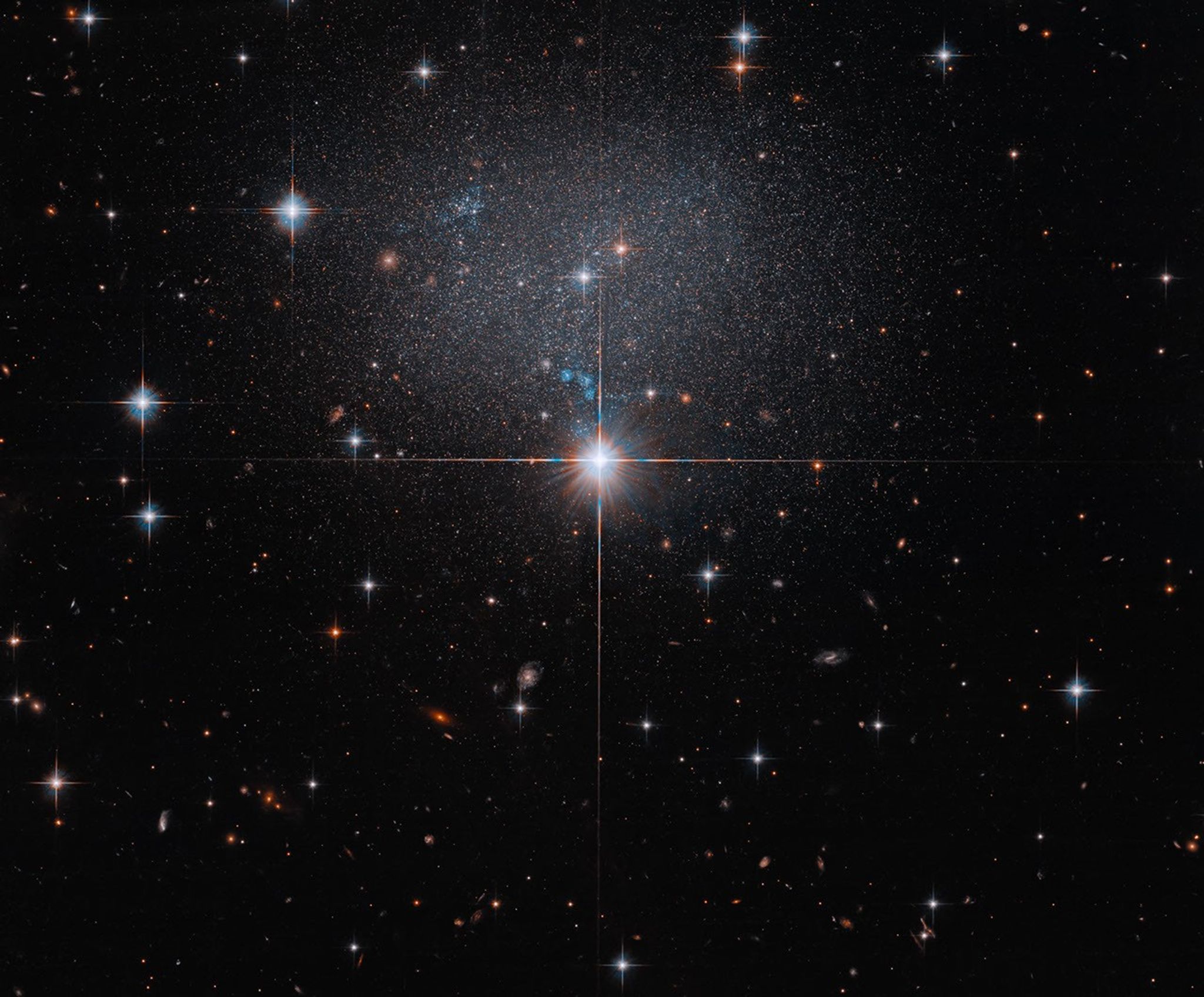
Image (Credit): Image of the dwarf irregular glaxy ESO 490-017 (top center) captured by the Hubble Space Telescope. (NASA, ESA, R. Tully (University of Hawaii); Image Processing: G. Kober (NASA/Catholic University of America))
This week’s image is from the Hubble Space Telescope. It shows the dwarf irregular galaxy ESO 490-017 as a mist of stars in the upper center of the image (hence the term “irregular”). The galaxy is about 23 million light-years away and only 12,000 light years across, compared to the 100,000 light-year diameter of the Milky Way Galaxy. If you look carefully, you can spot a variety of regular galaxies in the background that blend in with the stars in the foreground.
The Planetary Society has provided a nice summary of where the NASA funding battle is at this moment. Here is its latest summary of events:
The House budget bill that includes NASA funding just cleared a key hurdle, advancing out of the Appropriations Committee. This is the first funding bill for FY 2027 to be released and reach this stage, establishing congressional intent and rejecting the worst of the Office of Management and Budget’s proposed cuts to NASA.
The bill keeps NASA funding flat with the currently enacted budget, but reprioritizes funding levels across the agency, including a 17% cut to Science to offset increases elsewhere.
A number of science missions proposed for cancellation by the OMB see their funding protected by this bill, including OSIRIS-APEX, New Horizons, and the Chandra X-Ray Observatory. New programs initiated by Administrator Isaacman that were absent from the OMB proposal, like Space Reactor-1 Freedom, also see their first dedicated mention in the proposal.
The full House still needs to vote on this, and the Senate is expected to release its own proposal within weeks. Congress will then work to develop full-year funding, in anticipation of the start of FY 2027 on Oct. 1, but will likely require a short-term funding patch, which comes with its own hurdles.
I recommend you read the entire statement, House Appropriators Advance Key NASA Funding Bill, to fully understand the rigors of this Hill battle. Fortunately, both the House and Senate continue to be supportive of NASA’s work and Administrator Isaacman’s new direction for Artemis. It helps to have someone full time at the helm of the agency.
I was especially pleased to read that missions such as New Horizons and the Chandra X-Ray Observatory are being saved and key programs like the James Webb Space Telescope and the Hubble Space Telescope are no longer facing drastic cuts. It is unfortunate that the White House was so willing to destroy generations of space-related work – what have been called the crown jewels of our space program.
The budget battle is not over, but we are seeing that when good legislators push back, good things can happen.
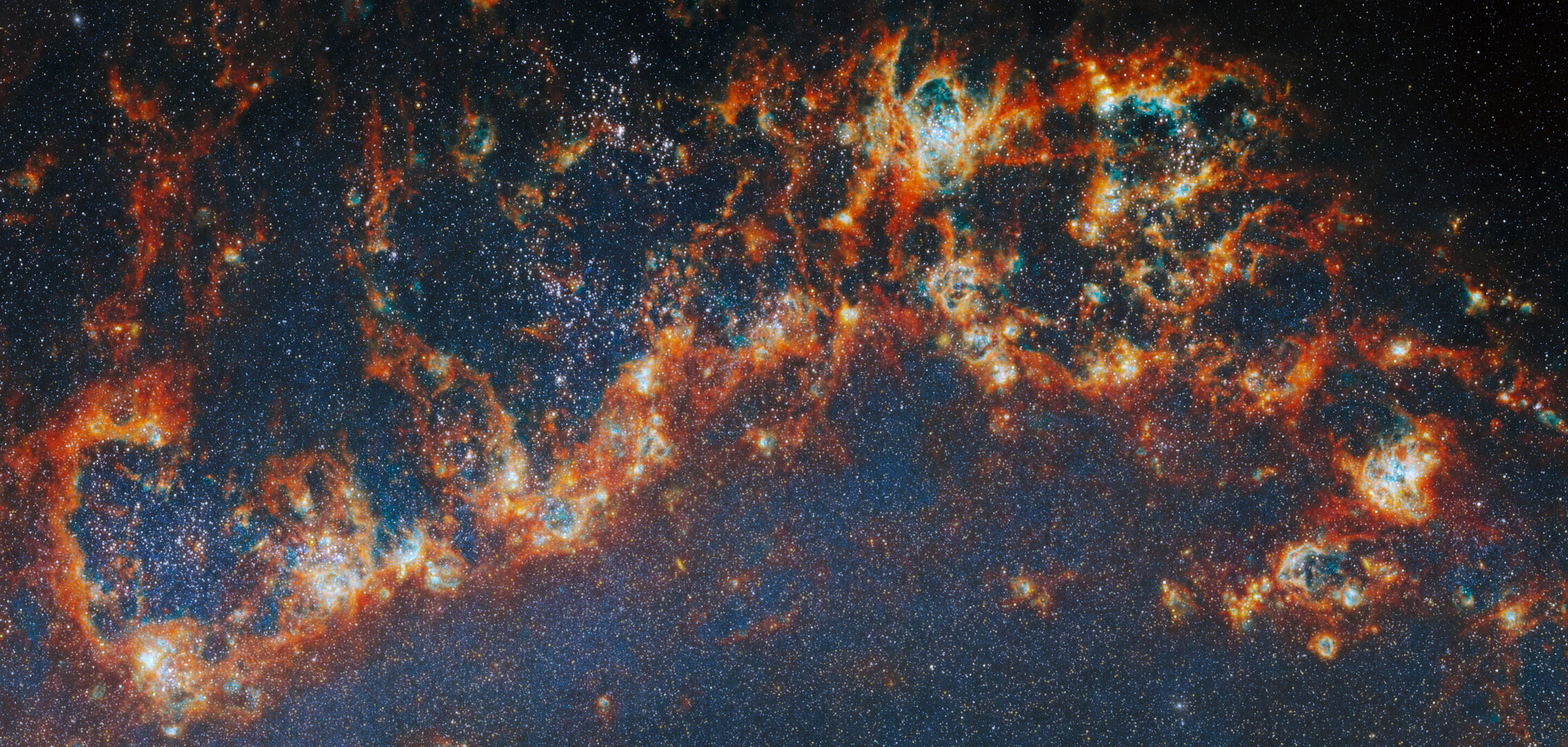
Image (Credit): View of an arm of the Messier 51 galaxy from both JWST and the Hubble Space Telescop. (ESA/Webb, NASA & CSA, A. Pedrini, A. Adamo (Stockholm University) and the FEAST JWST team)
This week’s image is from the James Webb Space Telescope (JWST) and Hubble Space Telescope, which together scanned about 9,000 star clusters in the four galaxies. What you are looking at above comes from the spiral arm of one of the galaxies – Messier 51 (M51).
A large, long portion of one of the spiral arms in galaxy M51. Red-orange, clumpy filaments of gas and dust that stretch in a chain from left to right comprise the arm. Shining cyan bubbles light up parts of the gas clouds from within, and gaps expose bright star clusters in these bubbles as glowing white dots. The whole image is dotted with small stars. A faint blue glow around the arm colours the otherwise dark background.
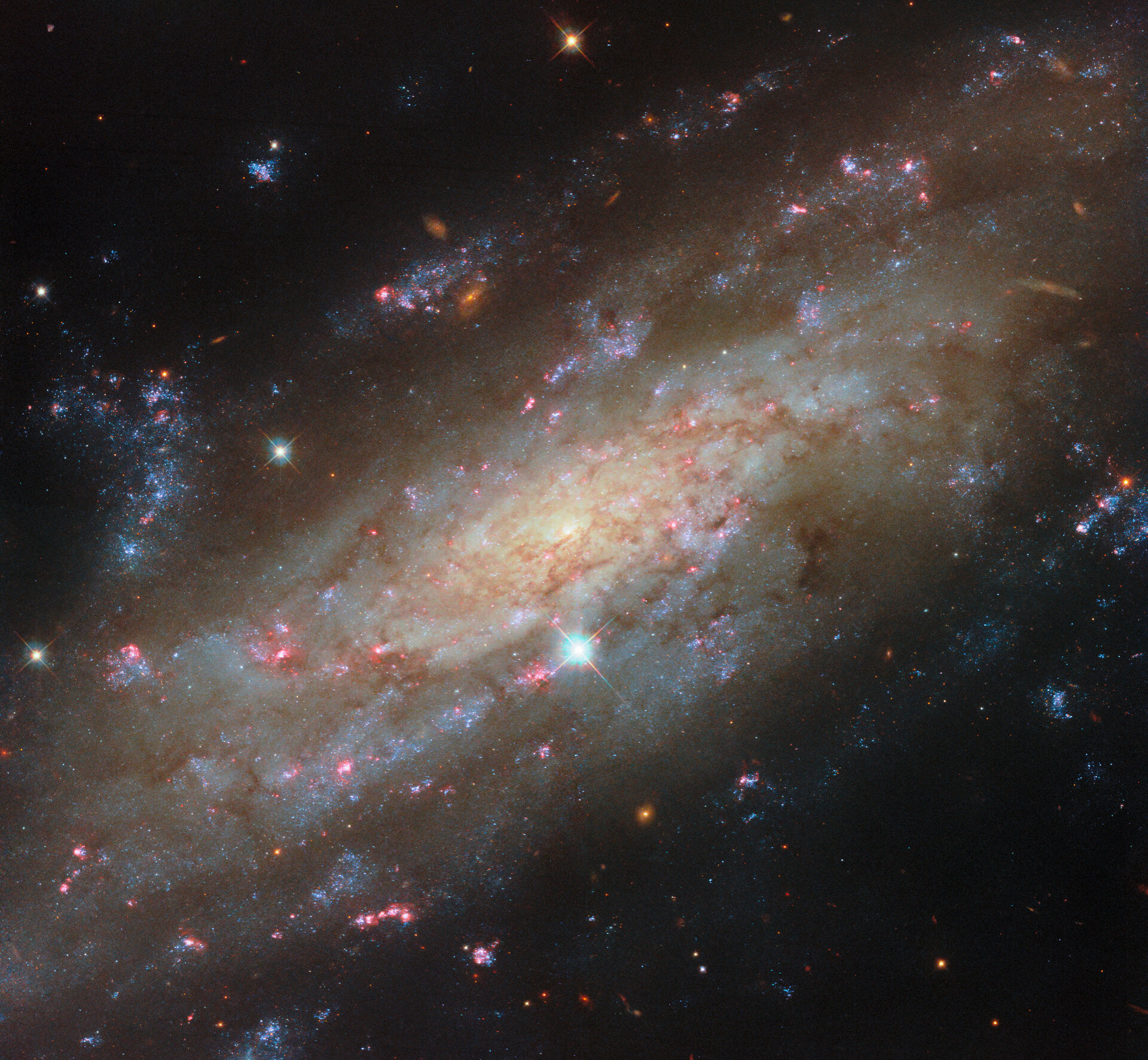
Image (Credit): Hubble Space Telescope image of NGC 3137, located 53 million light-years away. (ESA/Hubble & NASA, D. Thilker and the PHANGS-HST Team
This week’s image is from the Hubble Space Telescope. It shows spiral galaxy NGC 3137 in all its glory. We are getting a nice inclined view of the galaxy, allowing us to see multiple arms of stars.
A spiral galaxy seen close up and tilted at an angle, so that its disc fills the view from corner to corner. Its disc is yellow near to the centre and pale blue farther out, showing cooler and hotter stars, respectively. Thin brown clouds of dust, glowing pink spots of star formation, and sparkling blue patches filled with star clusters swirl through the galaxy. Behind it, small orange dots are very distant galaxies.
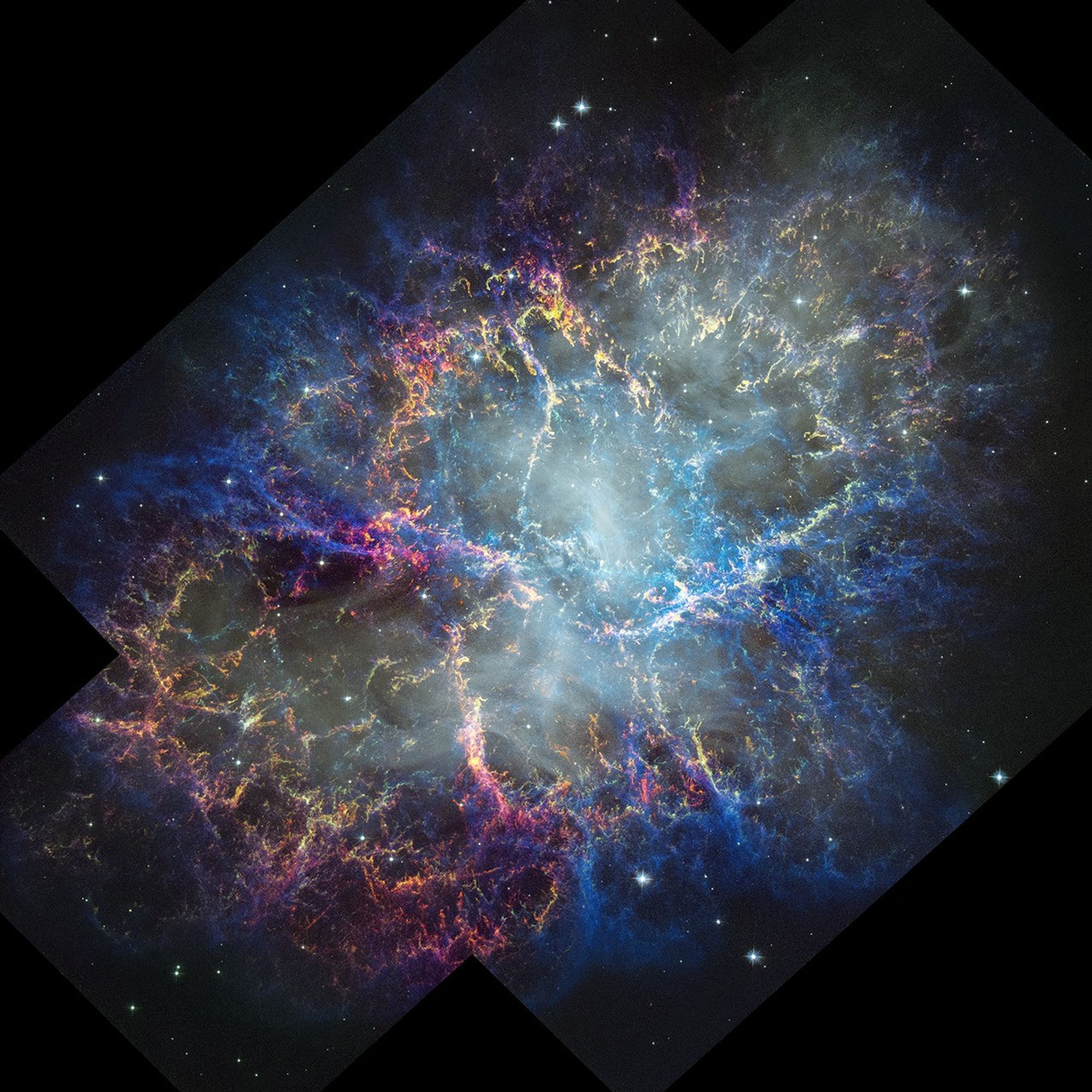
Image (Credit): A 2024 image of the Crab Nebula captured by NASA’s Hubble Space Telescope. (NASA, ESA, STScI, William Blair (JHU); Image Processing: Joseph DePasquale (STScI))
This week’s image is from the Hubble Space Telescope. It is an image of the Crab Nebula taken 25 years after the Hubble’s first image of the nebula. If you want to learn more about this history, a paper titled The Crab Nebula Revisited Using HST/WFC3 can be found in The Astrophysical Journal.
Here is a little more from NASA on earlier sightings of the nebula:
This new Hubble observation continues a legacy that stretches back nearly 1,000 years, when astronomers in 1054 recorded the supernova as an impressively bright new star that, for weeks, was visible even during the day. The Crab Nebula is the aftermath of SN 1054, located 6,500 light-years from Earth in the constellation Taurus…
The supernova remnant was discovered in the mid-18th century, and in the 1950s Edwin Hubble was among several astronomers who noted the close correlation between Chinese astronomical records of a supernova and the position of the Crab Nebula. The discovery that the heart of the Crab contained a pulsar — a rapidly rotating neutron star — that was powering the nebula’s expansion finally aligned modern observations and ancient records.