Pic of the Week: The Jellyfish Galaxy

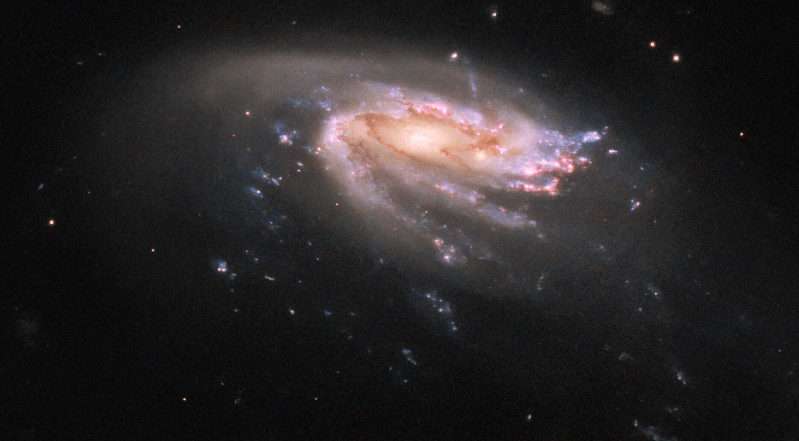
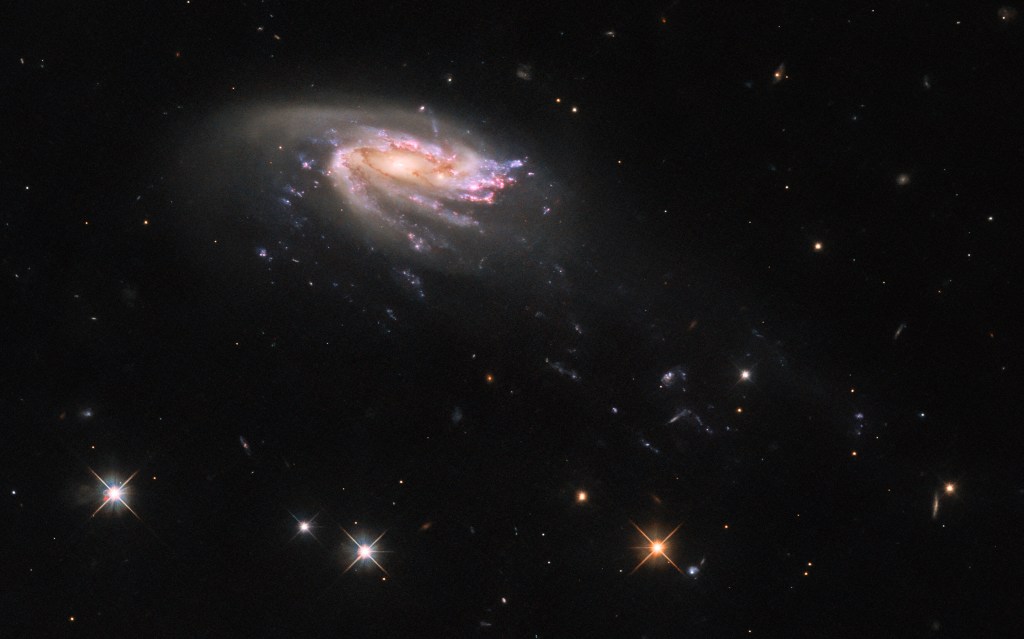
Image (Credit): The massive galaxy JO204. (NASA)

This week’s image is from the Hubble Space Telescope. You are looking at JO204, also called the “jellyfish galaxy” because of its tendrils. It is about 600 million light-years away. It is an impressive sight.

Here is a little more on the galaxy from NASA:

While the delicate ribbons of gas beneath JO204 may look like floating jellyfish tentacles, they are in fact the outcome of an intense astronomical process known as ram pressure stripping. Ram pressure is a particular type of pressure exerted on a body when it moves relative to a fluid. An intuitive example is the sensation of pressure you experience when you are standing in an intense gust of wind – the wind is a moving fluid, and your body feels pressure from it. An extension of this analogy is that your body will remain whole and coherent, but the more loosely bound things – like your hair and your clothes – will flap in the wind. The same is true for jellyfish galaxies. They experience ram pressure because of their movement against the intergalactic medium that fills the spaces between galaxies in a galaxy cluster. The galaxies experience intense pressure from that movement, and as a result their more loosely bound gas is stripped away. This gas is mostly the colder and denser gas in the galaxy – gas which, when stirred and compressed by the ram pressure, collapses and forms new stars in the jellyfish’s beautiful tendrils.

A Day in Astronomy: The Hubble Space Telescope is Launched

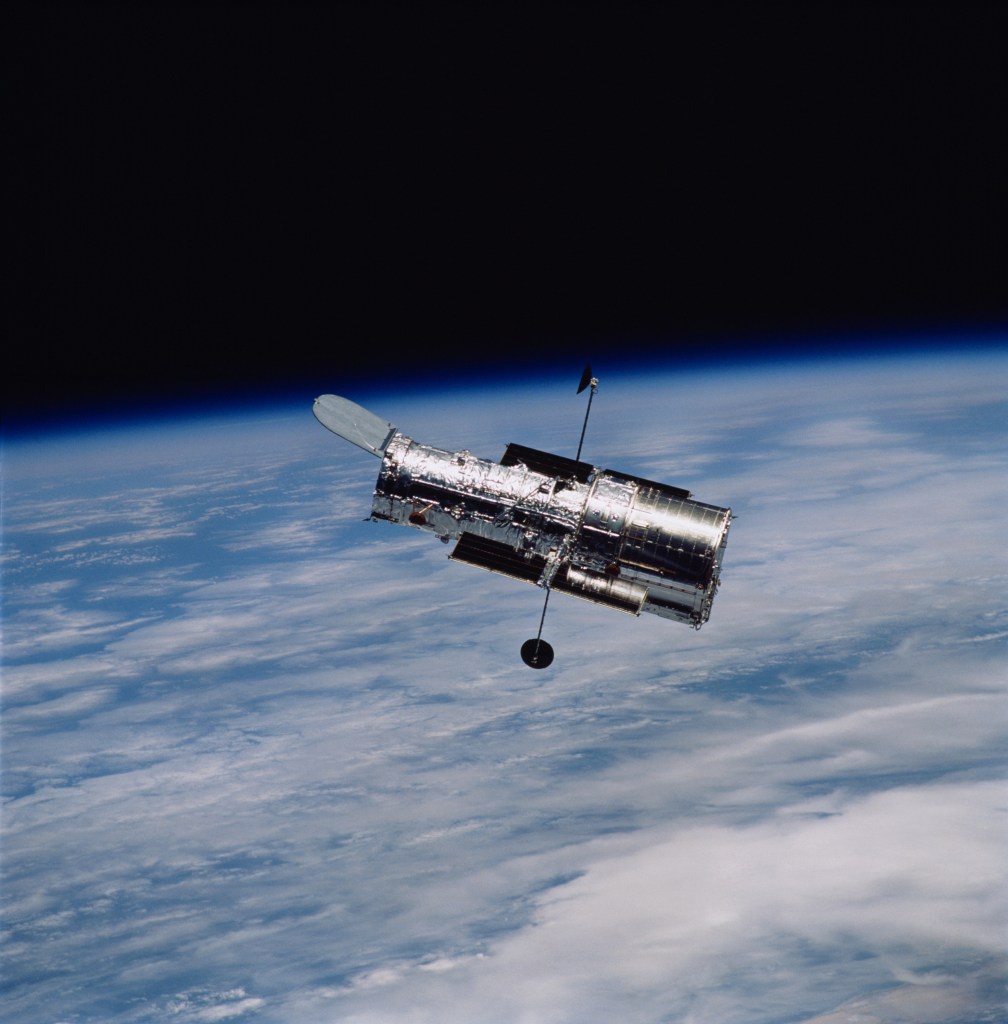
Image (Credit): The Hubble Space Telescope orbits with Earth in the background. (NASA)

On this day in 1990, NASA’s Space Shuttle Discovery launched the Hubble Space Telescope. We do not think of the shuttles anymore as we discuss reusable rockets, but the shuttles were the first reusable spacecraft-launching vehicles.

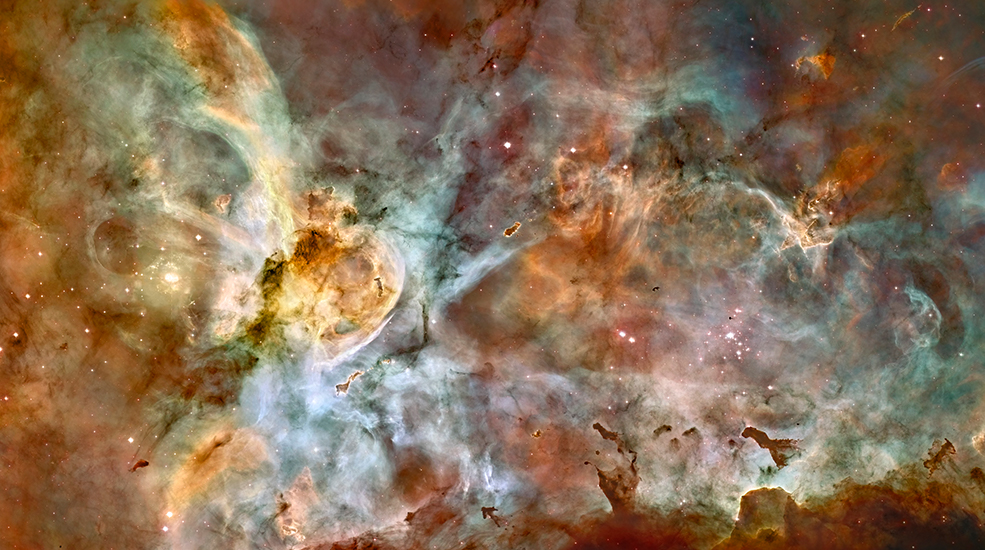
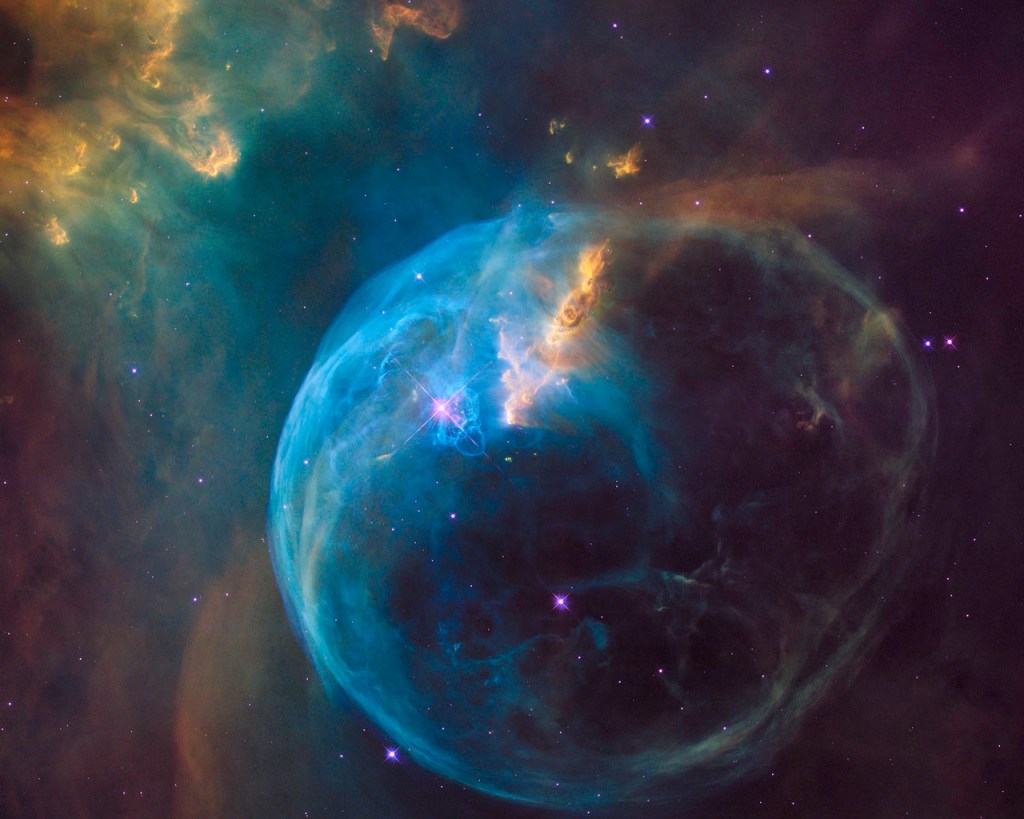
After some initial problems, the Hubble became a critical component in the exploration of the universe. Some of the telescope’s amazing images are shown below.

It is still going strong, even though its successor, the James Webb Space Telescope (JWST), is the more powerful of the two. Launched in late 2021, the JWST has expanded on some of Hubble’s earlier work. The pair are a powerful team.

Here are a few interesting facts about Hubble:

  • Hubble has made more than 1.5 million observations since its mission began in 1990.
  • Astronomers using Hubble data have published more than 19,000 scientific papers, making it one of the most productive scientific instruments ever built. Those papers have been cited in other papers over 1.1 million times.
  • Hubble has no thrusters. To change angles, it uses Newton’s third law by spinning its wheels in the opposite direction. It turns at about the speed of a minute hand on a clock, taking 15 minutes to turn 90 degrees.
  • Hubble has peered back into the very distant past, to locations more than 13.4 billion light-years from Earth.
  • Hubble’s mirror is about 7.9 feet (2.4 m) across. It was so finely polished that if you scaled it to be the diameter of the Earth, you would not find a bump more than 6 inches (15 cm) tall.
Image (Credit): The Carina Nebula. (NASA, ESA, N. Smith (University of California, Berkeley), and The Hubble Heritage Team (STScI/AURA)
Image (Credit): NGC 3603. (NASA, ESA and the Hubble Heritage (STScI/AURA)-ESA/Hubble Collaboration)
Image (Credit): The Horsehead Nebula, otherwise known as Barnard 33. (NASA, ESA, and the Hubble Heritage Team (AURA/STScI))

Good Article: Telescope Mishaps on Earth and in the Heavens

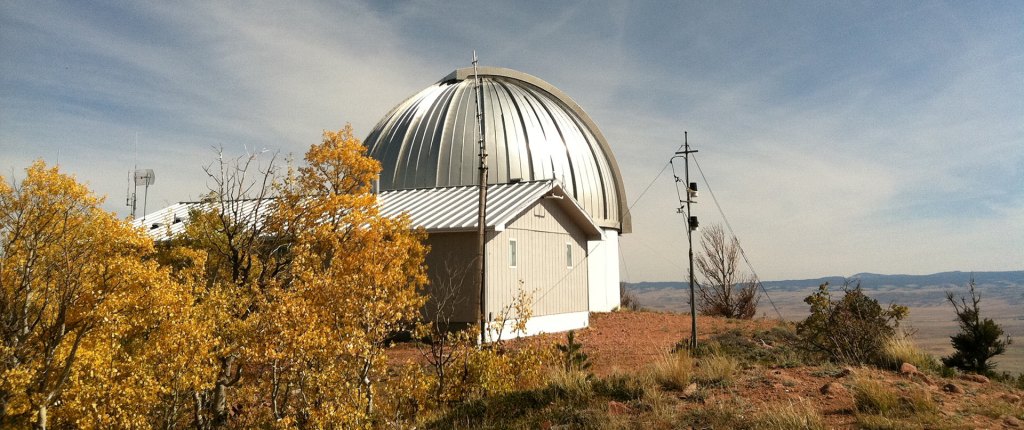
Image (Copy): The Wyoming Infrared Observatory (WIRO). (WIRO)

The New York Times had a good article on various mishaps related to telescopes here on Earth (such as WIRO above) as well as those now floating in space. The story, “From Bullets to ‘Bird Residue,’ the Many Trials of Telescopes,” shares stories about various natural (bird poop) and man-made (dropped tool) events that have left their marks on astronomy.

We have all heard about the misshaped mirror on the Hubble Space Telescope as well as micrometeors hitting the James Webb Space Telescope, but have you heard about the employee who shot and hammered the primary mirror at the McDonald Observatory in West Texas?

Take a look at the article. You will find plenty of stories to amuse you as well as give you pause.

Pic of the Week: Runaway Black Hole

Image (Credit): Artist’s rendering of a black hole with a trail of stars behind it. (NASA, ESA, Leah Hustak, STScI)

This week’s image is an illustration showing what scientists believe the NASA/ESA Hubble Space Telescope has detected, though it initially showed as only a smudge. The dramatic illustration tells a fascinating story, as described by NASA’s Hubblesite

There’s an invisible monster on the loose, barreling through intergalactic space so fast that if it were in our solar system, it could travel from Earth to the Moon in 14 minutes. This supermassive black hole, weighing as much as 20 million Suns, has left behind a never-before-seen 200,000-light-year-long “contrail” of newborn stars, twice the diameter of our Milky Way galaxy. It’s likely the result of a rare, bizarre game of galactic billiards among three massive black holes.

Pic of the Week: Blooming Stars in the Irregular Spiral Galaxy NGC 5486

Image (Credit): Irregular Spiral Galaxy NGC 5486. (ESA/Hubble & NASA, C. Kilpatrick)

This week’s image is from the Hubble Space Telescope. It shows the irregular spiral galaxy NGC 5486 with pink areas indicating the formation of new stars.

Here is a little more from the European Space Agency (ESA):

NGC 5486 hangs against a background of dim, distant galaxies in this image from the NASA/ESA Hubble Space Telescope. The tenuous disc of the galaxy is threaded through with pink wisps of star formation, which stand out from the diffuse glow of the galaxy’s bright core. While this particular galaxy has indistinct, meandering spiral arms it lies close to the much larger Pinwheel Galaxy, one of the best known examples of ‘grand design’ spiral galaxies with prominent and well-defined spiral arms. In 2006 Hubble captured an image of the Pinwheel Galaxy which was — at the time — the largest and most detailed photo of a spiral galaxy ever taken with Hubble.

NGC 5486 lies 110 million light-years from Earth in the constellation Ursa Major. This observation comes from a selection of Hubble images exploring debris left behind by Type II supernovae. As massive stars reach the end of their lives, they cast off huge amounts of gas and dust before ending their lives in titanic supernova explosions. NGC 5486 hosted a supernova in 2004, and astronomers used the keen vision of Hubble’s Advanced Camera for Surveys to explore the aftermath in the hopes of learning more about these explosive events.