Pic of the Week: Happy Birthday Hubble!

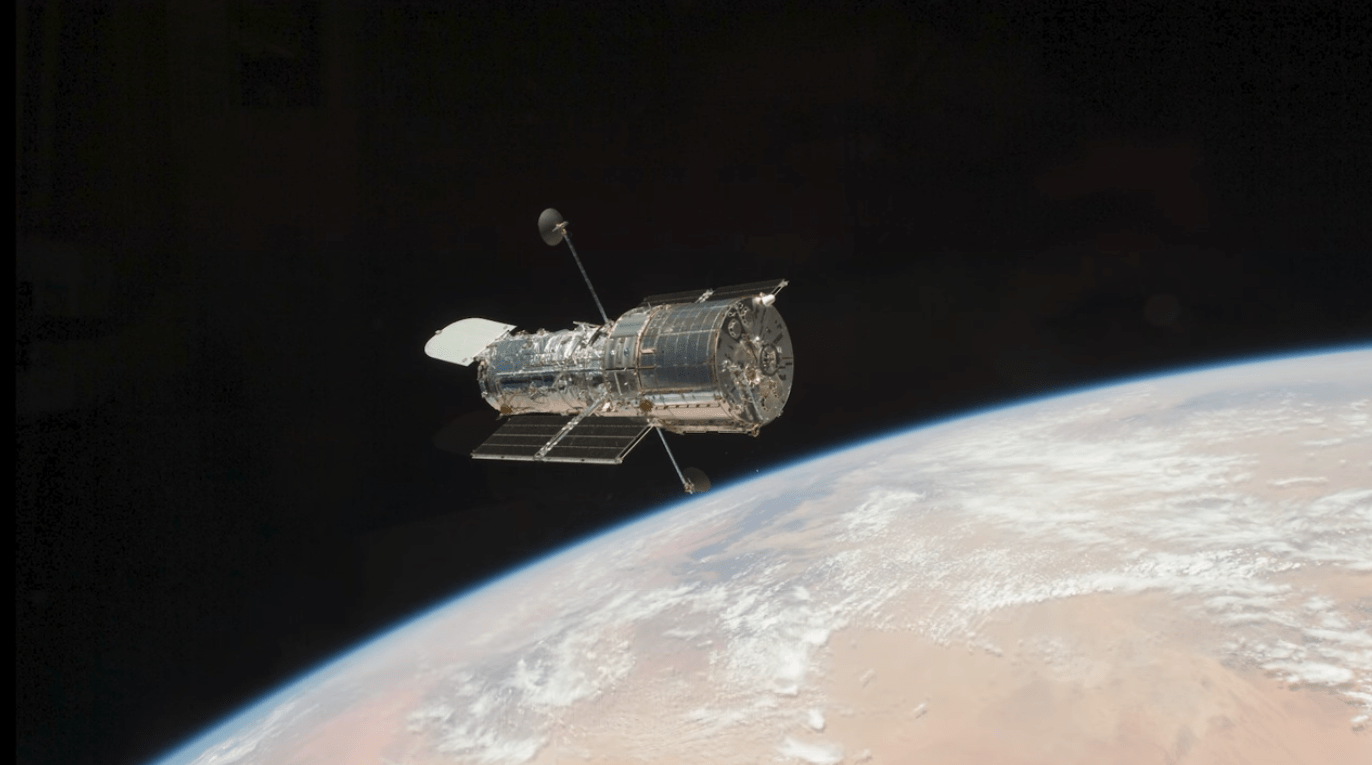
Image (Credit): The Hubble Space Telescope in low-Earth orbit. (NASA)

This year marks the 35th anniversary of the Hubble Space Telescope. It was launched on April 24, 1990 aboard the Space Shuttle Discovery. The telescope was expected to have a service life of 35 years, though it is still going strong with various proposals to update the telescope and keep it operating for years to come.

To mark the occasion, NASA put together a video highlighting missions and related images. The celebration will continue throughout the year with new images and other selected items.

Here are a few interesting facts related to the Hubble:

  • Hubble is currently located 326 miles (525 km) above Earth’s surface. If you could drive straight up, you could reach it in about the same time it would take you to drive from Baltimore, Maryland to Boston, Massachusetts. 
  • Hubble races through its orbit at about 17,000 miles per hour (27,000 kph), completing an orbit about every 95 minutes. That means it sees 15 sunrises every day.
  • While Hubble is speeding around Earth, it can lock onto a target without deviating more than 7/1000th of an arcsecond, or about the width of a human hair seen at a distance of one mile.
Image (Credit): Hubble 35th Anniversary Graphic. (NASA)

Podcast: The Curious Universe

If you are looking for new podcast material, you may want to check out NASA’s Curious Universe podcast. It has been around for a while, but it is starting a new series celebrating Earth from April 15 to May 13.

The first episode in the new Earth series is titled “How NASA Sees Our Blue Marble.” In the episode, we hear from Karen St. Germain, the director of NASA’s Earth Science Division. It is a chance to learn about the planet that NASA spends the most time studying.

If you like this series, you can go back and listen to other episodes, such as:

-“Inside the Team That Keeps Hubble Flying” (March 14, 2025)
-“The Sun Series” (March 19 to May 3, 2024)
-“Defending the Planet from Asteroids” (February 21, 2023)
-“The Search For Life: Are We Alone?” (June 21, 2022)

Pic of the Week: The Starburst Galaxy

Image (Credit): Starburst Galaxy Messier 94. (ESA/Hubble and NASA)

This week’s image is from the Hubble Space Telescope. It was shared on NASA’s Astronomy Picture of the Week website last month. The sparkling galaxy, Messier 94, is about 15 million light-years away.

Here is NASA’s description of what you are seeing above:

Beautiful island universe Messier 94 lies a mere 15 million light-years distant in the northern constellation of the hunting dogs, Canes Venatici. A popular target for earth-based astronomers, the face-on spiral galaxy is about 30,000 light-years across, with spiral arms sweeping through the outskirts of its broad disk. But this Hubble Space Telescope field of view spans about 7,000 light-years or so across M94’s central region. The sharp close-up examines the galaxy’s compact, bright nucleus and prominent inner dust lanes, surrounded by a remarkable bluish ring of young, massive stars. The massive stars in the ring appear to be less than about 10 million years old, indicating the galaxy experienced a corresponding well-defined era of rapid star formation. As a result, while the small, bright nucleus is typical of the Seyfert class of active galaxies, M94 is also known as a starburst galaxy. Because M94 is relatively nearby, astronomers can explore in detail reasons for the galaxy’s burst of star formation.

Note: I swapped out the earlier protostar image for this one when I realized I was duplicating an earlier entry.

Pic of the Week: Swan Song for Stars

Image (Credit): A planetary nebula named Kohoutek 4-55. (ESA/Hubble & NASA, K. Noll)

This image is from the ESA/Hubble Picture of the Week website. It shows a colorful planetary nebula called Kohoutek 4-55, which is about 4600 light-years away.

The ESA/Hubble website defines what you are seeing in this way:

A planetary nebula, a glowing shell of material thrown off by a star. A small central region of greenish clouds is encircled by a glowing, jagged ring, like a hole torn in fabric. A band of silvery-blue clouds outside this is again encircled by a larger, fainter yellow ring of gas. Puffy, smoky clouds of orange and red gas billow out from there into a large oval nebula, fading into the dark background of space.

Space Stories: More Space Tourists, Chinese Maglev Rocket Launches, and New Hubble Findings on Uranus

Image (Credit): Launch of the Fram2 mission earlier this week. (SpaceX)

Here are some recent stories of interest.

South China Morning Post: SpaceX Launches Fram2: 4 Astronauts Seek to Make Historic Flight Over Earth’s Poles

A SpaceX spacecraft carrying four international astronauts is on a pioneering journey circling Earth over its poles after launching Monday night from Florida…Fram2 follows in the footsteps of other commercial spaceflight ventures, including Inspiration4 and Polaris Dawn – two missions also bankrolled and led by billionaire Jared Isaacman. In fact, the Fram2 crew is now traveling on the same Dragon spacecraft that the Polaris Dawn crew rode to orbit in September for a five-day mission in which they completed a historic spacewalk.

South China Morning Post: China in Bid to Challenge SpaceX by Deploying Maglev Rocket Launch Pad by 2028

In a bid to disrupt the United States’ long-held dominance in space exploration, China is quietly advancing a radical new rocket launch system – powered not by roaring engines but by electromagnetic force – that could propel satellites into orbit with unprecedented speed and efficiency. At the heart of the ambitious project is Galactic Energy, a private aerospace company that plans to debut the world’s first electromagnetic rocket launch pad by 2028, a project that could redraw the competitive lines of the global space industry.

Space Telescope Science Institute: 20-Year Hubble Study of Uranus Yields New Atmospheric Insights

Halfway through its fourth decade, Hubble’s long life has proven invaluable for studying the atmosphere of the mysterious ice giant Uranus. By repeatedly training Hubble on the distant cyan planet over the course of 20 years, researchers chronicled a two-decade story of seasonal changes. These astronomers have gained new understanding of the atmospheric dynamics of Uranus, which can serve as a proxy for studying exoplanets of similar size and composition.