“This would be the first time that we can directly show through an atmospheric detection, that these planets with water-rich atmospheres can actually exist around other stars…This is an important step toward determining the prevalence and diversity of atmospheres on rocky planets.”
–Statement by Björn Benneke of the Trottier Institute for Research on Exoplanets at Université de Montréal. He was referring to the Hubble space telescope’s detection of water vapor in the atmosphere of exoplanet GJ 9827d. The exoplanet is about twice the Earth’s diameter and approximately 97 light-years from Earth. You can read more about the Hubble discovery here.
Image (Credit): The Hubble Space Telescope’s view of Galaxy UGC 8091. ( ESA/Hubble, NASA Y. Choi (NOIRLab), K. Gilbert (Space Telescope Science Institute), J. Dalcanton (Flatiron Institute and University of Washington))
The image this week is from the NASA/European Space Agency’s (ESA) Hubble Space Telescope. It shows an irregular dwarf galaxy, UGC 8091, that is about seven million light-years away. What I see appears to be jellyfish within some cloudy water. I also the variety of other galaxies you can see throughout the image (see below).
A collection of stars and galaxies fill the scene against a dark background. The image is dominated by a dense collection of stars that make up the irregular galaxy UGC 8091. The stars span a variety of colours, including blue and orange, with patches of blue occupying the central part of the galaxy. There are also visible circular regions of red/pink gas within the galaxy.
Image (Credit): Section of the above image – upper left hand corner. (ESA/Hubble, NASA Y. Choi (NOIRLab), K. Gilbert (Space Telescope Science Institute), J. Dalcanton (Flatiron Institute and University of Washington))
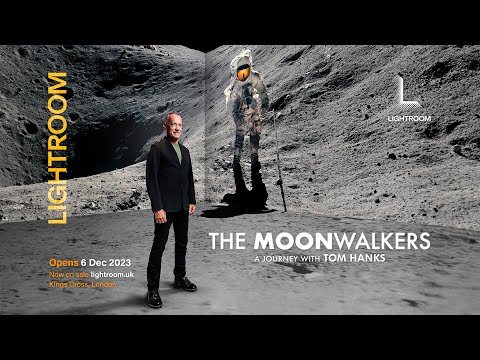
Archive footage of space rockets taking off beam across giant walls in a new immersive show in London, as Hollywood actor Tom Hanks narrates the story of human voyages to the moon. “The Moonwalkers: A Journey With Tom Hanks” looks at the first moon landings of the Apollo missions from 1969 to 1972 and their successor, NASA’s human spaceflight program, Artemis. The next mission – the Artemis II lunar flyby – is planned for next year and interviews with the four-member team are also projected on the walls at the Lightroom gallery space in London’s King Cross area.
Just as it can be assumed that the stars in our Milky Way are orbited by planets, moons around these exoplanets should not be uncommon. This makes it all the more difficult to detect them. So far, only two of the more than 5300 known exoplanets have been found to have moons. A new data analysis now demonstrates that scientific statements are rarely black or white, that behind every result there is a greater or lesser degree of uncertainty and that the path to a statement often resembles a thriller. In observations of the planets Kepler-1625b and Kepler-1708b from the Kepler and Hubble space telescopes, researchers had discovered traces of such moons for the first time. A new study now raises doubts about these previous claims. As scientists from the Max Planck Institute for Solar System Research and the Sonnenberg Observatory, both in Germany, report in the journal Nature Astronomy, “planet-only” interpretations of the observations are more conclusive.
Human beings first disturbed moon dust Sept. 13, 1959, when the USSR’s unmanned spacecraft Luna 2 alighted on the lunar surface. In the following decades, more than a hundred other spacecraft have touched the moon — both crewed and uncrewed, sometimes landing and sometimes crashing. The most famous of these were NASA’s Apollo Lunar Modules, which transported humans to the moon’s surface to the astonishment of humankind. In the coming years, missions and projects already planned will change the face of the moon in more extreme ways. Now, according to anthropologists and geologists at the University of Kansas, it’s time to acknowledge humans have become the dominant force shaping the moon’s environment by declaring a new geological epoch for the moon: the Lunar Anthropocene.
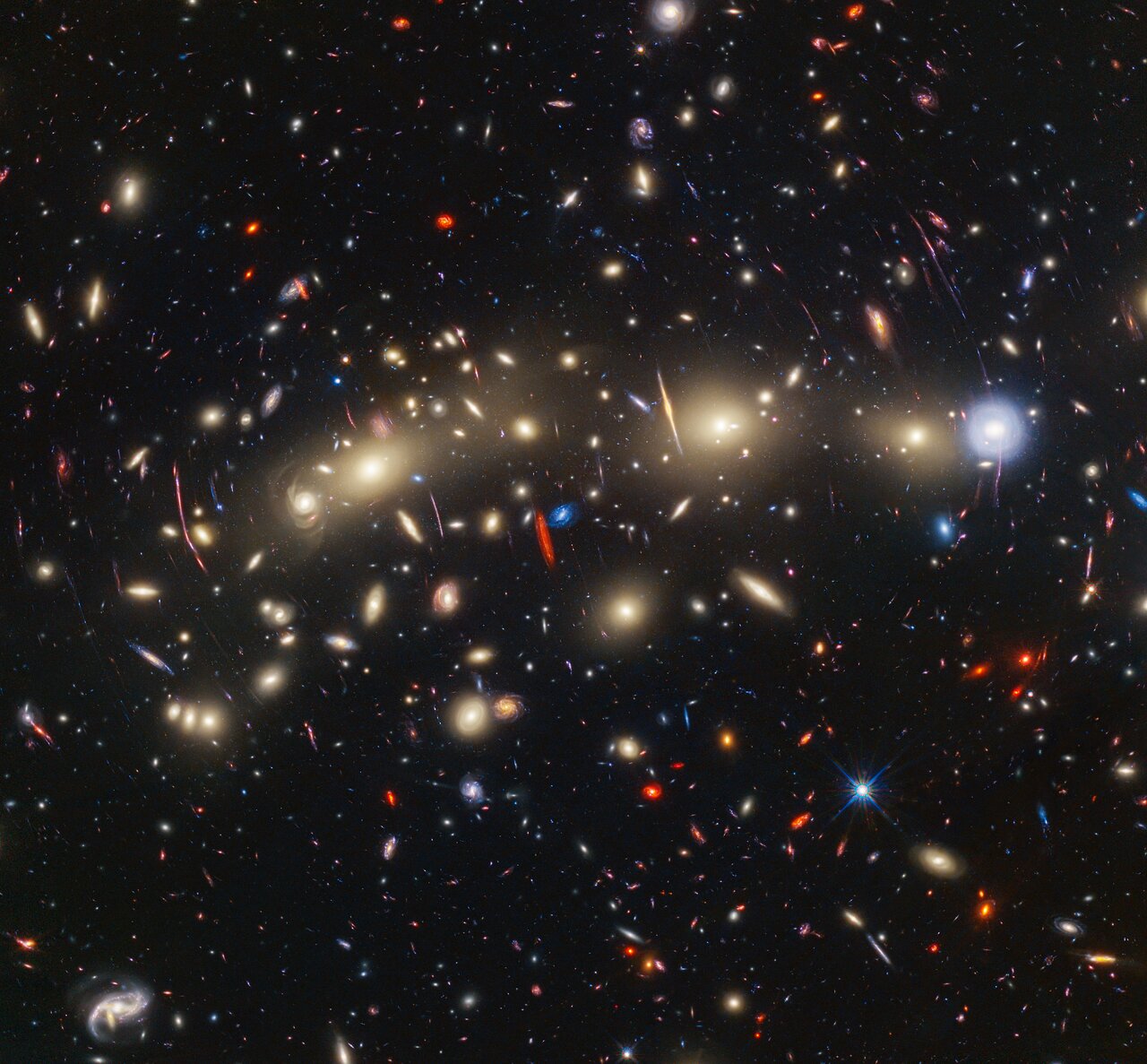
Image (Credit): Galaxy cluster MACS0416. (NASA, ESA, CSA, STScI, J. Diego (Instituto de Física de Cantabria, Spain), J. D’Silva (U. Western Australia), A. Koekemoer (STScI), J. Summers & R. Windhorst (ASU), and H. Yan (U. Missouri))
This week’s image combines the talents of the Hubble Space Telescope and the James Webb Space Telescope to create a dazzling show of light. The galaxy cluster, known as MACS0416, is about 4.3 billion light-years from Earth.
The image reveals a wealth of details that are only possible by combining the power of both space telescopes. It includes a bounty of galaxies outside the cluster and a sprinkling of sources that vary over time, likely due to gravitational lensing — the distortion and amplification of light from distant background sources.
This cluster was the first of a set of unprecedented, super-deep views of the Universe from an ambitious, collaborative Hubble programme called the Frontier Fields, inaugurated in 2014. Hubble pioneered the search for some of the intrinsically faintest and youngest galaxies ever detected. Webb’s infrared view significantly bolsters this deep look by going even farther into the early Universe with its infrared vision.
To make the image, in general the shortest wavelengths of light were colour-coded blue, the longest wavelengths red, and intermediate wavelengths green. The broad range of wavelengths, from 0.4 to 5 microns, yields a particularly vivid landscape of galaxies.
Those colours give clues to galaxy distances: the bluest galaxies are relatively nearby and often show intense star formation, as best detected by Hubble, while the redder galaxies tend to be more distant and are best detected by Webb. Some galaxies also appear very red because they contain copious amounts of cosmic dust that tends to absorb bluer colours of starlight.
While the new Webb observations contribute to this aesthetic view, they were taken for a specific scientific purpose. The research team combined their three epochs of observations, each taken weeks apart, with a fourth epoch from the CANUCS (CAnadian NIRISS Unbiased Cluster Survey) research team. The goal was to search for objects varying in observed brightness over time, known as transients.
They identified 14 such transients across the field of view. Twelve of them were located in three galaxies that are highly magnified by gravitational lensing, and they are likely to be individual stars or multiple-star systems that are briefly very highly magnified. The remaining two transients are within more moderately magnified background galaxies and are likely to be supernovae.
The finding of so many transients with observations spanning a relatively short timeframe suggests that astronomers could find many more transients in this cluster and others like it through regular monitoring with Webb.
Among the transients the team identified, one stood out in particular. Located in a galaxy that existed about 3 billion years after the Big Bang, it is magnified by a factor of at least 4000. The team nicknamed the star system Mothra in a nod to its ‘monster nature’, being both extremely bright and extremely magnified. It joins another lensed star that the researchers previously identified and that they nicknamed Godzilla. Both Godzilla and Mothra are giant monsters known as kaiju in Japanese cinema.
Interestingly, Mothra is also visible in the Hubble observations that were taken nine years earlier. This is unusual, because a very specific alignment between the foreground galaxy cluster and the background star is needed to magnify a star so greatly. The mutual motions of the star and the cluster should have eventually eliminated that alignment.
The most likely explanation is that there is an additional object within the foreground cluster that is adding more magnification. The team was able to constrain its mass to be between 10 000 and 1 million times the mass of our Sun. The exact nature of this ‘milli-lens’, however, remains unknown. It is possible that the object is a globular star cluster that’s too faint for Webb to observe directly.
If you are trying to learn more about the space programs at NASA, you can download the recently updated NASA+ app, which has a variety of videos and astronomy series to please anyone’s curiosity. For instance, check out the videos under “Scientific Wonders” to learn more about the James Webb Space Telescope, the New Horizons mission to Pluto, the Hubble Space Telescope, the Kepler Space Telescope, the OSIRIS-REx asteroid sample return, and much more.
This free app can bring you up to speed on the earlier space programs as well as provide updates on the latest missions. For example, you can watch the video showing yesterday’s docking of the SpaceX CRS-29 Cargo Dragon Resupply Craft with the International Space Program.
You cannot go wrong with this free app. You can read more about the updated NASA+ app here.



 Our Awesome Universe