Top Astronomy Stories in 2023

Image (Credit): Chart showing the planned travel of the JUICE spacecraft. (ESA, work performed by ATG under contract to ESA)

I wanted to start out the new year by first remembering all of the great missions from 2023. I also decided to group this work rather than focus on single missions.

Here is what I came up with:

NASA’s Moon Mission: We saw more progress towards the next steps in the Artemis program to put humans on the Moon, including NASA’s announcement of the four astronauts to lead the Artemis II mission, SpaceX’s tests of the Starship rocket, and the design of new spacesuits for the Artemis astronauts.

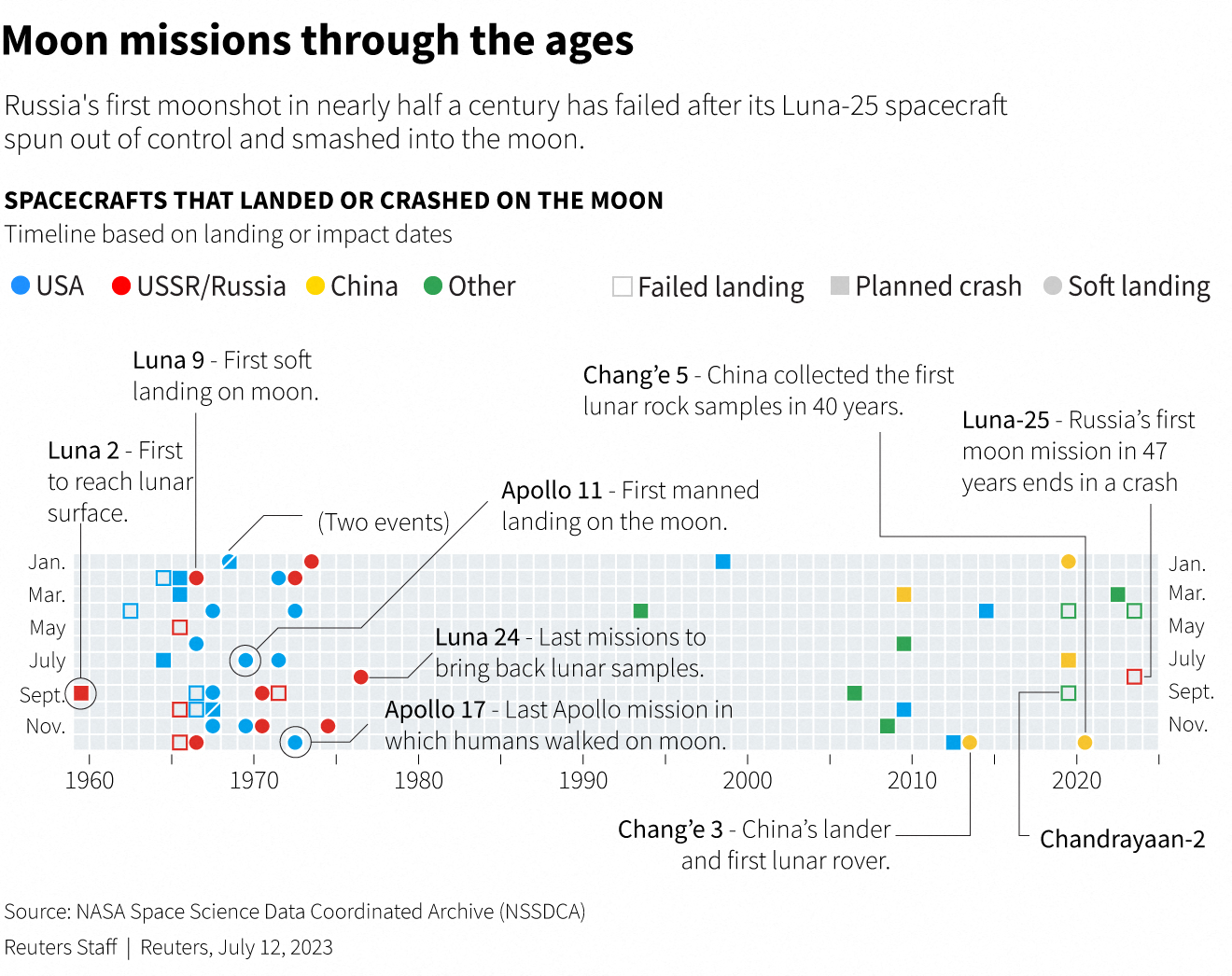
Other Attempts to Land on the Moon: We saw other nations also reaching for the Moon. While India had great success landing a rover on the lunar South Pole, both Russia and a commercial venture from Japan did not have similar luck. We also saw Japan trying it again late last year.

NASA Asteroid Missions: Asteroids were the big news this year, with Lucy encountering a surprise pair of asteroids, OSIRIS-REx bringing back a sample from the asteroid Bennu, and NASA launching the Psyche mission.

JWST Discoveries: This year we celebrated the anniversary of the James Webb Space Telescope (JWST), which has been better than ever imaged. It is helping to change our understanding of the origin of the universe while poking and prodding at exoplanets to review their secrets.

ESA Missions: The European Space Agency (ESA) has also been very busy in 2023. For instance, the launch of the Euclid mission to study dark matter and dark energy, as well as the JUICE mission to study Jupiter and its moons, will assist with our understanding of the big picture as well as our own neighborhood.

That’s an impressive record, and I look forward to even more great news in 2024.

Space Stories: Japan Bolsters it Space Investments, The Next Starship, and Russia’s Declining Space Program

Image (Credit): Artist’s rendering of JAXA’s proposed lunar rover with Toyota. (Toyota/JAXA)

Here are some recent stories of interest.

Forbes: “Modern Space Race: Japan Pledges $6.6 Billion For Developing Space Sector As U.S. And China Plan Historic Missions

The Japanese government has said it will establish a $6.6 billion (¥1 trillion) fund to develop the country’s space industry as programs in the U.S., Russia, China and India rush to put men on the moon, build lunar sites and plan for the future of the International Space Station in a renewed race for celestial supremacy...Nikkei, a Japanese newspaper, reported that funding will be given to companies developing technologies that could be used to support national security or those that could rival Elon Musk’s SpaceX by developing rockets and “satellite constellations”—groups of satellites that operate as one system.

PayloadSpace.com: “SpaceX Announces a Starship Version Two is in the Works

With just two Starship integrated test flights under its belt, SpaceX announced last week it is already working on a major overhaul of its second-stage Starship vehicle. The design changes will be significant enough to speciate the ship, giving it the title of Version 2. SpaceX plans to finish and launch four or five additional Starship V1 prototypes before transitioning to its V2 product line, Elon Musk said on X. Insights gained from the upcoming flights will be integrated into the next-gen rocket.

Center for European Policy Analysis: “Russia’s Earthly Aggression Cripples its Celestial Plans

When the US imposed sanctions to degrade Russia’s aerospace industry, including embargoes on semiconductors, lasers, sensors, and navigation equipment, Dmitry Rogozin, then chief of Russia’s space program, warned it might cause the International Space Station to fall on the US or Europe. These comments and others from a supposedly serious scientific organization did cause a crash — the decades-old US-Russia space partnership was effectively ended after decades of joint work, including the Soviet era, that had benefited science, détente, and humanity. The events of 2022-2023 have made it more likely Russia would step away from exploration and, with China, focus on military applications in space. 

Note: The helpful graphic below is used in the Center for European Policy Analysis story.

India Has Even Greater Space Ambitions

Image (Credit): Logo of the Indian Space Research Organization. (ISRO)

After recently sending a rover to the Moon and a spaceship to the Sun, India announced plans to build its own space station by 2035 and also send its own astronaut to the Moon by 2040. It also wants to start work on missions to Venus and Mars. How is that for ambitious?

In a press release this week, India’s Prime Minister Shri Narendra Modi stated the following:

Building on the success of the Indian space initiatives, including the recent Chandrayan-3  and Aditya L1 Missions, Prime Minister directed that India should now aim for new and ambitious goals, including setting up ‘Bharatiya Antariksha Station’ (Indian Space Station) by 2035 and sending first Indian to the Moon by 2040.

To realize this Vision, the Department of Space will develop a roadmap for Moon exploration. This will encompass a series of Chandrayaan missions, the development of a Next Generation Launch Vehicle (NGLV), construction of a new launch pad, setting up human-centric Laboratories and associated technologies.

Prime Minister also called upon Indian scientists to work towards interplanetary missions that would include a Venus Orbiter Mission and a Mars Lander.

The space race continues with India showing itself as a strong player in space, potentially replacing Russia as one of the key space-faring nations. It benefits everyone to have more nations studying our solar system. It is unfortunate that Russia has concerned itself with less dignified matters back here on Earth. Maybe it will look to the stars again one day soon.

Space Missions: Good News for an Asteroid Sample, But Bad News for a Lunar Rover

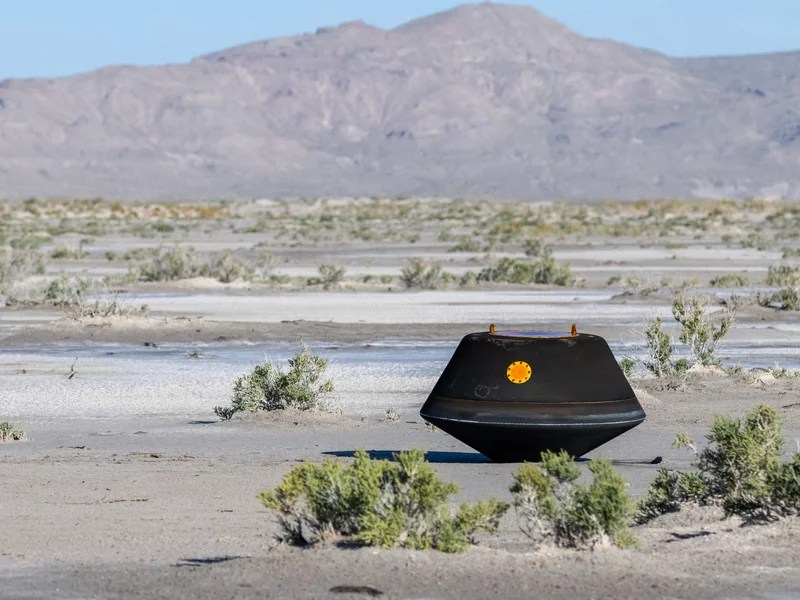
Image (Credit): NASA’s OSIRIS-REx sample capsule safely situated in the Utah desert earlier today. (Keegan Barber/NASA)

First, let discuss the good news. The capsule carrying the sample material from the asteroid Bennu successfully landed in the Utah desert earlier today, as planned. NASA’s Origins, Spectral Interpretation, Resource Identification, Security, Regolith Explorer (OSIRIS-REx) mission was a success. The space agency has plenty to celebrate.

And now for the bad news. India’s Chandrayaan-3 moon lander as well as its lunar rover were supposed to wake up around September 22 with the return of sunlight to the Moon’s South Pole. Unfortunately, neither craft showed any signs of coming back online. That said, the India space agency still has plenty to celebrate given its ability to successfully explore the South Pole before night set in.

The Pragyan Rover is Sleeping on the Moon

Image (Credit): Photo of the Vikram lander, which put the Pragyan rover on the Moon. (ISRO via AP/Alamy)

After a few weeks of work, India’s Pragyan rover on the Moon’s south pole was put to sleep last weekend to sit out the long lunar evening. It accomplished all of its goals, according to a Tweet from the Indian Space Research Organisation (ISRO):

We shall know in a few weeks whether the little lander is ready for more work.

Nature magazine noted some of the findings from the rover’s primary mission, including:

  • ions and electrons swirling near the lunar pole;
  • variations in soil temperature;
  • a moonquake; and
  • presence of sulfur and other elements.

Whatever happens, the Indian rover has been a great success.