India Has Even Greater Space Ambitions

Image (Credit): Logo of the Indian Space Research Organization. (ISRO)

After recently sending a rover to the Moon and a spaceship to the Sun, India announced plans to build its own space station by 2035 and also send its own astronaut to the Moon by 2040. It also wants to start work on missions to Venus and Mars. How is that for ambitious?

In a press release this week, India’s Prime Minister Shri Narendra Modi stated the following:

Building on the success of the Indian space initiatives, including the recent Chandrayan-3  and Aditya L1 Missions, Prime Minister directed that India should now aim for new and ambitious goals, including setting up ‘Bharatiya Antariksha Station’ (Indian Space Station) by 2035 and sending first Indian to the Moon by 2040.

To realize this Vision, the Department of Space will develop a roadmap for Moon exploration. This will encompass a series of Chandrayaan missions, the development of a Next Generation Launch Vehicle (NGLV), construction of a new launch pad, setting up human-centric Laboratories and associated technologies.

Prime Minister also called upon Indian scientists to work towards interplanetary missions that would include a Venus Orbiter Mission and a Mars Lander.

The space race continues with India showing itself as a strong player in space, potentially replacing Russia as one of the key space-faring nations. It benefits everyone to have more nations studying our solar system. It is unfortunate that Russia has concerned itself with less dignified matters back here on Earth. Maybe it will look to the stars again one day soon.
Space Missions: Good News for an Asteroid Sample, But Bad News for a Lunar Rover

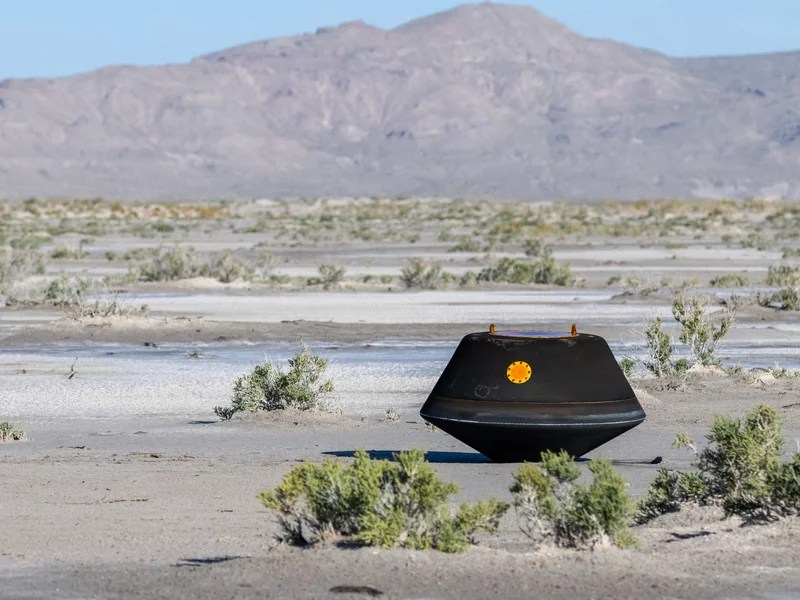
Image (Credit): NASA’s OSIRIS-REx sample capsule safely situated in the Utah desert earlier today. (Keegan Barber/NASA)

First, let discuss the good news. The capsule carrying the sample material from the asteroid Bennu successfully landed in the Utah desert earlier today, as planned. NASA’s Origins, Spectral Interpretation, Resource Identification, Security, Regolith Explorer (OSIRIS-REx) mission was a success. The space agency has plenty to celebrate.

And now for the bad news. India’s Chandrayaan-3 moon lander as well as its lunar rover were supposed to wake up around September 22 with the return of sunlight to the Moon’s South Pole. Unfortunately, neither craft showed any signs of coming back online. That said, the India space agency still has plenty to celebrate given its ability to successfully explore the South Pole before night set in.

The Pragyan Rover is Sleeping on the Moon

Image (Credit): Photo of the Vikram lander, which put the Pragyan rover on the Moon. (ISRO via AP/Alamy)

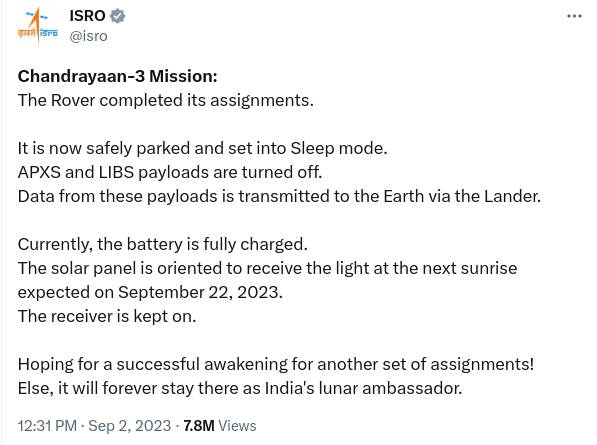
After a few weeks of work, India’s Pragyan rover on the Moon’s south pole was put to sleep last weekend to sit out the long lunar evening. It accomplished all of its goals, according to a Tweet from the Indian Space Research Organisation (ISRO):

We shall know in a few weeks whether the little lander is ready for more work.

Nature magazine noted some of the findings from the rover’s primary mission, including:

  • ions and electrons swirling near the lunar pole;
  • variations in soil temperature;
  • a moonquake; and
  • presence of sulfur and other elements.

Whatever happens, the Indian rover has been a great success.

India Has Been Busy – It Now Heads for the Sun

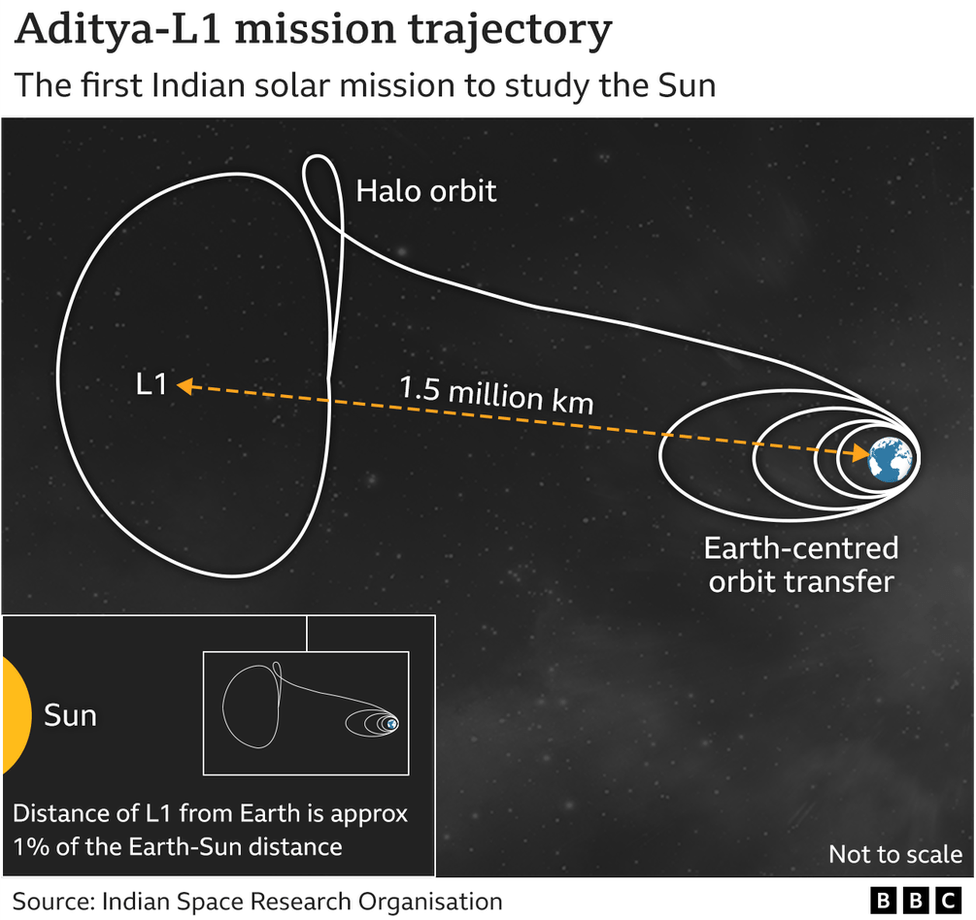
Over the weekend, India launched another important space mission. The mission of the Aditya-L1 spacecraft is to spend four months studying the outer layers of the Sun.

The Indian Space Research Organisation (ISRO) is overseeing the mission, which will come to rest at the L1 Lagrange point from where it will observe the Sun.

For more details on the mission, check out the ISRO website where you can find details about the spacecraft’s objectives and scientific equipment.

This latest mission comes right after India’s successful landing on the Moon, showing all of us that it is not resting on its laurels. The country clearly wants to be in the forefront of the space and science race.

Space Quote: The Changing Competition in Space and Elsewhere

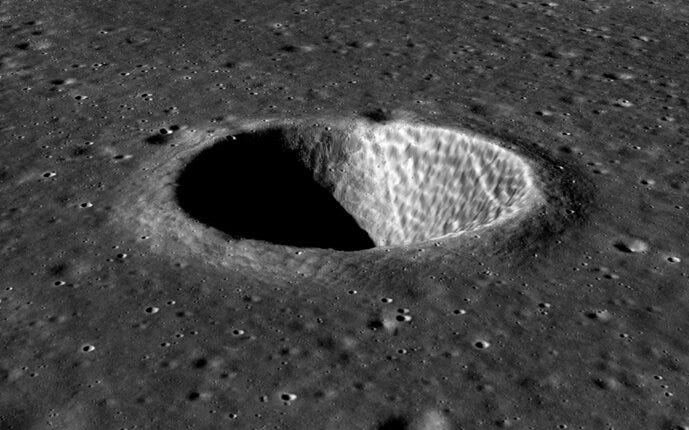
Image (Credit): 3D view of a crater on the Moon generated from images captured by Chandrayaan 2 orbiter’s Terrain Mapping Camera in 2019. (ISRO)

“…a comparison with India is illuminating: India’s economy was about half the size of Russia’s when the Berlin Wall came down in 1989. Today, India’s economy is 50 percent bigger than Russia’s. Forget about keeping pace with the United States: Russia can’t keep up with India.”

-Editorial in The Washington Post by David Von Drehle titled “India’s Brilliant Moon Landing Illuminates Russia’s Drastic Decline.” India’s steady progress on space missions, including Chandrayaan 2 back in 2019 (shown above), has occurred during Russia’s slow decline and current situation. This cannot be lost on Russia as its cosmonaut traveled to the International Space Station this weekend aboard an American rocket. Around the world, space programs are moving on without Russia, which was the leading nation at the start of the Space Age.