We Await the Indian Moon Landing

Image (Credit): Images of the Moon from India’s Chandrayaan-3 spacecraft after it entered lunar orbit more than two weeks ago. (Indian Space Research Organisation)

We are down to one spacecraft approaching the Moon’s south pole – India’s Chandrayaan-3 mission, which is expected to land as early as tomorrow. This is India’s second try for a Moon landing after the loss of Chandrayaan-2, so fingers crossed. Chandrayaan-1 also sent a probe that impacted the Moon, but that was the plan.

We shall see if Indian patience beats Russian bravado.

India Prime Minister Modi put a possible spin on the past missions. Regarding Chandrayaan-1, he said:

Chandrayaan-1 is considered to be a path-breaker among global lunar missions as it confirmed the presence of water molecules on the moon. It featured in over 200 scientific publications around the world.

Even the failed second mission has its successes:

Chandrayaan-2 was equally pathbreaking because data from the Orbiter associated with it detected the presence of chromium, manganese and sodium for the first time through remote sensing. This will also provide more insights into the moon’s magmatic evolution. The key scientific outcomes from Chandrayaan 2 include the first ever global map for lunar sodium, enhancing knowledge on crater size distribution, unambiguous detection of lunar surface water ice with IIRS instrument and more. This Mission has featured in almost 50 publications.

I like the positive attitude.

Luna-25 Fails to Land (Properly) on the Moon

Image (Credit): Our Moon in all its glory. (NASA/JPL/USGS)

The message from Roscosmos was pretty bland:

During the operation, an abnormal situation occurred on board the automatic station, which did not allow the maneuver to be performed with the specified parameters.

Translated into normal speech, we learned that Luna-25 crashed during its attempted landing on the lunar surface.

This is a blow for Russia and Putin as well. The Soviet Union could threaten the world and run a terrific space program. The Russians are bogged down in Ukraine and unable to pick up a lunar program ceased about 50 years ago. It is sad to watch.

Roscosmos Director General Yury Borisov blamed the crash on Russia’s long absence from the Moon, stating,

The negative experience of interrupting the lunar program for almost 50 years is the main reason for the failures.

He may want to add corruption, economic sanctions, and horrible leadership to that list of reasons.

At least the Russian mission was able to share a few photos from orbit before it all ended.

The Moon’s south pole is still available for anyone who wants it. The Indian space program will give it a try this week. We can only wish them well as they fly over the Russian rubble.

Space Stories: Mars Ascent Vehicle, Dark Matter Stars, and a New Russian Space Station

Image (Credit): Artist’s rendering of the Mars Ascent Vehicle. (NASA)

Here are some recent stories of interest.

NASA/JPJ.com : “NASA Mars Ascent Vehicle Continues Progress Toward Mars Sample Return

NASA’s Mars Ascent Vehicle (MAV) recently reached some major milestones in support of the Mars Sample Return program. The Mars Ascent Vehicle would be the first launch of a rocket from the surface of another planet. The team developing MAV conducted successful tests of the first and second stage solid rocket motors needed for the launch. Mars Sample Return will bring scientifically selected samples to Earth for study using the most sophisticated instrumentation around the world. This strategic partnership with ESA (European Space Agency) features the first mission to return samples from another planet. The samples currently being collected by NASA’s Perseverance Rover during its exploration of an ancient river delta have the potential to reveal the early evolution of Mars, including the potential for ancient life.

ScienceNews : “The James Webb Telescope May Have Spotted Stars Powered by Dark Matter

The James Webb Space Telescope has spotted objects in the early universe that might be a new kind of star — one powered by dark matter. These “dark stars” are still hypothetical. Their identification in JWST images is far from certain. But if any of the three candidates — reported in the July 25 Proceedings of the National Academy of Sciences — turn out to be this new type of star, they could offer a glimpse of star formation in the early universe, hint at the nature of dark matter and possibly explain the origins of supermassive black holes.

CNN : “Russia Proposes Joint Research Module on Space Station for China, India, Brazil and South Africa

The head of Russia’s space agency has extended an offer to Moscow’s partners in the BRICS group – Brazil, IndiaChina and South Africa – to participate in the construction of a joint module for its planned orbital space station, state media reported Monday. Construction of the planned space station follows Moscow’s decision last year to end its decades-long partnership with NASA and withdraw from the aging International Space Station – one of the last remaining channels of cooperation between Russia and the United States.

Rocket Launches: Good and Bad News for Lunar Launches

Image (Credit): Chandrayaan-3 launch on July 14, 2023. (Aijaz Rahi/AP)

First, the good news is that India successfully launched a rocket to the Moon last Friday. The Chandrayaan-3 mission, or “moon craft,” includes an orbiter as well as a rover that will explore the southern pole of the Moon. This is India’s second attempt to land on the lunar surface after a failed attempt back in 2019.

The Indian rover is expected to land on the Moon on August 23rd. You can read more about the mission on the Indian government’s mission page.

The other rocket news involves a setback with the United Launch Alliance’s (ULA) new heavy-lift rocket. The launch of the new rocket, the Vulcan Centaur, was delayed until later this year after it was determined that “minor reinforcements” were still needed with the rocket’s upper stage. The upper stage failed back in March.

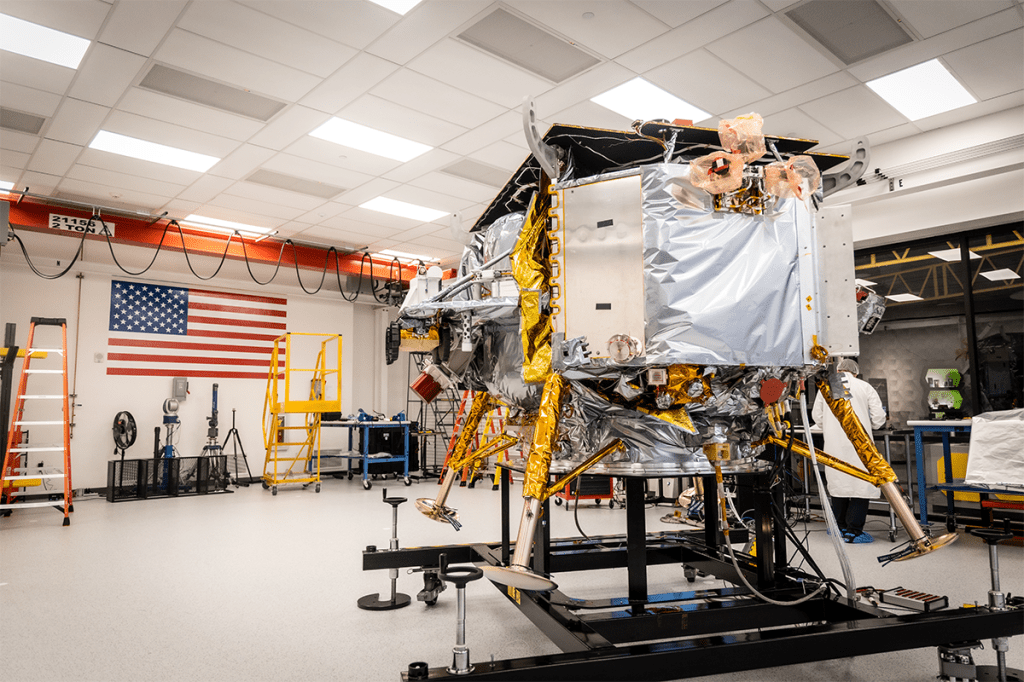
The Vulcan Centaur is the successor to ULA’s Atlas V and Delta IV rockets. It’s planned first launch includes Astrobotic’s Peregrine Lunar Lander (shown below). NASA notes that the lander’s scientific objectives for the upcoming Moon mission include:

…to study the lunar exosphere, thermal properties and hydrogen abundance of the lunar regolith, magnetic fields, and the radiation environment. It will also test advanced solar arrays. 

Image (Credit): Newly assembled Peregrine lunar lander being readied for its journey to Florida for integration with the Vulcan Centaur. (Astrobiotic)

The State of the Space Industry

Credit: The Space Foundation

A recent report by the Space Foundation shared the following figures:

  • The global space economy hit $469 billion in 2021;
  • The space sector saw 9 percent revenue growth since 2020; and
  • 1,022 spacecraft placed in orbit during the first six months of 2022.

In a troubling time around the globe, those are some pretty positive numbers. Just in terms of launched spacecraft, we can also see the commercial sector is playing a large role:

The [second quarter] edition also looks at the record pace of successful launches from Jan. 1 to June 30, with 72 rockets inserting 1,022 identified spacecraft into space. That is more spacecraft attaining orbit in just six months than were launched in the first 52 years of the Space Age. Most of those new satellites came from the commercial sector, which launched 958 spacecraft in the first half of 2022.

It is clearly not just a government space game, though the report also notes that government spending increased since 2020 around the globe, such as the U.S. (18 percent), China (23 percent), and India (36 percent).

As you can also see from the graphic above, 90 nations are now operating in space. We cannot pretend that all of this is for space exploration. While much of it relates to defense and commercial spacecraft looking downward, it still leaves plenty of spacecraft to explore our awesome universe.