Television: Last Days of the Space Age

Credit: Hulu

If you are watching the list of fall shows, you might have noticed Hulu’s upcoming series Last Days of the Space Age. The new drama premieres on October 2, 2024.

Here is the summary from Hulu:

In 1979, a power strike threatens to plunge the region into darkness in Western Australia, while the city hosts the Miss Universe pageant and the US space station, Skylab, crashes just beyond the city’s suburbs.

The trailer provides a little more context, but there is a reason that Skylab is mentioned last in the short summary. The space age plays a small part in a bigger human drama. Fortunately, it is not really the end of the space age as much as the end of a bit of the space age as it falls from the sky. The real Skylab disintegrated in the Earth’s atmosphere on July 11, 1979, leading to debris falling into the Indian Ocean as well as Western Australia.

Once the International Space Station is nudged out of orbit in the coming years, we may have more debris fields generating television ideas. I just wonder if it will take another 45 years to make it to your screen.

This series may be as good as it gets on television until Andor returns next year. The space-related television pickings are pretty slim at the moment.

Update: To be fair, there are a few more shows to check out before the end of the year, including Dune: Prophecy coming on November 17 and another Star Wars series called Skeleton Crew premiering on December 3.
While We Were Watching Polaris Dawn, Just Another Day for the ISS

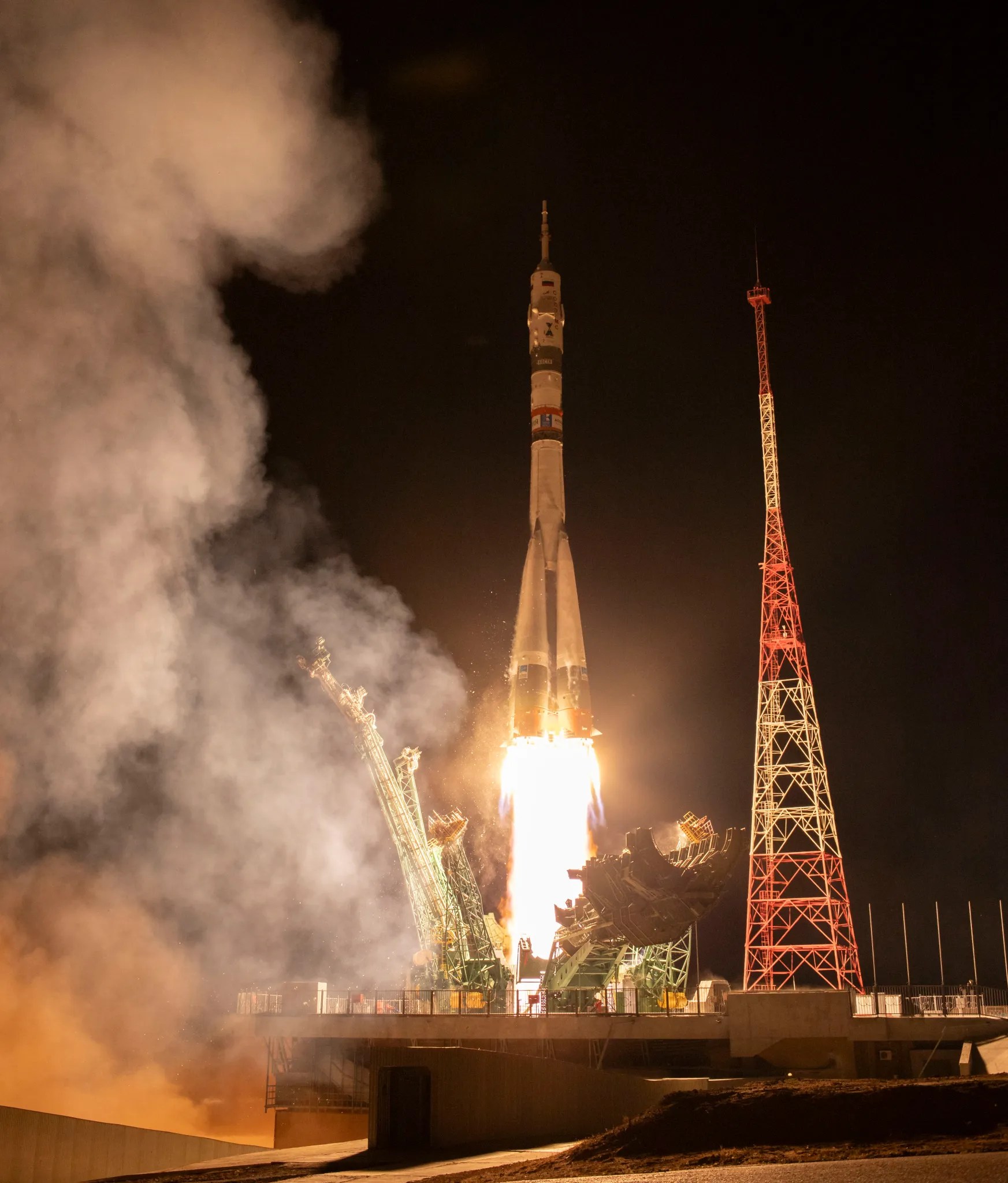
Image (Credit): The Russian Soyuz rocket launching from the Baikonur Cosmodrome in Kazakhstanon September 11 to bring the Expedition 72 crew to the ISS. (NASA/Bill Ingalls)

While all eyes were on the Polaris Dawn mission this week, the Russian Roscosmos Soyuz MS-26 was busy bringing a crew of three cosmonauts and one US astronaut to the International Space Station (ISS). Crewed and uncrewed launches to the ISS have been pretty routine for years, which is a good thing.

NASA reports that its astronaut Don Pettit, accompanied by Roscosmos cosmonauts Alexey Ovchinin and Ivan Vagner, are now safely aboard the space station. Expedition 72 will officially start on Monday, September 23. Members of the Expedition 71 crew – NASA astronaut Tracy C. Dyson and cosmonauts Nikolai Chub and Oleg Kononenko – will be departing the station shortly.

Let’s remember that while the Polaris Dawn crew will be playing in space for about 5 days, these crews are in space for 6-12 months.

So Did NASA Make the Right Call with Starliner?

Image (Credit): The Starliner capsule in White Sands, NM. (Boeing Space)

So now that the Starliner capsule is back here on Earth, some may wonder if it was necessary to return it without a crew.

Here is what Steve Stich, manager of NASA’s Commercial Crew Program, had to say during a post-landing press conference:

If we’d have had a crew on board the spacecraft, we would have followed the same back away sequence from the space station, the same deorbit burn and executed the same entry. And so it would have been a safe, successful landing with the crew on board.

So that is good news for Boeing, but not likely to thrill Boeing stockholders. No matter how you spin it, only a crewed return would have been seen as a success.

It also appears the flight back was not quite as simple as portrayed by Mr. Stich’s initial statement. For instance, a Quartz article noted that during the capsule’s return another thruster failed and the guidance system blacked out for a moment.

Boeing has been pretty quite on the issue. Its latest update had a simple statement about the landing and an uncertain comment about “next steps”:

Boeing’s Starliner landed safely at 12:01 a.m. Eastern time on Saturday, Sept. 7 (10:01 p.m. Mountain time, on Friday, Sept. 6). After an extended stay at the International Space Station, Starliner’s reusable crew module touched down at its designated landing site, White Sands Space Harbor at the U.S. Army’s White Sands Missile Range in New Mexico.

“I want to recognize the work the Starliner teams did to ensure a successful and safe undocking, deorbit, re-entry and landing,” said Mark Nappi, vice president and program manager of Boeing’s Commercial Crew Program. “We will review the data and determine the next steps for the program.”

The Starliner crew module will be transported back to NASA’s Kennedy Space Center in Florida, where Boeing teams will analyze mission data.

Maybe when cooler heads prevail over at Boeing we will learn more. I just hope they are still in the game.

Space Quote: Exciting Days Ahead for the US Space Program

Image (Credit): An image of Buzz Aldrin’s bootprint on the lunar surface from the Apollo 11 mission. (NASA)

“After having no other U.S. options for over 30 years, three different human spacecraft programs are now underway. In addition to the SpaceX Crew Dragon and the Boeing Starliner, NASA’s Orion spacecraft for the Artemis II mission, is planned to fly four astronauts around the Moon in the next couple of years. These programs have had setbacks and bumps along the way – and there will be more – but I haven’t been this excited about human spaceflight since I was an 11-year-old cheering for Apollo and dreaming about putting the first human footprints on Mars.”

Statement by former commander of the International Space Station Michael Fossum when asked by The Conversation about NASA’s decision to return the craft uncrewed, the future of the Starliner program and its crew’s extended stay at the space station.

Starliner: So Far, So Good

Image (Credit): NASA video coverage of the Starliner pulling away from the ISS earlier today. (NASA)

The Boeing CST-100 Starliner capsule has started its journey back to Earth from the International Space Station (ISS). Soon we will learn whether the spacecraft is operating as expected and could have returned the two astronauts safely.

The extra caution is not unexpected, and this does not spell doom for Boeing, but it is a setback. The real question will be the rate at which the Starliner’s issues can be resolved and another launch attempted.

On August 2, Boeing stated:

Boeing remains confident in the Starliner spacecraft and its ability to return safely with crew. We continue to support NASA’s requests for additional testing, data, analysis and reviews to affirm the spacecraft’s safe undocking and landing capabilities. Our confidence is based on this abundance of valuable testing from Boeing and NASA. The testing has confirmed 27 of 28 RCS thrusters are healthy and back to full operational capability. Starliner’s propulsion system also maintains redundancy and the helium levels remain stable. The data also supports root cause assessments for the helium and thruster issues and flight rationale for Starliner and its crew’s return to Earth.

Let’s hope Boeing is correct and the company is back on the launch pad with an improved Starliner shortly.

Update: NASA reported that the uncrewed Starliner capsule safely landed at 10:01 p.m. MDT on Friday, September 6, at White Sands Space Harbor in New Mexico.