Image (Credit): Expedition 72 astronauts on the ISS celebrating Thanksgiving. (NASA)
This week’s image shows the four US astronauts aboard the International Space Station (ISS) showing their Thanksgiving meal to all of us (contained in the white plastic bags). The astronauts pictured (clockwise from bottom left) are Nick Hague, Suni Williams, Butch Wilmore, and Don Pettit. You also watch a video where they share their holiday messages.
Image (Credit): Russia’s MS-19 Mission approaching the ISS yesterday. (NASA)
The International Space Station (ISS) had another visitor on Saturday morning – this time a Russian Soyuz capsule bringing about three tons of food, fuel, and supplies to the station as part of its Progress MS-29 mission (Progress 90 mission to NASA).
The Russian News Agency provided a list of items delivered to the ISS and also noted that the resupply mission also included Christmas gifts for the crew.
Here are the items delivered:
…869 kg of refueling propellant, 420 liters of potable water and 43 kg of pressurized nitrogen, and also 1,155 kg of material and equipment in the dry cargo hold, in particular, for experiments dubbed Vampire (growing crystals in an electric vacuum furnace), BTN-Neutron-2 (studying the neutron spectrum) and 3D Print (3D printing of polymer materials).
It nice that the Russians took the time to assist Santa with his gift giving.
Of course, the U.S. Department of Defense’s North American Aerospace Defense Command (NORAD) will be tracking the actions of Santa here on Earth this year, so be sure to visit the site closer to Christmas next month.
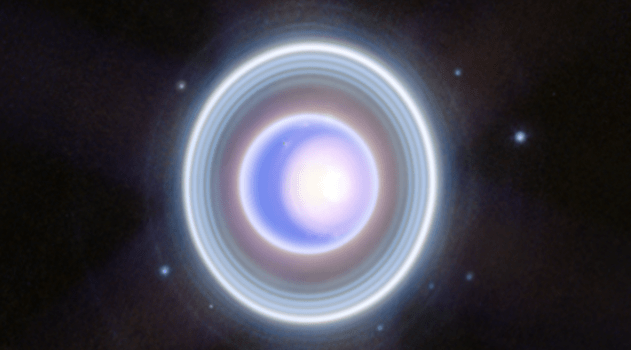
Image (Credit): Uranus captured the James Webb Telescope’s Near-Infrared Camera (NIRCam). This Webb image also shows 9 of the planet’s 27 moons. (NASA, ESA, CSA, STScI)
The Voyager 2 observations had suggested that its two largest moons — Titania and Oberon — often orbit outside the magnetosphere. However, the new study indicates they tend to stay inside the protective bubble, making it easier for scientists to magnetically detect potential subsurface oceans. “Both are thought to be prime candidates for hosting liquid water oceans in the Uranian system due to their large size relative to the other major moons,” Jet Propulsion Laboratory planetary scientist and study co-author Corey Cochrane said.
Three Nasa astronauts whose prolonged space station mission ended with a trip to hospital last month have declined to say which one of them was sick. Astronauts Matthew Dominick, Michael Barratt and Jeanette Epps publicly discussed their spaceflight for the first time since returning from the International Space Station on October 25.
Supermassive black holes exist at the center of most galaxies, and modern telescopes continue to observe them at surprisingly early times in the Universe’s evolution. It’s difficult to understand how these black holes were able to grow so big so rapidly. But with the discovery of a low-mass supermassive black hole feasting on material at an extreme rate, seen just 1.5 billion years after the Big Bang, astronomers now have valuable new insights into the mechanisms of rapidly growing black holes in the early Universe.
Image (Credit): The Dragon capsule approaching the ISS earlier this week with Argentina in the background. (NASA)
This week’s image from NASA shows the uncrewed Dragon capsule approaching the International Space Station (ISS) on Tuesday, November 5th. Once connected with the station, the crew removed the cargo that included new scientific gear. You can read more about the ongoing operations on the ISS here.
Image (Credit): The 31st SpaceX commercial resupply mission to the ISS, seen here, lifted off on a Falcon 9 rocket from our Kennedy Space Center in Florida at 9:29 p.m. EST, Monday, November 4, 2024. (NASA)
A SpaceX Falcon-9 rocket launched the loaded Dragon capsule from NASA’s Kennedy Space Center. The Cargo Resupply Services (CRS)-31 mission successfully met up with the station earlier today so that the 6,089 pounds of cargo could be unloaded.
As far as the election, the busy astronauts had an opportunity to be part of today’s election, as noted in an earlier post.