Space Stories: Crew Returns from ISS, Isaacman Nomination Advances, and Robotic Spacecraft to Save Space Telescope

Image (Credit): The Soyuz MS-27 spacecraft undocking from the ISS earlier today. (NASA)

Here are some recent space-related stories of interest.

CBS News: 3-man Crew Undocks from International Space Station, Wrapping Up 8-month Stay

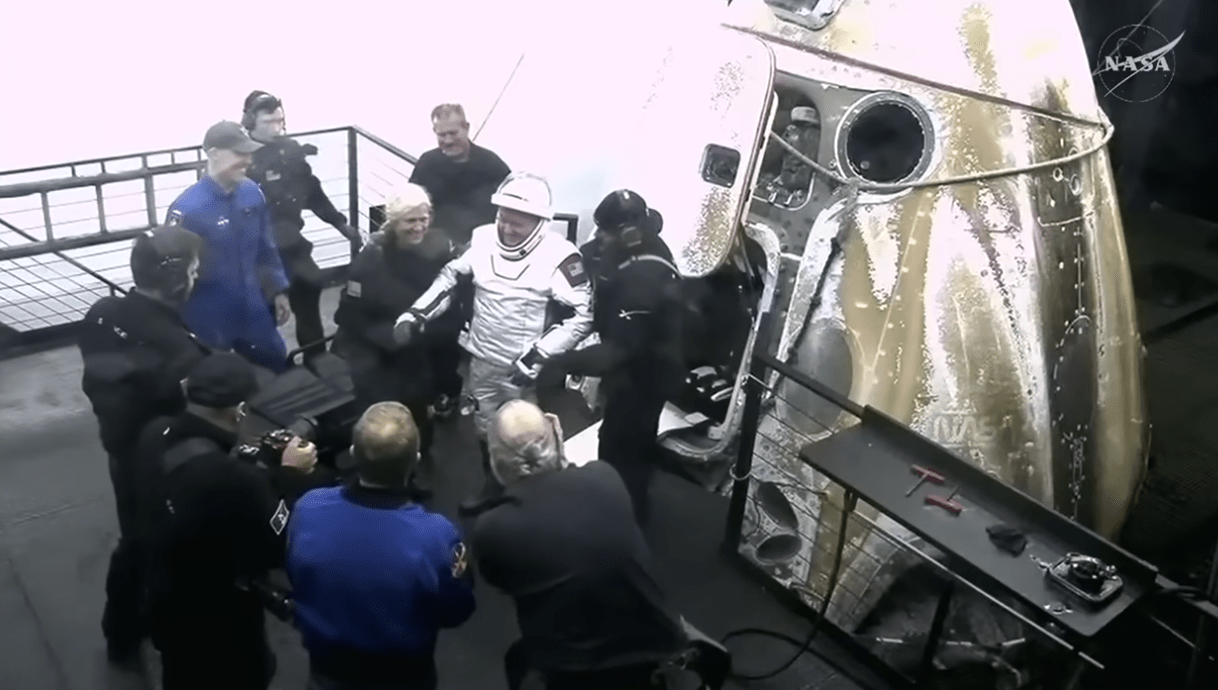
A NASA astronaut and two cosmonaut crewmates strapped into their Soyuz ferry ship and undocked from the International Space Station on Monday, heading for landing on the steppe of Kazakhstan to wrap up an eight-month mission…With Soyuz commander Sergey Ryzhikov strapped into the descent module’s center seat, flanked on his left by cosmonaut Alexey Zubritsky and on the right by NASA’s Jonny Kim, the Soyuz MS-27/73S spacecraft undocked from the lab at 8:41 p.m. ET.

Reuters: US Senate Committee Votes to Advance NASA Nominee Jared Isaacman

The U.S. Senate Commerce Committee voted late on Monday to advance the nomination of billionaire private astronaut Jared Isaacman to lead NASA...Senate Commerce Committee Chair Ted Cruz said: “You are as committed to American supremacy in the final frontier as is this committee and the entire Senate. My hope is that you will be confirmed and in this role before the end of this year.” He also won support of the panel’s top Democrat, Senator Maria Cantwell.

Indian Defence Review: A Rescue Mission Will Save NASA’s Space Telescope Using a Rocket Dropped from a Plane

Launched in 2004 to study gamma-ray bursts, Swift has been a crucial asset in understanding some of the most energetic events in the universe. However, over time, the spacecraft’s orbit has been decaying due to the drag from Earth’s atmosphere. As the orbit continues to degrade, the telescope is set to fall from its current 249-mile altitude unless action is taken. The problem is that Swift lacks onboard thrusters for orbit adjustments. With no replacement mission in the pipeline, NASA has turned to the private sector for a solution, and Katalyst is stepping in with a bold plan…For Neil Gehrels Swift Observatory, however, no astronauts will be involved. Instead, Katalyst will perform the rescue entirely remotely.

Space Stories: Russia Destroys Own Cosmonaut Launch Site, Cosmonaut Removed from ISS Crew, and Martian Drainage Systems (Not Canals)

Credit: Image by WikiImages from Pixabay

Here are some recent space-related stories of interest.

The Independent: Russia Accidentally Destroys its Only Way of Sending Astronauts to Space

Russia’s only crewed-mission launch site has suffered major damage following a rocket launch on Thursday. The Baikonur Cosmodrome in Kazakhstan will be unable to host launches until repairs are made, according to the space agency Roscosmos, marking the first time in decades that Russia has lost the ability to send people to space. The launch of the Soyuz MS-28 spacecraft was otherwise successful, with none of the crew members injured.

United24 Media: Russian Cosmonaut Allegedly Photographed Confidential SpaceX Docs, Removed From NASA Crew-12 Mission

Russian cosmonaut Oleg Artemyev has been removed from the prime crew of SpaceX’s Crew-12 mission to the International Space Station and replaced by fellow Roscosmos cosmonaut Andrey Fedyaev after sources alleged he photographed confidential SpaceX materials in California in violation of US export control rules, according to The Insider on December 2. The outlet reported that Trishkin also said NASA did not want the controversy around Artemyev to become public, while Artemyev was removed from training at SpaceX’s Hawthorne California, facility last week after allegedly photographing SpaceX engines and other internal materials on his phone and taking them off-site.

University of Texas Scientists Map Mars’ Large River Drainage Systems for First Time

A new study published in PNAS from researchers at The University of Texas at Austin is the first to define large river drainage systems on the red planet. They outlined 16 large-scale river basins where life would have been most likely to thrive on the neighboring planet.We’ve known for a long time that there were rivers on Mars,” said co-author Timothy A. Goudge, an assistant professor in the Department of Earth and Planetary Sciences at the UT Jackson School of Geosciences. “But we really didn’t know the extent to which the rivers were organized in large drainage systems at the global scale.”

Pic of the Week: New Crew Added to ISS on Thanksgiving Day

Image (Credit): The Expedition 74 crew members launched towards the space station earlier today aboard a Soyuz rocket from Baikonur Cosmodrome in Kazakhstan. (NASA/Bill Ingots)

This week’s image shows a Soyuz rocket sending a crew to the International Space Station (ISS) on Thanksgiving Day. One NASA astronaut and two Russian cosmonauts are thankful today that they are safe and sound on the ISS. NASA astronaut Chris Williams joined Roscosmos cosmonauts Sergey Kud-Sverchkov and Sergei Mikaev aboard a Soyuz rocket launched from Russia earlier today.

The three crew members of Expedition 74 join the Expedition 73 crew members already on the station, increasing the crew count to 10 members for the next few weeks. Expedition 74 is scheduled to begin on Monday, December 8th, once three members depart the ISS.

These crews change like clockwork, regardless of holidays, government shutdowns, or even hot wars back on the surface. This dedication to duty is something we can all be thankful for.

Happy Thanksgiving!

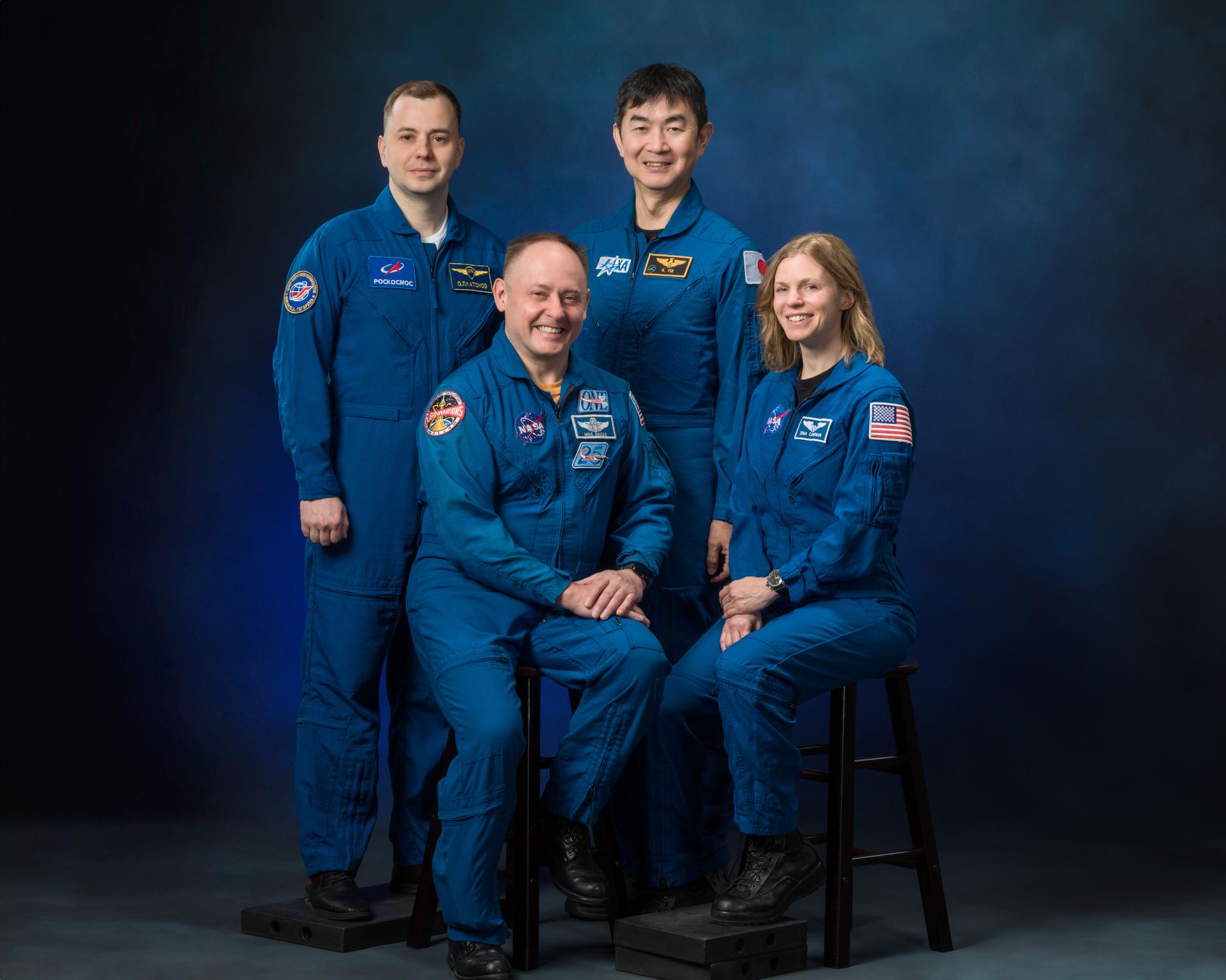
Image (Credit): NASA Expedition crew members (clockwise from the left) Zena Cardman, Mike Fincke, Jonny Kim, and JAXA astronaut Kimiya Yui recording their holiday message. (NASA)

The NASA Expedition 73 crew on the International Space Station (ISS) has recorded a Thanksgiving greeting for all of us down here looking up.

So what can the astronauts expect to eat for Thanksgiving? Astronaut Mike Fincke mentioned turkey and cranberry sauce, while astronaut Zena Cardman added mashed potatoes, crab meat, salmon, lobster, and more.

In a Florida Today news story, Steve Siceloff, a NASA public affairs officer, stated:

The crews’ holiday meals, including Thanksgiving, were flown up on NG-23 [on September 14]. On board the spacecraft was a special Holiday Bulk Overwrapped Bag (BOB) filled with festive foods like clams, oysters, crab meat, quail, and smoked salmon, along with shelf-stable treats such as candies, icing, almond butter, and hummus,

Happy Thanksgiving wishes to the ISS crew as well as everyone back here on Earth.

Space Stories: Telescope Moving from US to Spain, Starliner will be Cargo-Only, and Moss in Space

Image (Credit): Artist’s rending of the Thirty Meter Telescope. (TMT International Observatory)

Here are some recent space-related stories of interest.

Sky & Telescope: Thirty Meter Telescope Considers Move to Spain

The Thirty Meter Telescope (TMT) was conceived more than two decades ago as the largest and most advanced telescope in the Northern Hemisphere. However, the telescope has encountered significant roadblocks, from funding uncertainties — now heightened by President Trump’s proposed budget cuts — to local resistance to building the telescope on Mauna Kea, a volcanic mountain in Hawai‘i that’s sacred to native communities. Now, the telescope might find a new home in La Palma on the Canary Islands of Spain. In July, the Spanish government offered to host the telescope, with an investment of up to €400 million ($460 million) to help cover some of the costs. In a brief statement posted on November 11th, the TMT announced that it is officially considering the move to La Palma.

Spaceflight Now: NASA, Boeing Pivot Starliner-1 Mission from 4-Person Astronaut Flight to Cargo-Only

In its latest shakeup to the Commercial Crew Program, NASA announced on Monday it has reduced the number of missions Boeing is required to fly to the International Space Station and changing the next flight from a crew mission to a cargo mission. The original contract NASA awarded to Boeing and SpaceX called for each to fly an uncrewed demonstration flight to the ISS, followed by a crewed demo mission and then conduct six regular crew rotation missions.

Vice: Moss Just Survived a Full Year Outside the International Space Station

In the airless, radiation-saturated void outside of the International Space Station, researchers tested whether a common moss species known as Physcomitrium patens could survive at all, and if it could, for how long. The answers are yes and probably forever if it wants...Tomomichi Fujita, the study’s lead author, thinks moss could last up to 15 years in space, knowledge that could help build future extraterrestrial farms or entire ecosystems on the Moon or Mars.