Space Stories: Threats to Artemis, Two Saudis Visit the ISS, and Signs of the Japanese Lunar Crash

Image (Credit): The Moon and the Washington Monument. (NASA/Bill Ingalls)

Here are some recent stories of interest.

Axios: “NASA Return to the Moon Could be Imperiled by Politics

Efforts to insulate Artemis from possible cuts, delays and cancellation are facing a major test with the current budget fight on Capitol Hill. If NASA’s funding is stalled at the 2022 enacted level or reduced, agency administrator Bill Nelson has warned Artemis II and Artemis III could be delayed. The current launch dates are 2024 for Artemis II and 2025 for Artemis III.

Al Jazeera: “SpaceX Sends Saudi Astronauts, Including First Arab Woman, to ISS

A private rocket carrying the first Arab woman astronaut has blasted off on a mission to the International Space Station (ISS). Rayyanah Barnawi, a breast cancer researcher from Saudi Arabia, was joined on Sunday’s mission by fellow Saudi Ali al-Qarni, a fighter pilot. The pair are the first Saudi astronauts to voyage into space in decades.

Quartz: “NASA Found the Japanese Moon Lander that Crashed into the Moon

ispace’s attempt to become the first private company to safely land a robot on the Moon left a mark: A NASA space telescope orbiting Earth’s nearest neighbor in space spotted the impact of the vehicle on the lunar surface…NASA’s Lunar Reconnaissance Orbiter (LRO) has been circling the Moon since 2009, carefully mapping its surface. Today, it released the first images of the impact site, which required scientists at the Goddard Space Flight Center and Arizona State University to carefully hunt for changes to the lunar surface.
Space Stories: Russia Sticks with ISS, Czechs Join Artemis Accords, and China Plans for Sample Return from Far Side of Moon

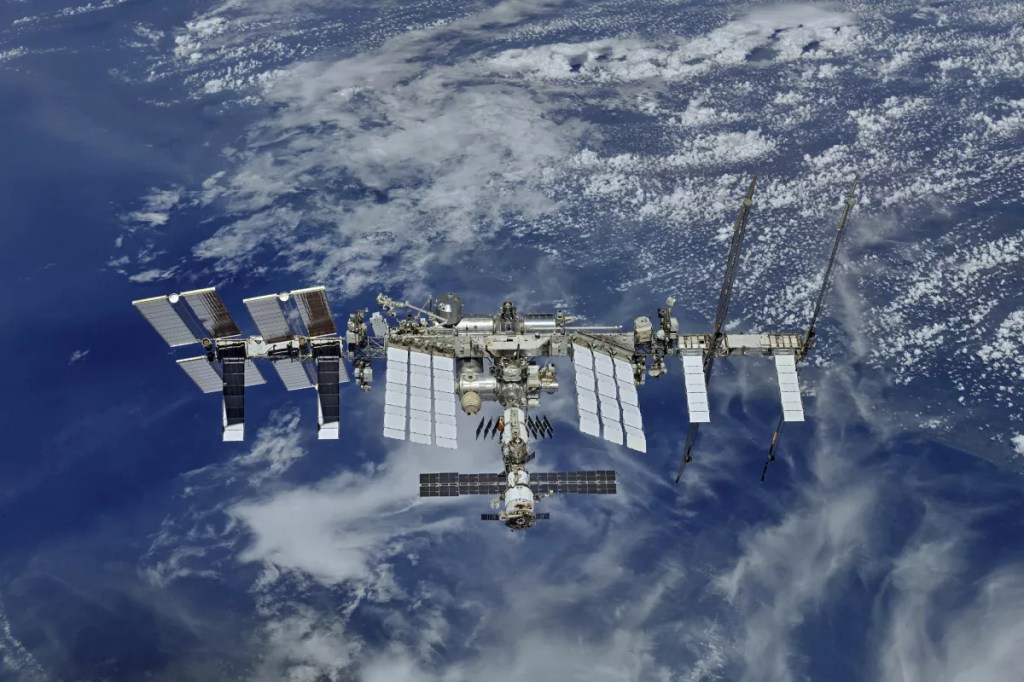
Image (Credit): The International Space Station. (Roscosmos)

Here are some recent stories of interest.

Phys.org: “Russia Will Use International Space Station ‘Until 2028’

Russia said Wednesday it planned to use the International Space Station until 2028, an apparent reversal of an earlier announcement to quit the orbiting laboratory after 2024. On Wednesday, the head of Russian space agency Roscosmos, Yuri Borisov, said Moscow’s participation in the international space project had been extended. “By the decision of the government, the operation of the International Space Station has been extended until 2028,” Borisov told President Vladimir Putin during a televised meeting, referring to the Russian segment.

SpaceNews.com: “Czech Republic signs Artemis Accords

The Czech Republic became the 24th country to sign the Artemis Accords May 3, growing Europe’s presence in the U.S.-led agreement. In a brief ceremony at NASA Headquarters, Jan Lipavský, minister of foreign affairs for the Czech Republic, formally signed the accords in the presence of officials from NASA and the U.S. State Department. Representatives of several other countries who previously signed the Artemis Accords also attended…Neither U.S. nor Czech officials announced specific plans to cooperate on the Artemis lunar exploration campaign as a result of signing the accords, but suggested the signing opened the door for future discussions. 

Space.com: “China to Launch 1st-ever Sample Return Mission to Moon’s Far Side in 2024

China will attempt to collect the first samples from the far side of the moon next year with its Chang’e 6 mission. The complex, four-spacecraft mission will launch on a Long March 5 rocket from Wenchang in May 2024, according to Wu Yanhua, chief designer of China’s Deep Space Exploration Major Project, speaking at a deep-space exploration conference on April 25 in the Chinese city of Hefei.

Space Quote: Russia Has Been a Good Space Partner, China Not so Much

Image (Credit): The Russian Segment of the International Space Station (ISS) (http://www.russianspaceweb.com/)

“We built the International Space Station with the Russians. What a contrast, with the Chinese government,…They are secretive, they are non-transparent. They will not share when Earth is threatened by one of their tumbling rockets coming back in, they will not share their trajectories, so it’s a huge difference in the way we approach our civilian space program with the Russians visa vie the Chinese.”

-Statement by NASA Administrator Bill Nelson during a recent interview with the Canadian CTV ‘s  Power Play. Of course, NASA has been prohibited from coordinating with China on space issues since 2011, so it should be no surprise that the Chinese have gone their own way.

Space Quote: The Value of the ISS

Image (Credit): Components of the International Space Station (ISS). (NASA)

“An attempt to do a cost-benefit analysis on ISS science would be rather difficult. Science research rarely conforms to that kind of examination while it’s being done. Only after the fact, when an entrepreneur rolls out some new product or service, can one point to something done in a laboratory as having helped to make it happen. The best bet for ISS science is the technology for 3D printing human organs for transplant patients. The number of lives that would be saved might make the $100 billion spent on the ISS worth it.”

-Statement in a recent editorial from The Hill titled, “Has the science on NASA’s International Space Station been worth the money?” In addition to 3D printing of human organs, you might want to view the other ISS achievements (also mentioned in the editorial) and decide for yourself: