Space Quotes: Russia is Pulling Out of the ISS? Maybe Not

Image (Credit): Russian cosmonauts headed for the ISS get ready to board the Soyuz MS-21 spacecraft prior to its launch at the Baikonur cosmodrome in Kazakhstan on March 18, 2022. (Roscosmos)

“Of course, we will fulfill all our obligations to our partners, but the decision about withdrawing from the station after 2024 has been made.”

-Statement by Yuri Borisov regarding Russia’s participation in the International Space Station (ISS), as quoted by Reuters. Mr. Borisov was recently appointed director-general of Russia’s space agency Roscosmos. However, like his predecessor, he may have spoken without thinking through the consequences. Time magazine quoted Vladimir Solovyov, an ISS flight director, who stated, “We, of course, need to continue operating the ISS until we create a more or less tangible backlog for ROSS. We must take into account that if we stop manned flights for several years, then it will be very difficult to restore what has been achieved.” In other words, the withdrawal may not be anytime soon. Not a very good start for Mr. Borisov.
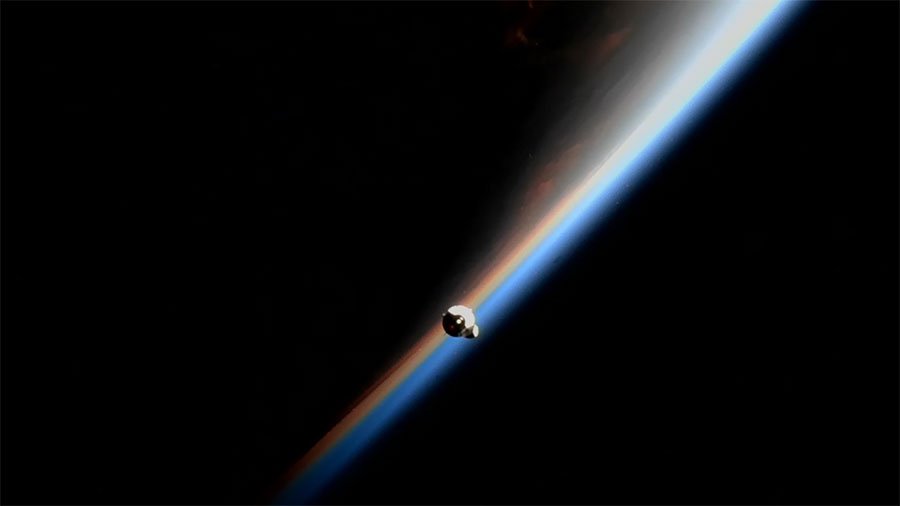
Pic of the Week: Orbital Sunrise

Image (Credit): SpaceX Dragon capsule approaching the ISS. (NASA)

This week’s image is from the International Space Station (ISS) as it awaits incoming cargo from an uncrewed SpaceX Dragon capsule approaching the station on July 16th. NASA noted that what we are seeing is an orbital sunrise above the Pacific Ocean.

NASA also highlighted the various experiments aboard the Dragon that will be added to the station, including one on extraterrestrial concrete:

Biopolymer Research for In-Situ Capabilities looks at how microgravity affects the process of creating a concrete alternative made with an organic material and on-site materials, such as lunar or Martian dust, known as a biopolymer soil composite. Using resources available where construction takes place makes it possible to increase the amount of shielding.

SpaceX and Russia: Shuttle Swaps

Image (Credit): Artist’s image of the Boeing Starliner space capsule. (Boeing)

It wasn’t that long ago U.S. astronauts were completely dependent on Russian rockets to get to the International Space Station (ISS). NASA was paying about $60 million per seat on the Soyuz spacecraft. Well, times have certainly changed with SpaceX now ferrying astronauts, Boeing working on its own crewed Starliner capsule, and Northrop Grumman already helping with cargo.

Now NASA is mixing it up. NASA and Russia’s Roscosmos agreed this weak to place astronauts on the Soyuz again and cosmonauts on the SpaceX Dragon spacecraft. Bloomberg reports NASA stated that such mixed crews “ensures there are appropriately trained crew members on board the station for essential maintenance and spacewalks.” In other words, with two launches to the ISS planned in September, a mixing of the crews will ensure some stability in space if only one makes it to the station. Not a bad idea.

Even with all the rhetoric and stunts taking place, it’s nice to see a little bit of common sense prevailing.

Space Quote: NASA Condemns Russian Political Stunt

Image (Credit): Russian cosmonauts Oleg Artemyev, Denis Matveev and Sergey Korsakov pose with a flag of the self-proclaimed Luhansk People’s Republic on the ISS in a photograph released July 4. (Roscosmos via Reuters)

“[NASA] strongly rebukes using the International Space Station for political purposes to support [the] war against Ukraine, which is fundamentally inconsistent with the station’s primary function among the 15 international participating countries to advance science and develop technology for peaceful purposes.”

-NASA statement, as quoted in the Washington Post, regarding the picture of three Russian cosmonauts on the International Space Station (ISS) holding a flag of the self-proclaimed Luhansk People’s Republic released earlier this month. Russia is probably try to clear up some earlier confusion about the colors worn by these same astronauts back in March (see below). We get it, you represent an aggressive nation preying on its neighbors.

Image (Credit): Russian cosmonauts clothing for their March arrival at the ISS . (Roscosmos)

A New Suit for the Moon Mission

Image (Credit): Space suits in the television series Lost in Space. (Netflix)

U.S. companies Axiom Space and Collins Aerospace have been tasked to build new suits for NASA’s astronauts. The suits will be worn as part of the Artemis Program returning astronauts to the Moon. First, the new suits will be tested and used on the International Space Station (ISS).

While both companies are still in the early stages of developing the next space suite, the $3.5 billion Extravehicular Activity Services (xEVAS) Contract will support this development and production.

In a press release, Mark Kirasich, deputy associate administrator of NASA’s Artemis Campaign Development Division, stated:

Our commercial partnerships will help realize our human exploration goals…We look forward to using these services for NASA’s continued presence in low-Earth orbit and our upcoming achievement of returning American astronauts to the Moon’s surface. We are confident our collaboration with industry and leveraging NASA’s expertise gained through over 60 years of space exploration will enable us to achieve these goals together.

You may recognize the name Axiom Space. It was the company that worked with SpaceX to put private citizens on the ISS with its Axiom Mission 1 (Ax-1). It is also developing the world’s first commercial space station, the Axiom Station.

Collins Aerospace, part of Raytheon Technologies, has plenty of experience with space suits. The company designed the spacesuit used by the Apollo mission astronauts who landed on the moon. It also designed the space suits currently in use for missions outside the ISS.